
Family Disintegration and the Islamic Perspective on Family Values
The family is one of the oldest and most important institutions of human society. Long before schools, workplaces and other social institutions existed, the family was the first place where a person experienced love, learned values, developed a sense of responsibility and understood his or her relationship with others. A strong family gives a person emotional security and a sense of belonging. When families become weak, the effects are rarely limited to the home. They gradually appear in the wider society as well.
Today, family relationships are under pressure in many parts of the world. Divorce, separation, loneliness, conflicts between generations, weakening communication and the excessive use of technology are becoming increasingly visible. Western societies have experienced significant changes in family structures, but Asian societies are not untouched by these changes. Urbanisation, migration, economic pressures, changing lifestyles and growing individualism are also affecting traditionally close-knit Asian families.
This raises an important question: What can preserve the family in a rapidly changing world?
From an Islamic perspective, the answer begins with understanding what the family actually means.
Family Disintegration: More than Divorce
When we talk about family disintegration, it is easy to think only of divorce or separation. But the problem can begin much earlier.
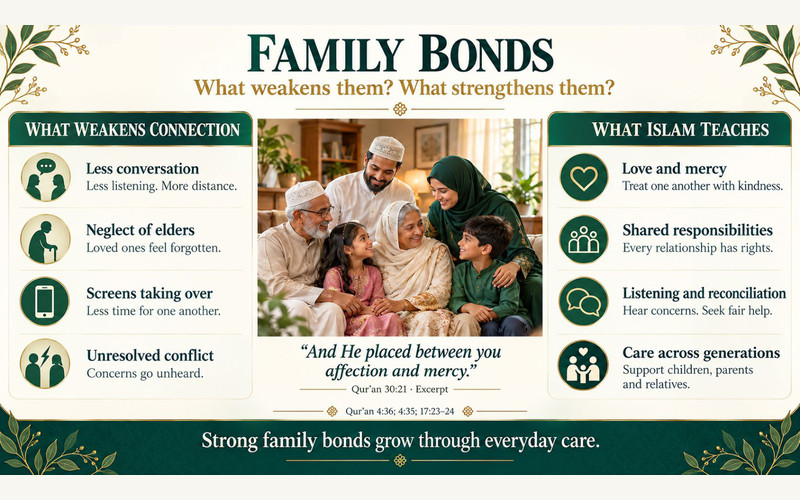
A family may remain under one roof while its members become emotionally distant from one another. Parents may be busy with work, children may spend most of their time on phones or social media, and conversations may be reduced to practical matters. Grandparents may feel unwanted, while young people may feel that nobody understands them.
In such a situation, the family may still exist physically, but its emotional and moral bonds are becoming weaker.
Family disintegration can therefore be understood as the gradual weakening of affection, trust, communication, responsibility and mutual care among family members.
The Changing Family: West and Asia
There are important differences between Western and Asian societies, although neither can be treated as a single uniform group.
Modern Western societies have generally placed a strong emphasis on individual autonomy, personal choice and independence. Marriage is increasingly viewed through the lens of personal fulfilment, and children are often encouraged to become independent at an earlier stage. Multigenerational households are less common in many Western societies, and elderly people may live independently or depend on professional care.
Asian societies have traditionally placed greater emphasis on family obligations. Parents, children and extended relatives have often remained closely connected, and caring for elderly parents has traditionally been regarded as a family responsibility. Marriage has also commonly involved the wider family.
However, Asian societies are changing rapidly. Nuclear families are becoming more common, young people are moving away from their hometowns for education and employment, and traditional patterns of family life are being affected by urbanisation and changing expectations. Technology has also changed the way family members communicate with one another.
Therefore, the issue should not simply be presented as “the West has broken families while Asia has strong families.” Asian families too are facing serious challenges.
The deeper question is what principles can preserve the positive aspects of family life while protecting people from injustice, unhealthy control and outdated practices.
What Does Islam Say About the Family?
Islam gives the family a position of great importance. It does not regard marriage and family relationships as merely social arrangements. They are connected to faith, responsibility and accountability before Allah.
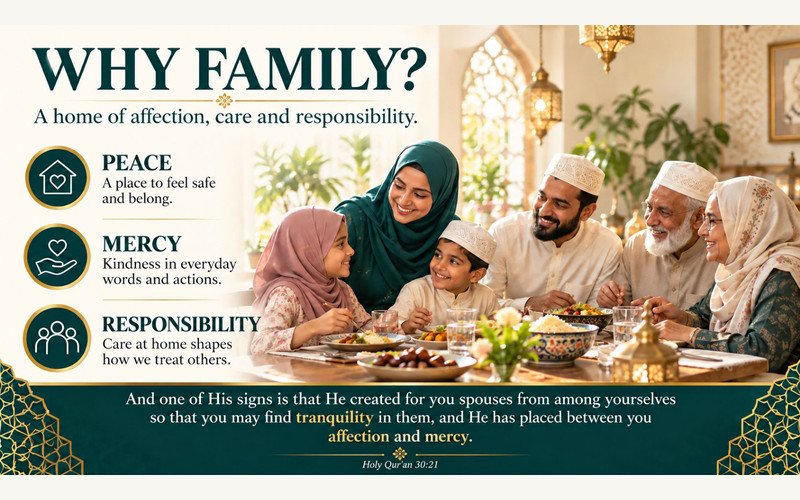
The Qur’an describes marriage in remarkably beautiful terms:
“And among His signs is that He created for you from yourselves spouses that you may find tranquility in them; and He placed between you affection and mercy.”
Qur’an 30:21
Three words in this verse provide a powerful foundation for family life:
Sakinah -- tranquillity
Mawaddah - - affection
Rahmah - - mercy
A healthy Islamic family is therefore not simply a household in which everyone fulfils duties. It is a place where people should experience peace, affection and mercy.
Marriage as a Sacred Covenant
Islam also gives marriage a serious moral status. The Qur’an refers to the marriage bond as mithaqan ghaliza, a solemn covenant (Qur’an 4:21).
This understanding creates a very different attitude towards marriage. A husband and wife are not merely two individuals who remain together as long as everything is convenient. They have entered into a serious commitment before Allah.
This does not mean that Islam ignores marital problems. Difficult marriages can involve genuine injustice, incompatibility or suffering, and Islam provides lawful ways of addressing such situations. But separation is not presented as something to be treated casually.
Islam first establishes a culture of responsibility, patience and reconciliation.
Family Values Begin with Responsibility
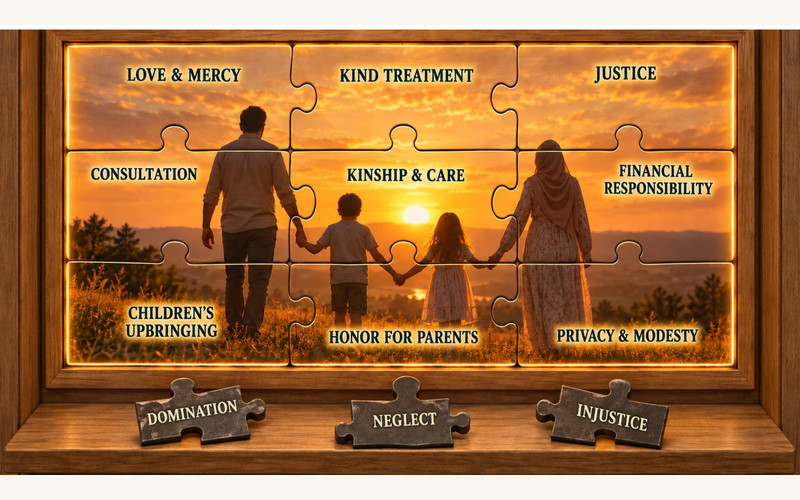
One of the greatest strengths of the Islamic family system is its emphasis on responsibility.
Islam does not teach a person to ask only, “What are my rights?” It also teaches, “What are my responsibilities?”
A husband has responsibilities towards his wife. A wife has responsibilities towards her husband. Parents have responsibilities towards their children, and children have responsibilities towards their parents.
The Prophet Muhammad ﷺ said:
“The best of you are those who are best to their families.”
This principle is extremely important. A person's character cannot be separated from the way he or she treats the people at home.
Religious commitment cannot be measured only by public worship while family members are treated with harshness or neglect.
Respect for Parents
Islam gives parents a special position within the family.
Allah says:
“And We have enjoined upon man goodness to his parents.”
Qur’an 29:8
In another well-known passage, Allah commands believers not even to say “uff” to their parents and instructs them to speak to them with honour and humility (Qur’an 17:23–24).
This creates an important intergenerational connection. Growing older does not make a parent irrelevant.
At the same time, Islam does not give parents unlimited authority over their adult children. Respect does not mean injustice, and family loyalty does not mean permitting wrongdoing. Islamic family values are based on rights and responsibilities on both sides.
Children are an Amanah
Islam also changes the way parents look at their children.
Children are not simply possessions or extensions of their parents' ambitions. They are an amanah, a trust from Allah.
Allah says:
“O you who believe, protect yourselves and your families from a Fire...”
Qur’an 66:6
This responsibility includes more than providing food, clothing and education. Children need moral guidance, affection, attention and a good example.
A child learns honesty by watching honesty. A child learns respect by experiencing respect. A child learns compassion when compassion is practised at home.
In this sense, the family becomes the first school of tarbiyah.
The Importance of Silah Rahmi
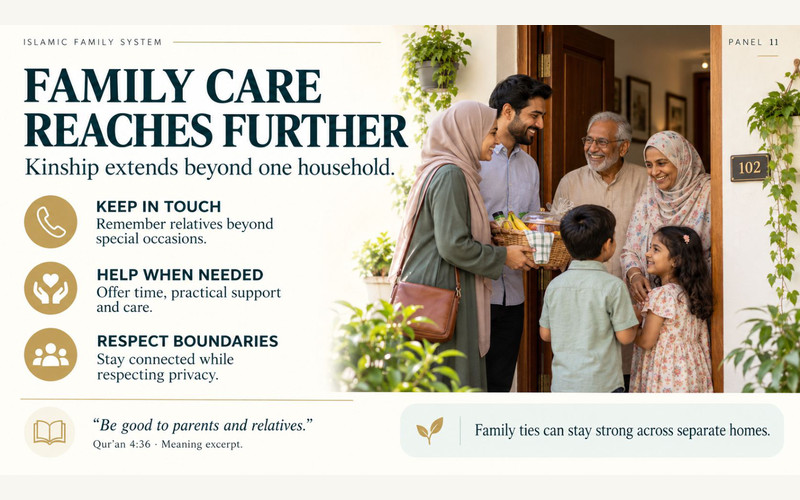
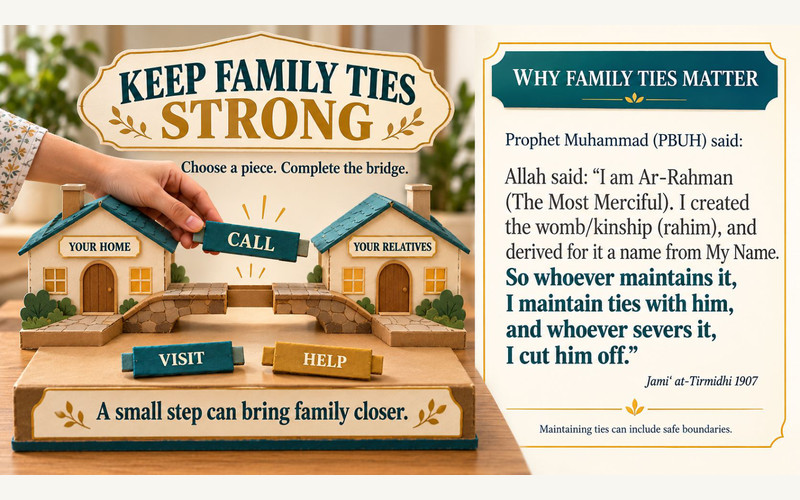
Another important Islamic concept is silah rahmi, maintaining ties of kinship.
Islam does not reduce family to parents, children and spouse alone. Grandparents, siblings, uncles, aunts and other relatives remain part of a wider network of relationships.
This can provide something that is increasingly missing from modern life: a sense that a person belongs to something larger than the individual self.
A family member has someone to visit, someone to call, someone to support in difficulty and someone to celebrate with in times of happiness.
These relationships create social resilience.
Reconciliation Instead of Immediate Breakdown
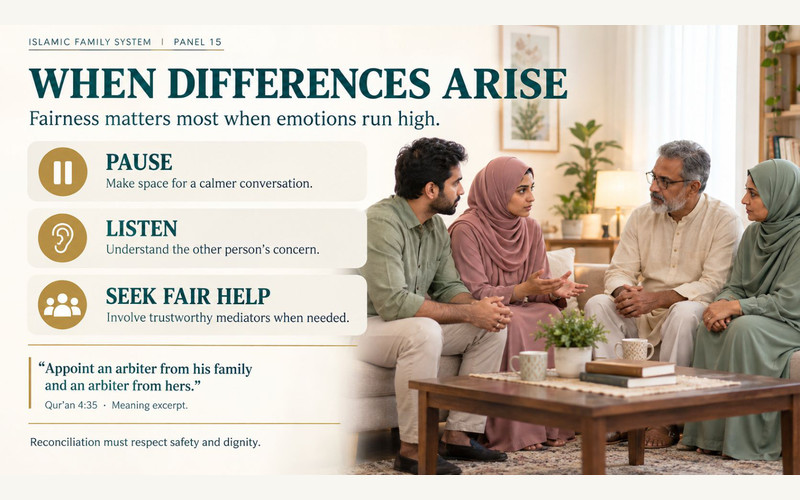
Disagreements are a normal part of human relationships. Islam does not assume that every family will be free from conflict.
What matters is how conflict is handled.
The Qur’an provides a framework for reconciliation when serious conflict arises between husband and wife:
“If you fear a split between them, appoint an arbiter from his family and an arbiter from her family...”
Qur’an 4:35
The emphasis on reconciliation shows that preserving relationships has value.
At the same time, preserving a family does not mean preserving abuse or injustice. Islam does not require a person to accept oppression simply in the name of family unity. Justice remains a fundamental Islamic principle.
Thus, Islamic family values combine preservation with justice.
What Has Changed in Modern Families?
One of the major challenges today is that technology has made communication easier while sometimes making meaningful communication harder.
A family can sit together in the same room while every person is looking at a separate screen.
Social media can also create unrealistic comparisons. People see carefully selected images of other people's lives and begin comparing their marriages, homes, children and lifestyles with an idealised picture that may not reflect reality.
Economic pressures add another layer of difficulty. Long working hours, financial insecurity and the demands of modern life can leave parents with little time and energy for their families.
Migration can also separate generations. A young person may live in another city or country, while parents and grandparents remain far away.
None of these developments automatically destroys families. But when combined with individualism, poor communication and weakened commitment, they can gradually create distance.
The Islamic Alternative to Extreme Individualism
Islam recognises individual dignity, rights and personal responsibility. It does not ask a person to lose his or her identity within the family.
At the same time, Islam does not promote the idea that an individual has responsibilities only towards himself or herself.
A Muslim's life is connected through a network of obligations:
Creator → spouse → children → parents → relatives → community
This does not mean that every relationship is equal or that family members can control one another. Rather, it means that freedom exists alongside responsibility.
This balance is particularly relevant today.
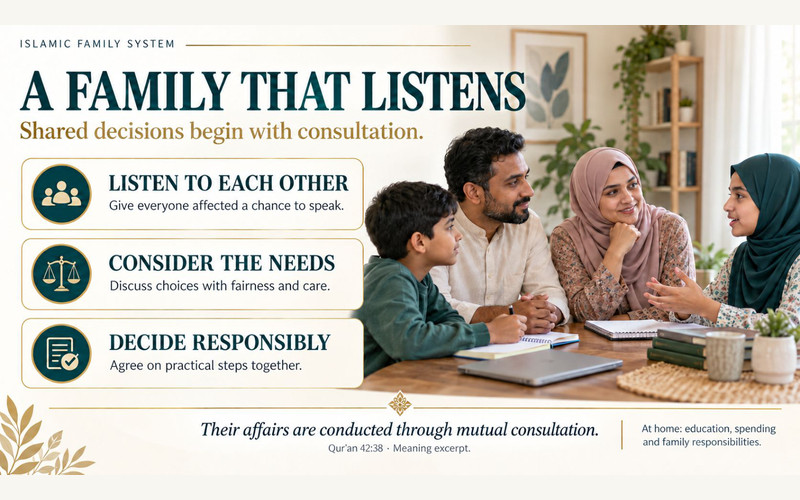
A healthy family cannot be built on control. Nor can it survive on complete individualism.
It needs freedom with responsibility, authority with mercy, rights with duties and love with commitment.
The Family as a Source of Social Strength
A strong family does not benefit only the people living inside the home.
A child who grows up experiencing compassion is more likely to understand compassion.
A person who learns responsibility at home is more likely to become responsible in society.
A person who learns to respect parents and relatives develops a stronger sense of social connection.
In this way, the family becomes a foundation for society.
The Qur’anic vision is therefore much broader than simply keeping a household together. It is about developing human beings who possess faith, character, responsibility and concern for others.
We do not need to abandon family values simply because modern society is changing.
The goal is to preserve the Moral principles:
Taqwa, amanah, justice, mercy, respect, responsibility, modesty, loyalty, forgiveness and maintaining family ties.
These principles can remain relevant in every generation.
Conclusion
The disintegration of families is not simply a problem of changing household structures. At a deeper level, it is a question of what holds people together when circumstances become difficult.
If family relationships depend only on convenience, emotions may not always be enough to sustain them.
Islam offers something deeper.
It connects family relationships with faith and accountability before Allah.
Marriage becomes a covenant.
Parenthood becomes an amanah.
Respect for parents becomes an act of worship.
Raising children becomes tarbiyah.
Maintaining relatives becomes silah rahmi.
Reconciliation becomes a virtue.
Mercy becomes a defining quality of family life.
The Islamic family is therefore not simply a structure of people living together. It is a network of relationships bound by faith, rights, responsibilities and compassion.
The strength of a society ultimately depends greatly on the strength of its families. And strengthening the family does not mean returning blindly to the past or copying another society. It means returning to the principles that give family life its deepest purpose.
A family connected to Almighty can remain connected to one another.