
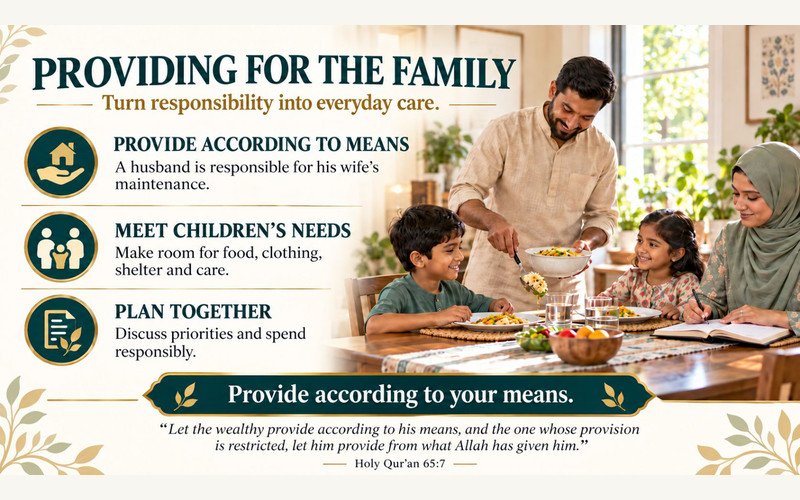
Financial Responsibilities of a Husband in Islam
Imagine a Muslim man reflecting on his wealth and earnings. Before asking, “What can I buy for myself?” Islam encourages him to ask: “Whose rights are attached to the wealth and earnings Allah has placed in my hands?” In Islam, wealth is a blessing—but it is also an amanah, a trust from Allah. A man is responsible not only for how much he earns, but also how he earns it and whose rights he fulfills through it.
1. Earn Through Halal Means
Financial responsibility begins with earning. A Muslim should seek halal income and stay away from fraud, deception, bribery, theft, and other unlawful means. Allah says: “Do not consume one another’s wealth unjustly, but only through trade by mutual consent.” — Surah An-Nisa 4:29 So the question is not only, “How much am I earning?” but also, “Is my income pleasing to Allah?”
2. Provide for Himself and His Family
A man may spend on his own genuine needs food, housing, healthcare, education, transport, and future necessities. But his responsibility does not end with himself. His wife and children have rights to reasonable maintenance according to his means. Allah says: “Let the man of wealth spend according to his means, and the one whose provision is restricted, let him spend from what Allah has given him.” — Surah At-Talaq 65:7
His Wife
A husband has a responsibility to provide reasonable maintenance for his wife according to his means—food, clothing, accommodation, and necessary household needs. But Islam’s expectation from a husband is not limited to financial provision. He is also expected to treat his wife with kindness, respect, and good character. The Prophet Muhammad ﷺ said: “The best of you are those who are best to their wives.” — Jami` at-Tirmidhi 1162 A husband’s income, therefore, should not become a source of control or resentment. His wife has financial rights, but his income also carries responsibilities towards his children, parents, dependent relatives, Zakat, Sadaqah, and the wider community. There is no fixed percentage of a husband’s income that Islam universally assigns to his wife. What matters is fulfilling her reasonable rights according to his ability and circumstances. And when he spends on his family seeking Allah’s reward, that spending can itself become
Sadaqah: “When a Muslim spends something on his family intending to receive Allah’s reward, it is regarded as Sadaqah for him.” — Sahih al-Bukhari 5351
His Children
A father is responsible for providing for his children’s essential needs, including food, clothing, housing, healthcare and education, according to his ability. His responsibility also includes protecting, guiding and nurturing them so that they can grow in a safe and supportive environment. Allah says: “No one is burdened beyond their ability. Neither a mother nor a father should suffer because of their child.” — Surah Al-Baqarah 2:233 This reminds us that the rights and responsibilities of parenthood must be fulfilled fairly, without causing harm to either parent because of the child. 3. Care for Parents and Needy Relatives
His Parents
A son’s responsibility towards his parents becomes especially important when they grow old, become ill, or are genuinely dependent on him. The Prophet Muhammad ﷺ said: “You and your property belong to your father.” — Sunan Abi Dawud 3530 This Hadith highlights the serious rights and status of parents. It does not mean that a father has unlimited ownership over everything his adult son possesses. Rather, it emphasises the son’s duty of kindness, support, and responsibility towards his parents, particularly when they are in genuine need. Allah says: “And honour your parents.” — Surah Al-Isra 17:23 When parents become genuinely dependent because of age, illness, or financial hardship, a capable son should not ignore their needs. Similarly, if needy relatives such as vulnerable brothers, sisters, or other family members are facing genuine hardship, helping them is both an act of kindness and a means of strengthening family ties. The Prophet Muhammad ﷺ said: “None of you truly believes until he loves for his brother what he loves for himself.” — Sahih al-Bukhari 13; Sahih Muslim 45
4. Give Zakat and Sadaqah
When Zakat becomes obligatory, it is not merely an optional donation. It is a right due from qualifying wealth. Allah has specified categories of people eligible for Zakat, including the poor and needy. Beyond Zakat, Islam encourages Sadaqah and helping the wider community. But the Prophet Muhammad ﷺ taught: “Start giving first to your dependents.” — Sahih al-Bukhari 1426 Charity should never become an excuse for neglecting the people whose rights are already
upon us.
5. Save and Spend with Balance
Islam does not require a man to spend everything he earns. Saving for emergencies, healthcare, children’s education, and future family needs can be part of responsible financial planning. At the same time, Islam warns against both extravagance and miserliness. Allah describes the believers as those who: “Spend neither wastefully nor stingily, but moderately in between.” — Surah Al-Furqan 25:67
The Bigger Picture
So, when a Muslim man considers his wealth and earnings, it is not simply “my money.”
● Some may be needed for himself. ● Some fulfils the rights of his wife and children. ● Some may support dependent parents or needy relatives. ● Some may be due as Zakat. ● Some may become Sadaqah. ● And some may be wisely saved for the future. The real measure of wealth is not how much a man owns, but how responsibly he fulfills the rights attached to what Allah has entrusted to him. A successful Muslim man is one who earns through halal means, provides for his family, honours his parents, helps those in need, gives Zakat and charity, and spends with balance. Because in Islam, wealth is not simply something a man owns. It is an amanah and every amanah comes with responsibility.