
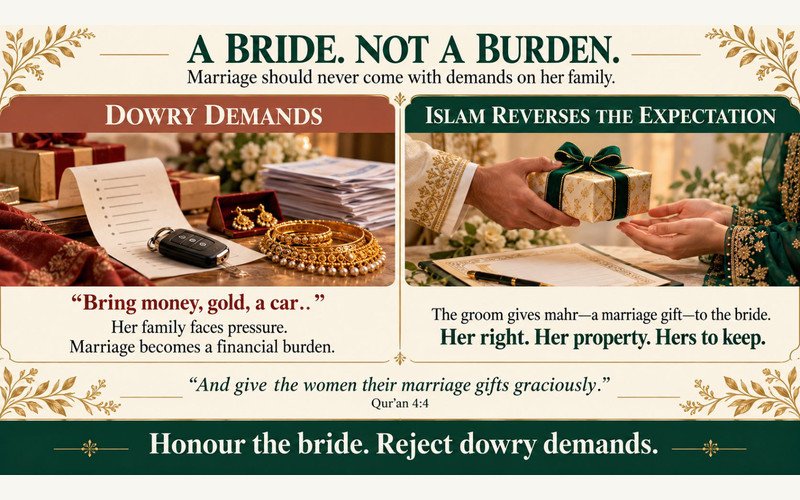
FINANCIAL RIGHTS OF WOMEN
Her Wealth, His Duty: What Islam Actually Says About Money in Marriage
Ask a dozen people what Islam says about a wife and money, and you'll often get answers shaped more by local custom than by revelation. In some homes a wife's salary is quietly absorbed into the household. In others her husband's responsibility is treated as a favour rather than a duty. Both habits drift from what the Qur'an and the Prophet's example establish, and the gap shows up most clearly when we go back to the sources and to how the first Muslims lived.
What women had before the revelation
Pre-Islamic Arabia was not a place where a wife could expect to own much. Ibn Abbas, in a report found in Sahih al-Bukhari (4579), explains the background to Surah an-Nisa 4:19. When a man died, his relatives had a claim over his widow. They could keep her, marry her to someone, or stop her from marrying at all. The verse ended this: "It is not lawful for you to inherit women against their will."
The Qur'an then gave women their own share of inheritance: "For men is a share of what the parents and close relatives leave, and for women is a share…" (4:7). The detailed shares follow in 4:11–12. This was not a minor adjustment, because it made a woman an owner in her own right.
The Mahr belongs to the bride
The Qur'an says: "And give the women their bridal gifts graciously" (4:4). The word the verse uses for the gift, nihlah, carries the sense of something freely given. The verse goes on to say that if she willingly gives up some of it, the husband may enjoy it. The word willingly is doing the work there. It cannot be pressured out of her.
Elsewhere the Qur'an is blunt about it: "If you wish to replace one wife with another, and you have given one of them a great amount, do not take back anything of it" (4:20). The following verse calls marriage "a firm covenant" (4:21). The Prophet ﷺ himself set the pattern. Aisha, may Allah be pleased with her, reported that the mahr he gave his wives was twelve uqiyyah and a nash, which she explained was five hundred dirhams (Sahih Muslim 1426). It was a real sum that was really handed over.
What she earns, inherits and receives is hers
Surah an-Nisa 4:32 states the principle plainly: "For men is a share of what they have earned, and for women is a share of what they have earned." Nothing in the verse says a woman's earnings fall into her husband's hands once she marries.
Classical jurists treated this seriously. In the legal schools, a married woman kept her own property and her own legal standing. It is worth remembering how different that was elsewhere. In England, under the old doctrine of coverture, a wife's property largely passed under her husband's control, and it took the Married Women's Property Acts of 1870 and 1882 to begin changing that. Muslim women had a recognised legal basis for owning, selling and endowing property many centuries earlier.
History bears this out. Khadijah bint Khuwaylid was a successful merchant who employed the young Muhammad ﷺ to trade on her behalf, before they married. Her wealth stayed hers, and she supported him with it in the early, difficult years of the mission.
The husband carries the maintenance
The other half of the picture is the husband's responsibility. Surah Al-Baqarah says that the father must provide the mothers of his children with food and clothing "in a reasonable manner," and adds that "no person is charged with more than his capacity" (2:233). Surah at-Talaq 65:7 puts it in similar terms: let the person of means spend from his means, and the one whose provision is restricted spend from what Allah has given him, since "Allah does not burden a soul beyond what He has given it."
Surah an-Nisa 4:34 describes men as qawwamun over women, partly "because of what they spend from their wealth." Many scholars read qiwamah primarily as a responsibility, meaning a duty to provide and protect, rather than a licence to take control of the wife's property. That reading fits the way the verse ties itself to spending.

In his Farewell Sermon the Prophet ﷺ said that women have a right over their husbands to be provided with food and clothing in a fair manner (Sahih Muslim 1218). He also told his community, in the same sermon, to fear Allah regarding women.
Most classical jurists held that this duty remains even if the wife is wealthy. Her money is not meant to subsidise the household unless she chooses to.
When the husband falls short
There is a well-known case. Hind bint Utbah came to the Prophet ﷺ and complained that her husband, Abu Sufyan, was a miserly man who did not give her enough for her and her children. He told her: "Take what is sufficient for you and your children, in a reasonable manner" (Sahih al-Bukhari 5364; also in Sahih Muslim 1714).
Two points stand out. First, the Prophet ﷺ treated her need as a real right that could be claimed, not a matter of charity. Second, he attached the limit: bil-ma'ruf, what is fair and customary, not whatever she might want.
Spending on family is an act of worship
Islam does not treat this duty as a dry obligation. The Prophet ﷺ said that when a Muslim spends on his family hoping for Allah's reward, it counts as charity for him (Sahih al-Bukhari 55, Sahih Muslim 1002). In another narration, the best dinar a person spends is the one spent on his family (Sahih Muslim 994).
So the husband's provision is both a legal duty and something that can be done with sincerity and reward in mind.
If a wife chooses to help
Nothing prevents a wife from supporting her husband and family, as long as it is her free choice. The hadith of Zainab, the wife of Abdullah ibn Mas'ud, shows this. She asked the Prophet ﷺ whether she could give charity to her husband and to orphans in her care. He replied that she would have two rewards, one for maintaining family ties and one for charity. The report is in both Sahih Al-Bukhari and Sahih Muslim.
The key is the word choice. A wife who gives out of love is doing something virtuous. A wife who is pressured to hand over her income is being denied a right the Qur'an gave her.
Consultation, not control
The Qur'an describes believers as those "whose affairs are conducted through mutual consultation" (42:38). Even in the matter of weaning a child, Surah Al-Baqarah speaks of decisions made "by mutual consent and consultation" between the parents (2:233). That is a useful model for money as well. Household budgets, savings and big purchases are better settled by talking than by one person's authority.
The Qur'an also describes the whole relationship as one of "affection and mercy" (30:21). And the Prophet ﷺ said that the best of you are the best to their wives (Sunan at-Tirmidhi 3895). Those verses and hadith set the tone for everything above. The rules on money are there to protect justice inside a relationship that is supposed to run on kindness.
Why it matters now
Many modern disputes in Muslim families come down to confusion on these points. A husband who believes his wife's salary is his to manage, or a wife who is told that her mahr "went into the house," is acting on custom rather than on the sources. Equally, a husband who treats provision as optional is neglecting the duty that Surah Al-Baqarah and the Farewell Sermon place squarely on him.
The clearest summary is probably this. Her property is hers. His duty to provide is his. And whatever she gives beyond that, she gives freely, and Allah rewards it.