
In brief
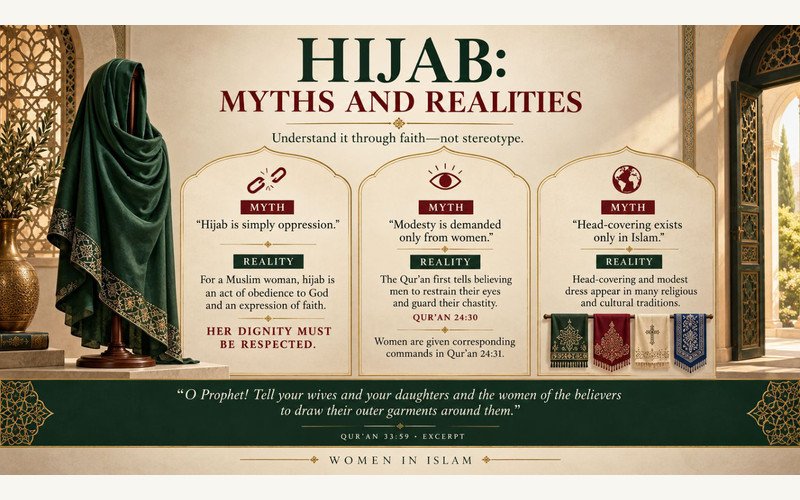
Hijab is commonly understood as the head-covering worn by many Muslim women, but its meaning reaches beyond a piece of clothing. For many women, hijab is connected with faith in Allah, worship, modesty, obedience, taqwa (awareness of Allah), dignity and a conscious effort to live according to Islamic teachings. The Qur’an discusses modest conduct, lowering the gaze, guarding chastity and covering adornment. Understanding hijab therefore involves both outward practice and inner purpose: what a person wears, why she wears it, and the wider character and spiritual commitments she seeks to cultivate.
1.1 Meaning of Hijab
The Arabic word hijab can mean a screen, barrier or covering. In everyday English, it most often refers to the headscarf worn by many Muslim women, usually covering the hair, ears and neck while leaving the face visible. In Islamic discussions, modesty is broader than a particular garment: it also concerns conduct, speech, intention and respect for boundaries. A niqab generally covers the face while leaving the eyes visible; a burqa usually refers to a garment covering the body and face, with a screen or opening for vision. Usage varies by region. For many Muslim women, hijab is a religious commitment; for some it also expresses identity, belonging or personal discipline. A person's reasons cannot be inferred from appearance alone.
1.2 Qur’anic Foundation
The Qur’an is the primary source for Muslim discussions of hijab and modesty. Two central passages are Surah An-Nur 24:30–31 and Surah Al-Ahzab 33:59.
Surah An-Nur 24:30–31
“Tell the believing men to reduce [some] of their vision and guard their private parts. That is purer for them.” — Qur’an 24:30, Sahih International. Source: https://legacy.quran.com/24/30-31
The next verse addresses believing women with related guidance, including lowering the gaze, guarding chastity, not displaying adornment except what appears, and drawing their khumur over their juyub. In the cited translation, this is expressed as drawing head-coverings over their chests. The passage links modesty with conduct and clothing. It addresses men before women, while the specific dress instructions in the two verses are not identical.
Muslim scholars have examined these verses in detail. Many classical scholars understand covering the hair as part of the required dress for adult Muslim women in public before unrelated men. Scholars have differed on some details, including whether and in what circumstances the face must be covered. Translation should be distinguished from legal interpretation.
Surah Al-Ahzab 33:59
“O Prophet, tell your wives and your daughters and the women of the believers to bring down over themselves [part] of their outer garments.” — Qur’an 33:59, Sahih International. Source: https://legacy.quran.com/33/59
This verse refers to outer garments and is important in Islamic discussions of public dress. Its wording, historical setting and application have been discussed by Muslim scholars; it should be read in context rather than treated as a complete answer to every modern question about clothing.
A Hadith about early Muslim practice
Aishah (may Allah be pleased with her) reported that when the instruction concerning head-coverings was revealed, the early emigrant women responded by using their cloth to cover themselves. Reference: Sahih al-Bukhari 4758; Book 65, Hadith 280 in Sunnah.com’s in-book numbering: https://sunnah.com/bukhari/65/280
This authentic report records the response of women in the early Muslim community to Qur’an 24:31. It is useful historical evidence of early Muslim practice and should be distinguished from later legal discussions about the precise requirements of dress.
1.3 Spiritual Dimensions of Hijab
For many Muslim women, hijab is not simply an outward appearance. It can be part of a conscious relationship with Allah and a daily reminder of faith. Its spiritual meaning can be explored through niyyah (intention), taqwa (awareness of Allah), ‘ibadah (worship), haya (modesty), sabr (steadfastness) and good character. These are related Islamic concepts, not interchangeable definitions of hijab.
Faith, obedience and worship
A woman may wear hijab because she believes it is part of Allah’s guidance and wishes to respond sincerely. In this understanding, hijab becomes an act of worship—not because the fabric itself has independent spiritual power, but because a believer intends to obey Allah through an action she understands as religiously required. The spiritual value of an act is connected with faith, intention and the way it is carried out.
Niyyah: the importance of intention
“The reward of deeds depends upon the intentions and every person will get the reward according to what he has intended.” — Prophet Muhammad I. Reference: Sahih al-Bukhari 1, https://sunnah.com/bukhari:1; Sahih Muslim 1907a, https://sunnah.com/muslim:1907a.
This Hadith establishes the general importance of intention in Islam. It is not a specific ruling about hijab, but it helps explain why the inner purpose of a religious action matters. Other people cannot fully know a person's intention simply by observing her clothing.
Taqwa: living with awareness of Allah
Taqwa is often explained as being conscious of Allah and seeking to live in a way that pleases Him. For a woman who understands hijab as part of her religious commitment, it may serve as a reminder to carry that consciousness into daily choices. Taqwa is not measured by clothing alone; it also concerns honesty, justice, mercy, humility, fulfilling responsibilities and avoiding harm.
The Qur’an states: “Indeed, the most noble of you in the sight of Allah is the most righteous of you.” — Qur’an 49:13, Sahih International. Source: https://legacy.quran.com/49/13. This verse places moral and spiritual worth in taqwa, not ancestry, status or outward appearance alone.
Haya: modesty of heart and action
Haya is commonly translated as modesty or moral restraint. The Prophet I said, “Modesty is a branch of faith.” Reference: Sahih Muslim 35a, https://sunnah.com/muslim:35a; Sahih al-Bukhari 9, https://sunnah.com/bukhari:9.
This teaching connects modesty with faith. Haya can be reflected in clothing, but also in speech, behaviour, humility and respect for others. It does not mean being afraid to ask questions, seek education, speak truthfully or participate in public life.
Sabr, consistency and inner growth
A religious practice may require patience when a person faces misunderstanding, social pressure or practical challenges. Sabr means patience and steadfastness, not passively accepting mistreatment. A woman may see hijab as a continuing commitment that encourages consistency between beliefs and daily choices. Her spiritual growth is not judged by other people's assumptions; it is part of her relationship with Allah.
Hijab and good character
Islamic spirituality connects worship with ethical conduct. It would be inaccurate to claim that every woman who wears hijab is automatically more virtuous, or that a woman who does not wear it lacks faith or good character. Outward practice and inward character are related but not identical. Qur’an 24:30 gives guidance to men as well as the guidance to women in 24:31; all people remain responsible for their own conduct.
For many Muslim women, hijab brings together outward observance and inward intention. It may express devotion to Allah, remind a person of taqwa, cultivate haya and strengthen religious identity. These meanings can vary and should not be assumed to be identical for every woman.
Important facts and distinctions
• Qur’an 24:30 addresses believing men before verse 24:31 addresses believing women.
• Qur’an 24:31 refers to khumur (head-coverings) and covering the chest in the cited translation.
• Qur’an 33:59 discusses outer garments.
• Sahih al-Bukhari 4758 reports how early Muslim women responded to the revelation associated with Qur’an 24:31.
• Niyyah, taqwa and haya explain spiritual concepts connected with hijab; they are not interchangeable terms or separate definitions of the garment.
Sources and further reading
• Qur’an 24:30–31, Sahih International: https://legacy.quran.com/24/30-31
• Qur’an 33:59, Sahih International: https://legacy.quran.com/33/59
• Qur’an 49:13, Sahih International: https://legacy.quran.com/49/13
• Sahih al-Bukhari 4758: https://sunnah.com/bukhari/65/280
• Sahih al-Bukhari 1, on intention: https://sunnah.com/bukhari:1
• Sahih Muslim 35a, on modesty: https://sunnah.com/muslim:35a