
In brief
For many Muslim women, hijab is a visible expression of faith, personal identity and religious commitment. Some describe it as a source of confidence and a way to express their beliefs, while others experience social pressure or discrimination because of what they wear. There is no single experience shared by every Muslim woman. Understanding hijab and empowerment requires listening to women's own accounts, recognising their achievements and respecting their ability to make decisions.
3.1 Hijab as personal identity
Personal identity includes the beliefs, values, experiences and relationships through which people understand themselves. For many Muslim women, hijab is one part of that identity. A woman may wear it as an expression of obedience to Allah; another may also connect it with family traditions, community belonging or a personal decision made after studying Islamic teachings.
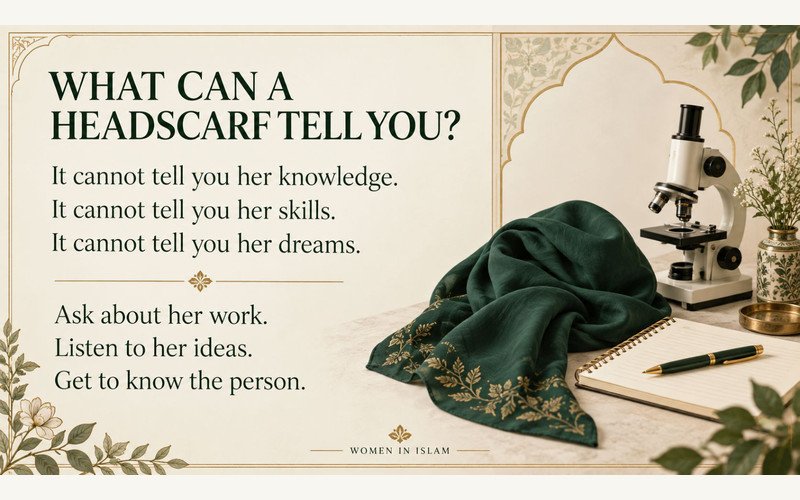
Identity is not formed by clothing alone. Education, profession, interests, family life, ambitions and experiences also shape a person. Hijab does not make all Muslim women alike, nor does it reveal everything about their personalities or beliefs. Respecting identity means allowing women to explain what hijab means to them rather than assigning them a meaning based on stereotypes.
3.2 Confidence and self-expression
Some women describe hijab as a source of confidence because it allows them to express a religious commitment that matters to them. Others may experience it differently, including social pressure, discomfort or concern about how they are perceived. Experiences can change over time and may be influenced by family, community, education, workplace culture and public attitudes.
Anderson Beckmann Al Wazni's qualitative study, published in Social Work in 2015, explored hijab, empowerment, feminist identity and body image through interviews with 12 Muslim women in North Carolina. Its small sample provides insight into those participants' experiences, not a representative picture of all Muslim women. Madeleine Chapman's 2016 study in the European Journal of Women's Studies examined how veiled Muslim women negotiate identity and public representations.
These studies support a careful conclusion: hijab can carry different meanings in different lives. Confidence also comes from education, skills, supportive relationships, opportunities and achievement. Hijab does not automatically create confidence, just as not wearing it does not indicate a lack of faith or self-respect.
3.3 Professional success while wearing hijab
Muslim women who wear hijab work in many fields, including medicine, education, engineering, business, public service, science and sport. Their abilities should be judged by qualifications, skills, performance and conduct—not assumptions about clothing. Professional abilities develop through education, training, experience and effort.
Some women who wear visible religious clothing report facing stereotypes or unfair treatment. Assumptions that a woman wearing hijab is less independent, less modern or less capable can affect how others interact with her. Highlighting successful Muslim professionals can challenge stereotypes, but a few examples cannot prove that discrimination no longer exists. A fair society allows women to participate in professional life without being required to hide or justify their religious identity, while observing legitimate professional and safety requirements that apply to everyone.
3.4 Balancing faith and modern life
Modern life involves education, careers, technology, travel, social relationships and changing cultural expectations. Muslim women make decisions about how to combine beliefs with responsibilities and ambitions. A woman who wears hijab may choose clothing for different climates, decide how to dress professionally or explain her practice to people unfamiliar with it.
Faith and participation in modern society are not automatically opposites. A woman can pursue higher education, use modern technology, build a career and contribute to public life while maintaining a religious commitment. The
Qur’an begins its revelation with the command to read or recite in Surah Al-Alaq 96:1–5. This passage concerns knowledge and learning rather than hijab specifically, but it provides relevant context for the value of seeking knowledge in Muslim life. Reference: https://legacy.quran.com/96/1-5.
Agency and the meaning of choice
Empowerment includes the ability to make decisions, pursue goals and participate in society. Some women freely choose hijab as part of their religious beliefs. Others may experience family or community pressure. Some women who wear hijab may also face pressure to remove it. These situations should not be treated as identical.
Respect for women means taking their accounts seriously and examining the circumstances in which choices are made. It does not mean assuming that every woman wearing hijab is oppressed, or that every woman wearing it experiences complete freedom from pressure. Women should be recognised as individuals with their own voices, abilities, beliefs and ambitions.
Important facts and distinctions
• Hijab can be part of a woman's religious and personal identity, but it does not define her entire identity.
• Research on hijab includes different experiences of faith, agency, social expectations and public perception.
• Small qualitative studies provide detailed accounts but should not be treated as representative surveys.
• Professional competence should be assessed through relevant skills and performance, not stereotypes about religious clothing.
Sources and further reading
• Al Wazni, Anderson Beckmann. “Muslim Women in America and Hijab: A Study of Empowerment, Feminist Identity, and Body Image.” Social Work 60(4), 2015, pp. 325–333. https://doi.org/10.1093/sw/swv033
• Chapman, Madeleine. “Feminist Dilemmas and the Agency of Veiled Muslim Women: Analysing Identities and Social Representations.” European Journal of Women's Studies 23(3), 2016, pp. 237–250. https://doi.org/10.1177/1350506815605346
• Qur’an 96:1–5: https://legacy.quran.com/96/1-5