
In brief
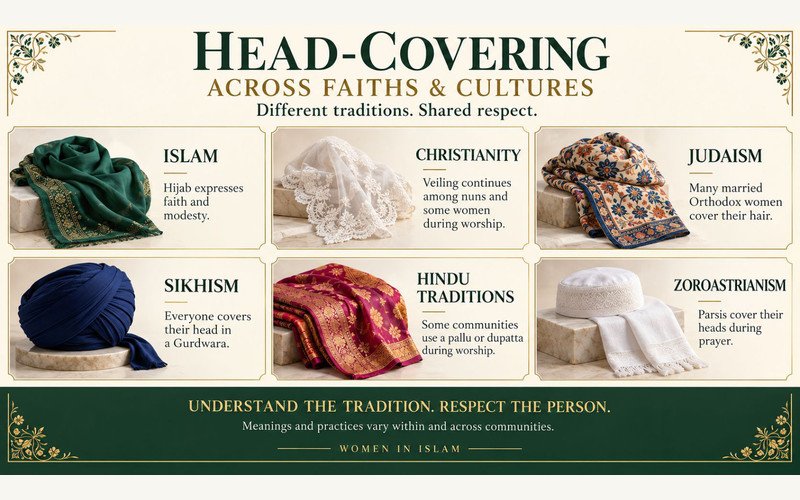
Head-covering and modest dress are found in several religious traditions, although their meanings, forms and requirements differ. In Islam, discussions of hijab draw on Qur’anic teachings about modesty and dress. Some Christian communities practise head-covering during worship, some Jewish women cover their hair in accordance with their community's traditions, and Sikh turbans have important religious and cultural significance. These practices should not be treated as identical, but studying them can help people understand how clothing may express faith, identity, respect and belonging.
4.1 Similar practices in different religions
Clothing can communicate religious identity, observance and community belonging. In different traditions, head-covering may be associated with worship, modesty, marital status, spiritual discipline or religious commitment. Similar outward appearances do not necessarily mean that the religious teachings behind them are the same. Each practice should be understood within its own history and tradition.
Islam
In Islam, Qur’an 24:30–31 discusses lowering the gaze, guarding chastity, modest conduct and covering adornment. Qur’an 33:59 refers to outer garments. These passages are central to Muslim discussions about hijab and modest dress. Sources: https://legacy.quran.com/24/30-31 and https://legacy.quran.com/33/59.
Many Muslim scholars understand covering the hair as an obligation for adult Muslim women in public before unrelated men, although scholars have differed on some details, including face-covering. Muslim women also differ in personal practice.
Christianity
The New Testament contains a passage about head-covering during prayer and worship in 1 Corinthians 11:2–16. Paul discusses women covering their heads while praying or prophesying. Christian communities interpret and apply the passage differently. Some women cover their heads during worship or prayer, while others do not regard head-covering as a requirement for contemporary practice.
Primary source: 1 Corinthians 11:2–16, NRSVUE: https://www.biblegateway.com/passage/?search=1%20Corinthians%2011%3A2-16&version=NRSVUE
Judaism
In Jewish tradition, tzniut is a Hebrew term commonly associated with modesty. It can relate to dress, behaviour and conduct. In some traditional Jewish communities, married women cover their hair using scarves, hats or wigs. Practice varies among Jewish movements and communities; some women cover their heads during prayer or in a synagogue rather than throughout the day.
Further reading: “Hair Coverings for Married Women,” My Jewish Learning: https://www.myjewishlearning.com/article/hair-coverings-for-married-women/
Sikhism
The dastar, commonly called a turban in English, is an important article of identity and religious commitment for many Sikhs. Sikh teachings place significance on kesh, the practice of maintaining uncut hair, and the turban helps keep the hair covered and cared for. The turban is especially associated with Sikh men, although some Sikh women also wear turbans or other forms of head-covering. The dastar should not be described as the same garment as hijab: the practices arise from different religious traditions and have their own meanings.
4.2 Shared values of modesty
Although religious traditions differ, modesty and respectful conduct are important themes in many communities. Some people wear particular garments or cover their heads during prayer and worship as an expression of reverence. Clothing may make religious identity visible, while shared practices can connect people with a community and its traditions. Religious practices may also encourage discipline, humility, service or responsibility.
These shared themes should not erase differences. Islamic teachings about hijab, Jewish traditions of hair-covering and Christian practices of veiling have distinct textual histories and interpretations. A respectful comparison explains both what practices may share and what makes each one unique.
4.3 Building understanding across faiths
Interfaith understanding means learning about other religious traditions accurately, listening to people who practise them and recognising differences without hostility. It does not require everyone to adopt the same beliefs. It encourages people to ask questions, examine assumptions and distinguish reliable information from stereotypes.
Head-covering practices can be found in more than one religious community in India. Their form and meaning vary by religion, region, family and individual. It is better to describe a specific tradition accurately than to make broad claims about what all members of a religion do.
Moving beyond stereotypes
A person should not assume that every woman in a religious community dresses the same way, or that a garment reveals her beliefs, character or level of freedom. It is also important to distinguish religious teaching from local custom. Some practices are directly connected with religious texts; others develop through historical traditions, family practices or community expectations. Many reflect a combination of influences.
Useful questions include: What does this practice mean to people who observe it? Which religious texts or traditions are connected with it? How does it vary among communities? What assumptions might outsiders make that do not reflect the experiences of the people concerned?
A foundation for mutual respect
Understanding modest dress across religions can help people recognise the importance of religious identity in everyday life. Visible differences do not prevent people from sharing public spaces, working together and treating one another fairly. Respectful dialogue does not remove all disagreement; it creates an opportunity to discuss differences with accurate information, patience and dignity.
The purpose of comparing religious practices is not to claim that all religions teach exactly the same thing. It is to understand each tradition more carefully and build relationships based on knowledge rather than assumption.
Important facts and distinctions
• The New Testament discusses women's head-covering during worship in 1 Corinthians 11:2–16.
• Tzniut is a broader Jewish concept of modesty, not simply another name for hijab.
• The Sikh dastar has its own religious and cultural significance and should not be equated with a Muslim headscarf.
• Practices vary within religious communities; no single garment or individual represents every member of a faith.
Sources and further reading
• Qur’an 24:30–31: https://legacy.quran.com/24/30-31
• Qur’an 33:59: https://legacy.quran.com/33/59
• 1 Corinthians 11:2–16, NRSVUE: https://www.biblegateway.com/passage/?search=1%20Corinthians%2011%3A2-16&version=NRSVUE
• “Hair Coverings for Married Women,” My Jewish Learning: https://www.myjewishlearning.com/article/hair-coverings-for-married-women/
• Article 1 — Hijab: A Journey of Faith, Spirituality and Purpose: related to Articles 2 and 3.
• Article 2 — Understanding Hijab: Beyond the Headscarf: related to Articles 1 and 4.
• Article 3 — Hijab, Identity and Empowerment: related to Articles 1 and 2.
• Article 4 — Interfaith Perspectives on Modest Dress: related to Articles 2 and 1.