
Child Custody
Classical Islamic jurists developed rules for custody and financial support after divorce. Mothers are often given priority in caring for young children, subject to conditions and differing school rules, while fathers generally have financial obligations. Age thresholds and custody outcomes vary, and Indian court decisions depend on the child’s welfare and applicable law.
Witness and Testimony
Quran 2:282 discusses documentation of deferred financial transactions and refers to two women witnesses in the specific context described in the verse. It should not be generalized into a claim that women’s testimony is always worth half that of men in every legal matter. Jurists have differed on testimony rules across legal contexts.
Quotations and Commentary
Quran 4:3: permits marriage to two, three or four women, but directs that if a person fears he cannot be just, he should marry one. Hadith in Jamiʿ at-Tirmidhi: reports emphasize that the best people are those best to their wives; verify the exact wording and reference. Quran 4:4: directs that women be given their mahr. Prophetic teachings and practice are commonly cited in support of kindness and the prohibition of harm in family life.
Common Misconceptions
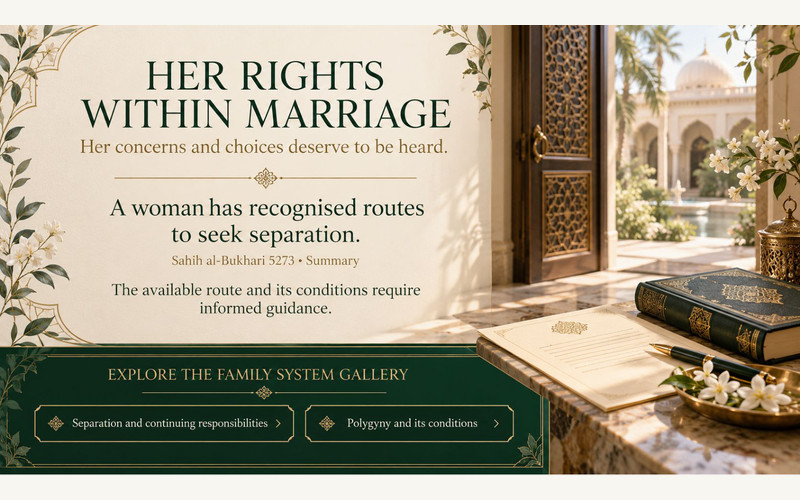
Misconception: “Islam forces women to stay married, giving husbands too much power.” Clarification: Islamic jurisprudence recognizes more than one route to ending a marriage, including khulʿ and judicial dissolution, although procedures and practical access differ. In India, the applicable statutory framework and court decisions also matter.
Sources and Further Reading
Shaheen Sardar Ali, Women and Personal Law in Plural Societies (Oxford University Press, 2011) – verify edition and relevant pages. Leila Ahmed, Women and Gender in Islam (Yale University Press, 1992).
Related Articles
Common Misconceptions (Article 6) Muslim Women in India Today (Article 7)
Article 4: Inheritance and Property – Equal Shares for Women
Article Status
Planned article outline supplied in the draft. The full article still needs to be written.
Content to cover: Quran 4:7 and 4:11 on inheritance; pre-Islamic injustices; women’s ownership of property; and how Muslim personal law operates today.
Article 5: Education and Social Roles – Empowering Muslim Women