
MUSLIM WOMEN IN INDIA
Faith, Leadership, Education and Nation-Building
In Brief
Muslim women have contributed to India’s social, educational, political, cultural and economic life across generations. Their stories include resistance to colonial rule, the creation of educational opportunities, public leadership, scientific and professional achievement, craft revival, community service and the documentation of lived experiences. These contributions are rooted in diverse regional histories and personal journeys. For many Muslim women, faith is not separate from public service; it can provide an ethical language of learning, justice, compassion and responsibility. Recognising these women broadens our understanding of Indian history and reminds us that nation-building is carried forward not only by political leaders, but also by educators, professionals, innovators, artists and community organisers.
Faith as a Foundation for Responsibility and Service
Islamic teachings place knowledge, justice, compassion and social responsibility among important moral duties. The Qur’an describes believing men and women as allies who encourage what is right and work against what is wrong (Qur’an 9:71). This verse presents women as participants in the moral life of society, not merely as observers of it. The Qur’an also promises a good life and reward to anyone—man or woman—who does righteous deeds while believing (Qur’an 16:97).
The pursuit of knowledge also has a strong place in the Prophetic tradition. In Sahih al-Bukhari, women asked Prophet Muhammad ﷺ for a dedicated time to learn from him, and he arranged a day for their instruction (Sahih al-Bukhari 101). The account offers an important example of women seeking education and of teaching being organised to meet their needs. Together, these sources provide a spiritual and ethical foundation for learning, dignity, service and active participation in society.
Muslim women in India have interpreted and lived these values in many ways, shaped by their times, languages, communities and opportunities. Their experiences are not all alike. Some challenged colonial power; others expanded access to education, entered public institutions, supported families and communities, or created new livelihoods. Their stories are best understood as part of India’s wider and diverse social history.
Leading in Public Life
Begum Hazrat Mahal is remembered for her role in the resistance to British rule during the uprising of 1857. After the British annexation of Awadh and the exile of her husband, she became a prominent figure in the struggle centred on Lucknow. Her leadership is a reminder that women were present in the political and military resistance to colonial expansion, even when historical narratives have often placed men at the centre.
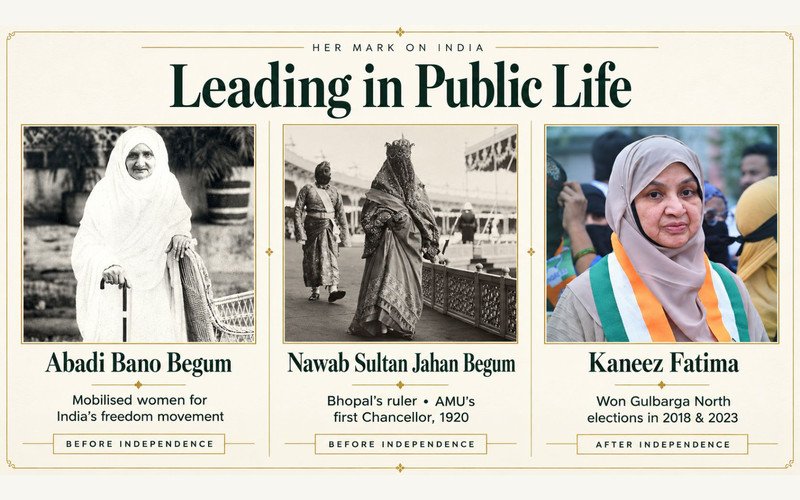
Abadi Bano Begum, widely known as Bi Amma, became an influential voice in the national movement. She addressed public gatherings and encouraged political participation at a time when women’s public presence was often restricted. Her life illustrates how women used speech, organising and moral conviction to support collective causes and inspire later generations.
Nawab Sultan Jahan Begum, the ruler of Bhopal, supported educational and public institutions and is associated with the early history of Aligarh Muslim University, where she served as its first Chancellor in 1920. Her public role demonstrates how women in positions of authority could use institutional leadership to support education and social development.
In contemporary public life, women such as Kaneez Fatima have participated in electoral politics, representing constituents and engaging with public concerns. Their work reflects the continuing presence of Muslim women in democratic institutions and the many ways in which political representation can connect local needs with public decision-making.
Opening Doors to Learning
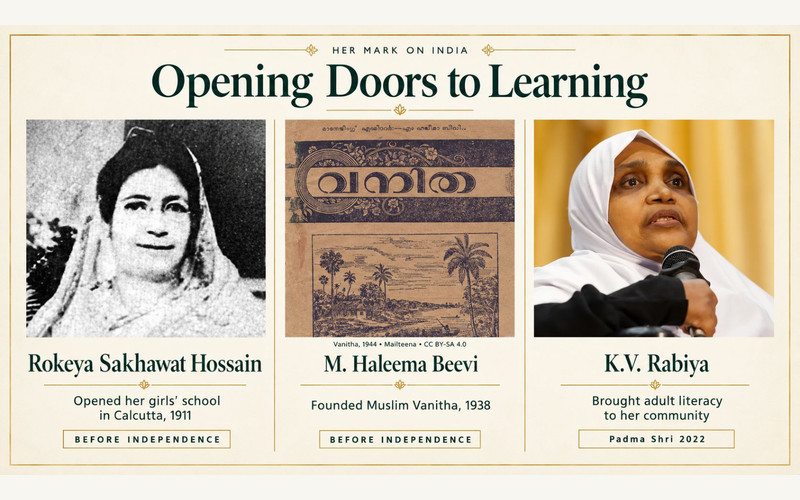
Education has been one of the most significant areas of Muslim women’s social reform. Rokeya Sakhawat Hossain, the Bengali writer, thinker and education reformer, established a school for girls in Calcutta in 1911. She argued for women’s education and intellectual freedom through both her writing and her educational work. Her legacy remains important to discussions about gender, learning and social change in South Asia.
M. Haleema Beevi worked in journalism and publishing and was associated with Muslim Vanitha, a Malayalam publication first issued in 1938. Through publishing and public engagement, she advocated education and social progress for Muslim women. Her work illustrates how print culture can create spaces for discussion, circulate ideas and connect women across communities.
K. V. Rabia, from Kerala, is known for her work in literacy and social development, including efforts to extend learning opportunities to adults and people facing barriers to education. Her journey highlights the importance of community-based education: progress often depends not only on formal schools, but also on persistent local initiatives that help people gain confidence, skills and access to public life.
These examples show that education is more than academic attainment. It can strengthen agency, widen choices, help families navigate institutions and enable communities to participate more fully in civic life.
Serving Through Expertise
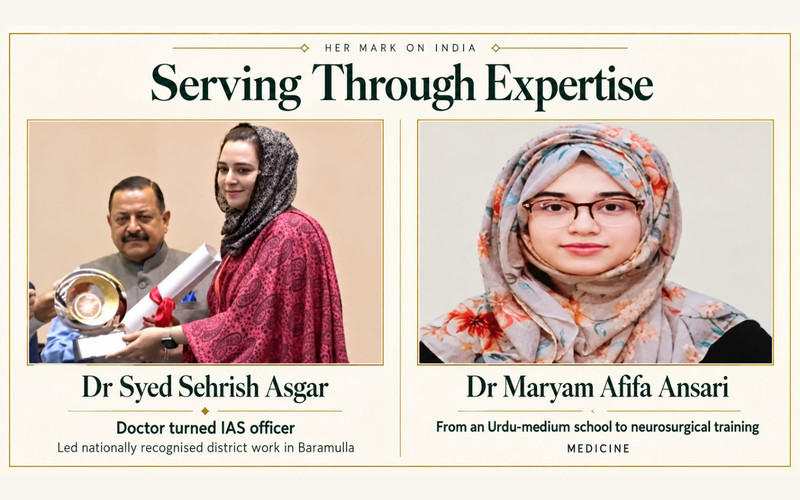
Muslim women also contribute through professional knowledge and public service. Dr Syed Sehrish Asgar, an Indian Administrative Service officer with a medical background, has served in administrative roles in Jammu and Kashmir, including as Deputy Commissioner of Baramulla. Her career illustrates how professional training can be carried into public administration, where decisions affect local services, development and people’s everyday lives.
Dr Maryam Afifa Ansari has been recognised for her work in neurosurgery, a demanding medical speciality requiring years of study, technical expertise and sustained responsibility. Women entering such fields can expand public ideas about who belongs in highly specialised professions and can become visible examples for students considering careers in science and medicine.
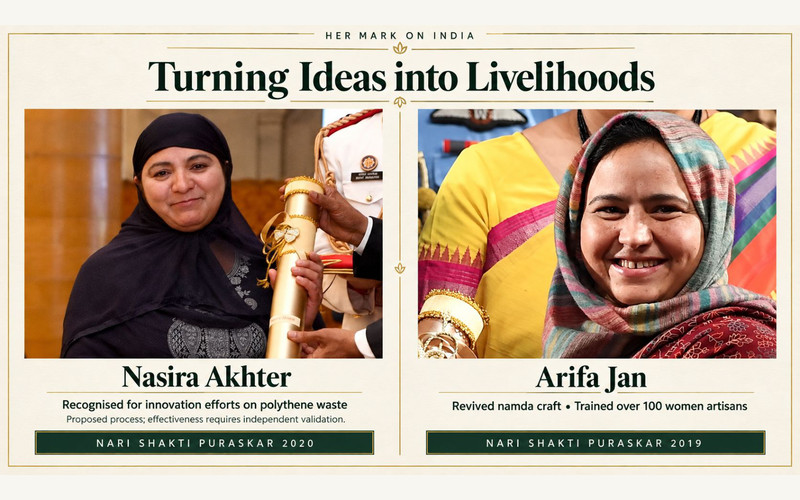
Innovation and environmental work are also forms of expertise. Nasira Akhter, from Jammu and Kashmir, received the Nari Shakti Puraskar for innovation related to environmental conservation and polythene waste. Her work points to the role that local problem-solvers can play in responding to environmental challenges. Such efforts remind us that innovation does not happen only in large laboratories or companies; it can also emerge from people who observe a problem in their surroundings and work persistently toward a solution.
Turning Skills into Livelihoods
Arifa Jan has worked to revive namda, a traditional felted-wool craft associated with Kashmir. Her efforts have helped sustain a craft tradition while creating work and training opportunities for women. The revival of a traditional skill can protect cultural knowledge, support household income and strengthen local economies. It also shows that heritage and entrepreneurship can reinforce each other.
Women’s economic participation takes many forms: running small enterprises, preserving crafts, organising savings groups, developing new products and building networks of mutual support. These efforts may not always attract national attention, but they can make a substantial difference to family security and community resilience. When women gain access to training, markets, credit and fair working conditions, the benefits can extend well beyond individual earnings.
Reaching New Heights in Aviation and Sport
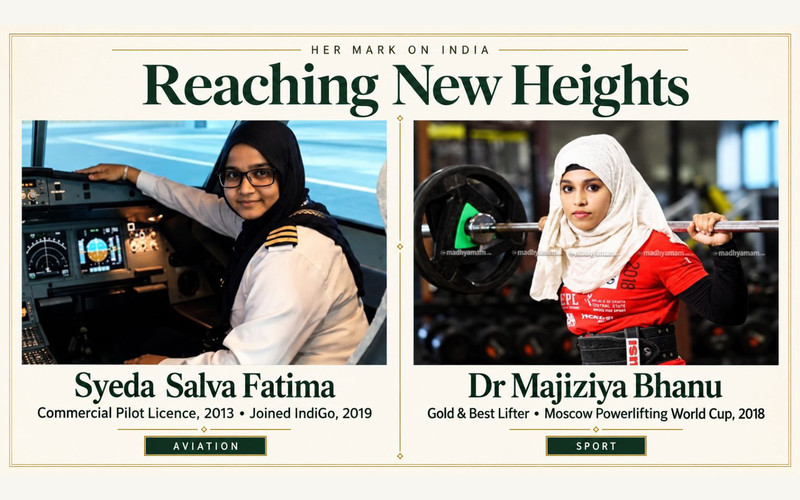
Syeda Salva Fatima’s path into commercial aviation represents the achievement of entering a highly technical profession that has often been difficult for women to access. Aviation requires rigorous training, discipline and responsibility. Her story can encourage young people to consider careers beyond the boundaries created by narrow expectations about gender or community.
Dr Majiziya Bhanu has gained recognition in powerlifting, a sport that demands strength, structured training, consistency and mental resilience. Sporting achievements challenge assumptions about women’s physical capabilities and show that athletic excellence can take many forms. Women athletes also create visibility for girls who may have limited access to sporting facilities, coaching or public encouragement.
These journeys do not suggest that every woman must follow an extraordinary or highly visible career. Rather, they show the value of ensuring that talent can develop—whether in aviation, sport, education, family life, business, public service or any other field.
Standing with Communities
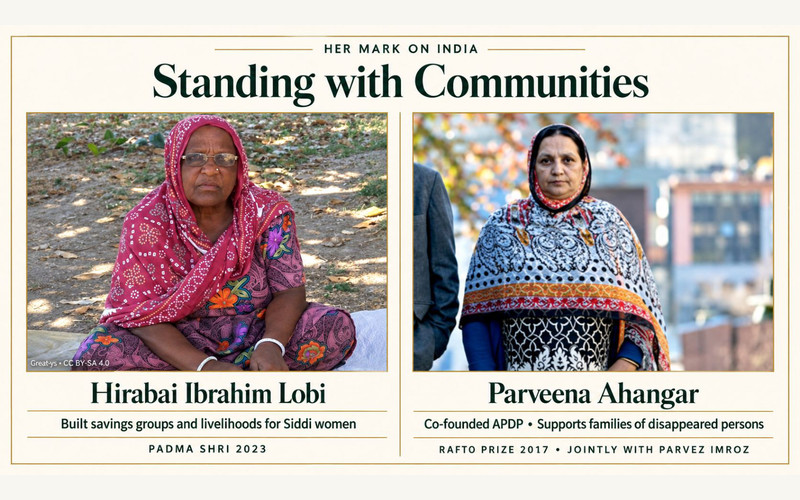
Hirabai Ibrahim Lobi, a social worker from Gujarat’s Siddi community, has worked to improve opportunities for women and families through education, livelihoods and community organisation. Her work illustrates the importance of leadership that begins with listening to local needs and building collective capacity. It also reminds us that India’s Muslim and other minority communities are internally diverse, with distinct histories, languages and social experiences.
Parveena Ahangar, co-founder and leader of the Association of Parents of Disappeared Persons (APDP), has supported families searching for relatives who disappeared in the conflict in Kashmir. Alongside human-rights lawyer Parvez Imroz, she received the Rafto Prize in 2017. Her work has drawn attention to the anguish of affected families and the need for accountability, dignity and humane treatment. Her story is an example of community advocacy carried out over many years under difficult circumstances.
Community service may involve helping people access education or livelihoods, supporting families in distress, advocating for rights or building institutions that endure. It often requires patience and courage rather than public recognition. These forms of service are an essential part of nation-building because they help communities seek dignity, safety and opportunity.
Culture, Stories and Voices
Writers, journalists, artists and photographers help society see experiences that may otherwise remain overlooked. Kashmiri photojournalist Masrat Zahra documents everyday life and the experiences of women in Kashmir. Her work illustrates how visual storytelling can record personal histories and bring attention to lives often reduced to headlines or political narratives.
Cultural work is not separate from social understanding. Stories, photographs, journalism and literature can preserve memory, question stereotypes and create space for people to describe their own lives. When women tell their stories in their own voices, they contribute to a fuller and more complex picture of India.
Beyond Stereotypes: Recognising Diversity
Muslim women are not a single, uniform group. They differ by language, region, class, education, profession, family circumstances, religious interpretation and personal aspiration. A woman’s experience in Kashmir may differ from that of a woman in Kerala, Bengal, Telangana or Gujarat. Urban and rural opportunities can differ too, as can access to schools, healthcare, employment and public space.
It is therefore important to avoid describing Muslim women only through the lens of disadvantage, or treating the achievement of a few individuals as representative of everyone. Both struggle and achievement are part of the story. Meaningful inclusion requires attention to the barriers women face as well as the choices, skills, leadership and contributions they bring to society.
Nation-building is broader than holding political office or receiving awards. It includes teaching a child to read, preserving a craft, providing medical care, building a business, serving in public administration, creating art, supporting a neighbour and standing beside families seeking justice. These contributions strengthen the social fabric and help create a society in which more people can participate.
Selected Milestones
1857 — Begum Hazrat Mahal played a leading role in resistance to British rule in Awadh.
1911 — Rokeya Sakhawat Hossain established a girls’ school in Calcutta.
1920 — Nawab Sultan Jahan Begum served as the first Chancellor of Aligarh Muslim University.
1938 — The Malayalam publication Muslim Vanitha began publication, associated with M. Haleema Beevi.
2017 — Parveena Ahangar and Parvez Imroz received the Rafto Prize for human-rights work.
2019 — Arifa Jan received the Nari Shakti Puraskar for her work reviving namda craft.
2020 — Nasira Akhter was among the Nari Shakti Puraskar awardees recognised for environmental innovation.
2022 — K. V. Rabia received the Padma Shri for her contributions to literacy and social work.
2023 — Hirabai Ibrahim Lobi received the Padma Shri for social work and community development.
Conclusion: A Shared Indian Story
The lives of Muslim women in India reveal many forms of courage and contribution: resistance and reform, teaching and scholarship, professional expertise and innovation, cultural preservation and community advocacy. Their experiences are diverse, but they share a place in the ongoing story of a country shaped by many communities and traditions.
Recognising these women is not simply about adding a few names to history. It is about understanding history more completely and ensuring that talent, dignity and opportunity are not limited by stereotypes. When women can learn, lead, create, serve and speak with confidence, families and communities benefit. Muslim women are not merely part of India’s story. They have helped write it.
Sources and Further Reading
The Qur’an, Surah At-Tawbah 9:71: https://quran.com/9/71
The Qur’an, Surah An-Nahl 16:97: https://quran.com/16/97
Sahih al-Bukhari 101, Book of Knowledge: https://sunnah.com/bukhari:101
Government of India, Azadi Ka Amrit Mahotsav: Abadi Bano Begum: https://amritmahotsav.nic.in/
Press Information Bureau, Nari Shakti Puraskar 2019 awardees: https://pib.gov.in/
Press Information Bureau, Nari Shakti Puraskar 2020 awardees: https://pib.gov.in/
President of India, Padma Awards 2023: https://www.padmaawards.gov.in/
University of Calicut repository, “Muslim Vanitha (1938)”: https://scholar.uoc.ac.in/
The Rafto Foundation, Parveena Ahangar and Parvez Imroz: https://www.rafto.no/
International Women’s Media Foundation, Masrat Zahra: https://www.iwmf.org/