
Polygyny in Islam: Between Human Complexity, Moral Responsibility and the Ethics of Family
Introduction:
Few questions about the Islamic family system generate as much debate as polygyny; the practice of a man being married to more than one woman at the same time. It is often discussed through two opposing assumptions: that it is an unrestricted male privilege, or that its very existence is incompatible with women's dignity. Both approaches risk reducing a complex moral and legal institution to a contest of ideological positions.
A more rigorous inquiry begins elsewhere: What is marriage intended to accomplish? How should societies respond to human vulnerability, sexual desire, companionship, parenthood and changing family circumstances? And what distinguishes a morally accountable relationship from one in which desire is separated from responsibility?
Islam approaches marriage not merely as a private emotional arrangement, but as a social and moral covenant. The Qur’an describes marriage through the language of tranquillity, affection and mercy (Qur’an 30:21), and characterises the marital bond as a solemn covenant (mīthāqan ghalīẓan, Qur’an 4:21). Within this ethical framework, polygyny is neither an unconditional command nor a universal model for every household. It is a regulated permission accompanied by demanding obligations.
The central question, therefore, is not simply whether polygyny is permitted, but what moral conditions must govern a permission that profoundly affects the lives, rights and futures of several people?
1. What is polygyny, and why does the distinction matter?
Polygyny is a form of polygamy in which one man has more than one wife simultaneously. It should not be confused with polyandry, in which one woman has multiple husbands, or with serial monogamy, in which a person marries different partners at different times.
2. Why permit polygyny at all?
A serious ethical framework must distinguish between what is universally ideal, what is ordinarily preferable, and what may be permissible under particular circumstances.
Human lives do not unfold according to one uniform pattern. Illness, widowhood, infertility, family responsibilities, demographic circumstances and changing needs can create situations that cannot be adequately addressed by a single social arrangement. A legal system may therefore preserve a range of permissible arrangements without requiring every person to adopt each one.
Within Islamic thought, polygyny can be understood as one such conditional provision. It may, in particular circumstances, enable a man and a woman to enter a recognised marital relationship where a strictly monogamous arrangement would not accommodate their situation. A widow, a divorced woman or a woman seeking marriage in circumstances shaped by social or personal constraints should not be presumed to lack agency, dignity or the capacity to make an informed decision about her future.
However, these possibilities must not be transformed into universal claims. Not every widow needs another marriage, not every childless marriage calls for a second wife, and not every social problem is solved by polygyny. A woman's worth is not determined by her fertility, and infertility is not a justification for humiliating or abandoning a wife. The Islamic ethical question is whether a proposed arrangement protects the dignity and legitimate interests of everyone involved.
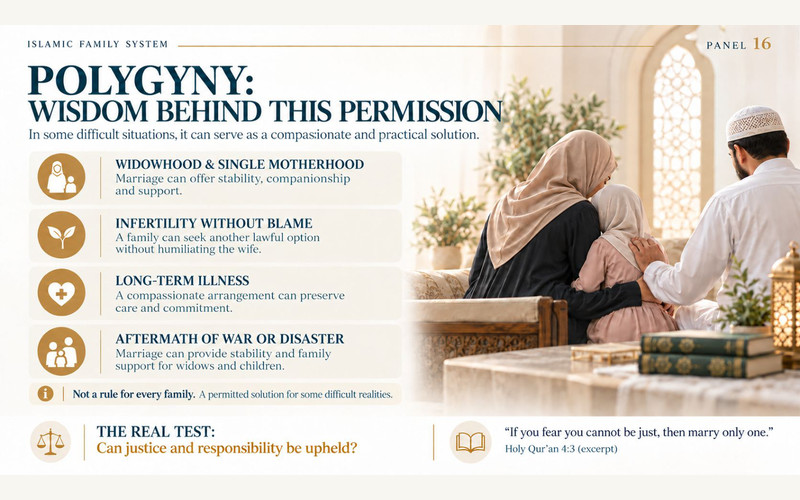
The permission, therefore, is best understood as a regulated option rather than a prescription for all households. Its legitimacy in Islamic law does not automatically establish its suitability for every individual circumstance.
3. Why is the number limited to four?
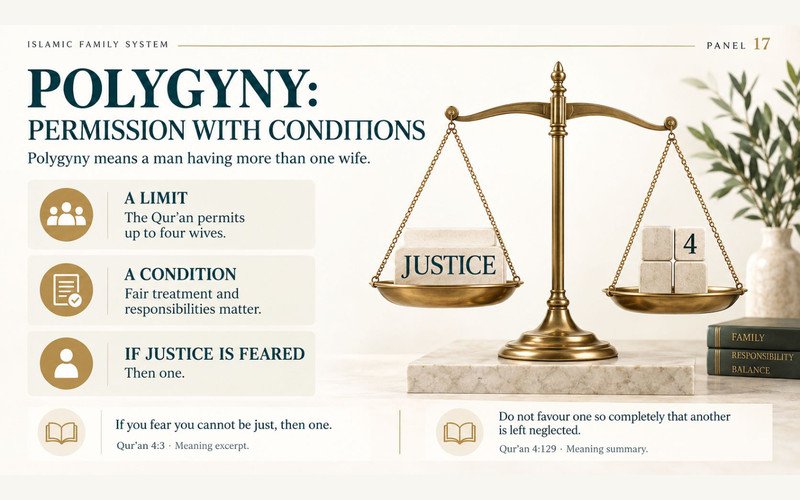
The Qur’an explicitly specifies two, three or four wives in 4:3 and immediately places this permission under the condition of justice. Classical Islamic jurisprudence understood this verse as establishing four as the maximum number of wives a man may have simultaneously.
The limit is important because it transforms an otherwise potentially unlimited practice into a bounded legal institution. The number is not merely numerical; it defines the outer boundary of a permission and prevents the practice from expanding without limit. Yet the Qur’an does not provide a separate, explicit philosophical explanation for why the ceiling is four rather than another number. It would therefore be inaccurate to present any particular modern social theory as the definitive divine rationale for that precise number.
4. The conditions of marriage: Desire must accept responsibility
The philosophical significance of Islamic marriage lies not merely in legitimising a relationship, but in grounding it in rights, responsibilities and moral accountability. The Qur’an describes marriage as a solemn covenant (4:21) and a bond of tranquillity, affection and mercy (30:21). Within this framework, justice is paramount. Qur’an 4:3 directs a man who fears he cannot act justly to marry only one, while 4:129 acknowledges the difficulty of achieving complete equality in affection, forbidding conduct that leaves a wife neglected or suspended. Thus, unequal feelings never justify injustice in conduct.
Several principles are especially relevant to polygyny.
First, justice between wives. Qur’an 4:3 makes justice a condition of the permission. In classical Islamic jurisprudence, this includes equitable treatment in matters within a husband's control, such as the allocation of time, accommodation and maintenance. The Prophet's warning against favouring one wife unjustly is recorded in Sunan Abi Dawud, hadith 2133.
Second, financial responsibility. Qur’an 4:4 establishes the wife's right to her bridal gift (mahr), while 4:34 addresses men's financial responsibility within the family. A second marriage cannot ethically be treated as a relationship that exists only when convenient. It entails material obligations, not merely emotional or sexual expectations.
Third, respect for the woman's rights and dignity. Qur’an 4:19 instructs believers to live with women honourably. Marriage must not be used as a means of coercion, degradation or exploitation. The precise legal requirements governing consent, witnesses, registration and contractual conditions differ across schools of jurisprudence and contemporary legal systems; these requirements should not be casually conflated with the general moral principles of marriage.
Fourth, the capacity to fulfil obligations. A man contemplating polygyny must seriously assess whether he can meet the material and practical responsibilities involved. The question is not simply whether he can afford another wedding, but whether he can sustain a just family arrangement over time.
These conditions expose a fundamental ethical distinction: permission does not eliminate accountability. Indeed, the more people affected by a decision, the greater the need for foresight, transparency and responsible conduct.
5. Polygyny and Illicit Relationships: The Importance of an Ethical Framework
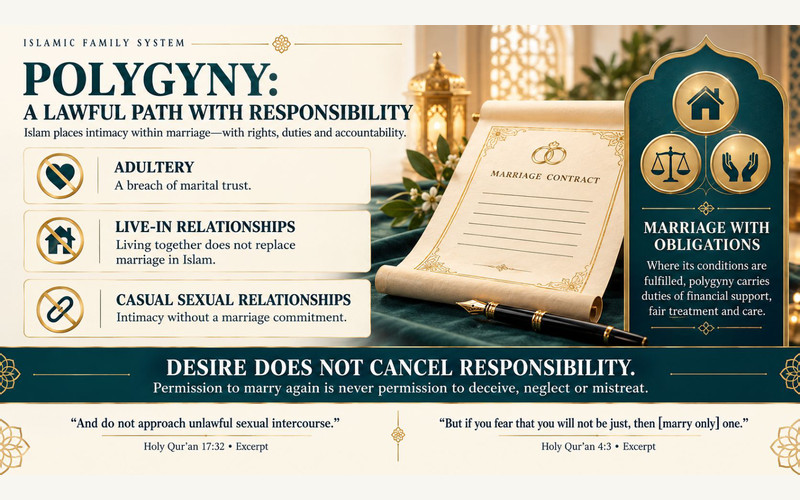
A central question in discussions of sexuality is whether intimacy should be governed solely by personal desire or by mutual rights and responsibilities. Islamic ethics places sexual intimacy within marriage, with Qur’an 17:32 prohibiting unlawful sexual relations and Qur’an 4:24 emphasising chastity within lawful relationships.
The distinction extends beyond religious permissibility to the moral and social responsibilities surrounding intimacy. Secret or exploitative relationships may offer emotional or physical gratification without a clear commitment to financial support, inheritance, or future responsibilities. Children, too, may face uncertainty. However, legal protections for non-marital relationships vary across jurisdictions; therefore, not every such relationship necessarily lacks legal rights.
The relevant comparison is between a responsible, transparent marriage and an arrangement in which one person enjoys intimacy while evading accountability. Within this context, polygyny can provide a legitimate alternative to secret or irresponsible relationships by establishing recognised marital obligations and placing intimacy within a framework of moral accountability.
Yet this advantage is conditional, not automatic. A marriage involving deception, neglect, injustice or the denial of a wife’s rights cannot be justified merely by invoking religious permission. Polygyny does not make a relationship ethical simply by formalising it; its ethical legitimacy depends on fulfilling the rights and responsibilities that marriage entails.
Conclusion: A permission is only as ethical as its exercise
Polygyny in Islam is best understood neither as an unrestricted privilege nor as an obligation imposed on every man. It is a conditional legal permission bounded by a maximum of four wives and governed by principles of justice and responsibility.
Its ethical significance becomes clearer when placed within the broader Islamic understanding of marriage: a solemn covenant in which intimacy is accompanied by rights, obligations and accountability. Compared with exploitative relationships that separate desire from responsibility, a properly conducted marriage can offer a more secure and morally structured alternative.
Yet the decisive qualification must remain: the existence of a lawful option does not guarantee that every use of it is just. A practice permitted in principle may become ethically indefensible in a particular case when it produces deception, neglect or injustice.
The deepest question, therefore, is not how many marriages a man is permitted to contract, but whether he is prepared to honour every person whose life becomes bound to his decision. In the Qur’anic framework, the legitimacy of permission cannot be detached from the demand for justice.
References
The Qur’an. Surah al-Nisāʾ 4:2–4, 4:19, 4:21, 4:24 and 4:34; Surah al-Rūm 30:21; Surah al-Isrāʾ 17:32; Surah al-Nisāʾ 4:129. See the Qur’anic Arabic Corpus, Surah 4:3.
Abu Dawud, Sulayman ibn al-Ashʿath. Sunan Abi Dawud, Book of Marriage, hadith 2133, “Dividing Fairly Between One’s Wives.” Sunnah.com.