
The Islamic Family System
What Islam actually teaches about marriage, divorce, duty and the dignity of women
Before we begin
Few subjects attract more assumptions than the Muslim family. Ask around and you’ll hear about instant divorces, four wives and women with no say in anything. Some of that comes from things that really do happen in some Muslim communities. Some comes from rumour, and some from a handful of verses read without the sentences around them.
Let’s see what the Quran and the example of the Prophet Muhammad (peace be upon him) actually say, and it is honest where Muslim practice has fallen short of that teaching. Whatever you believe, you deserve to hear the source before you hear the stereotype.
1. The Family System
Why the family?
Picture a family gathering at a house that is a little too small for everyone who showed up. Nobody calls this a “support system”. It’s just family. But look at what it quietly does. It feeds people, minds the children, looks after the old, and gives everyone in the room somewhere to belong.
Islam starts its social teaching exactly here, and the Quran gives the reason in one verse:
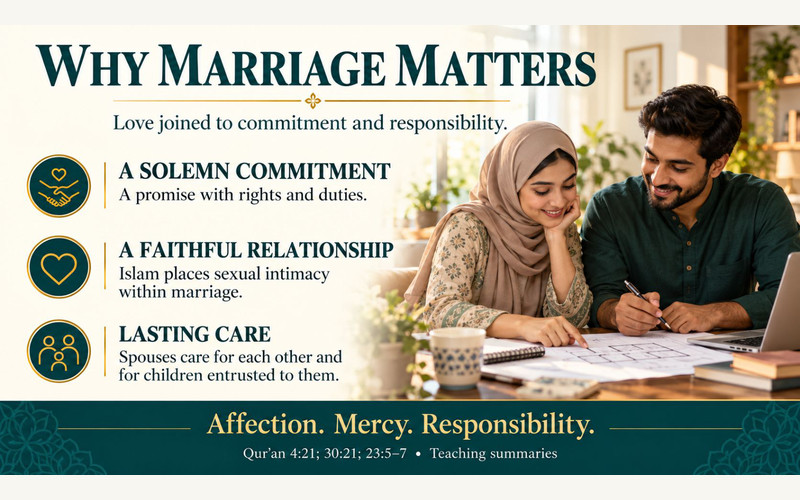
“And among His signs is that He created for you spouses from among yourselves, that you may find tranquility in them, and He placed between you affection and mercy.” (Quran 30:21)
Notice the vocabulary. Marriage is described with three words: sakinah (tranquility), mawaddah (affection) and rahmah (mercy). It isn’t framed as a business deal or a biological arrangement. It is meant to be a place where a person can finally exhale.
A family is also where a child first learns trust, where the elderly are cared for, and where character is shaped long before school or society gets its turn. That is why Islam treats it as a trust (amanah) and not just a private arrangement between two adults.
The present disintegration
Let’s be honest about where things stand. Divorce rates are rising in Muslim and non-Muslim societies alike. Joint families are shrinking into nuclear ones, and nuclear ones into individuals sharing a roof and separate screens. Parents work long hours, children are raised by devices, the elderly end up in care homes or in loneliness, and many couples walk into marriage with expectations borrowed from social media and no training in patience.
Picture a very ordinary evening. A husband gets home at nine, worn out. His wife has had just as long a day. He’s on his phone, she’s on hers, and dinner passes in near silence. Nobody shouted. Nobody did anything you could point to as wrong. Yet the tranquility the Quran talks about is slowly draining out of that house. This quiet kind of breakdown is probably more common than the dramatic fights that end up in court.
The causes are familiar: economic pressure, individualism, fading respect for elders, and ignorance of what religion actually teaches about marriage. There is another one that is easy to miss. Many of us know our rights very well and our duties hardly at all. Everyone demands, and few give.
In that situation the family may still exist physically while its emotional and moral bonds grow thin. Family disintegration can therefore be understood as the gradual weakening of affection, trust, communication, responsibility and mutual care among family members.
The Islamic model
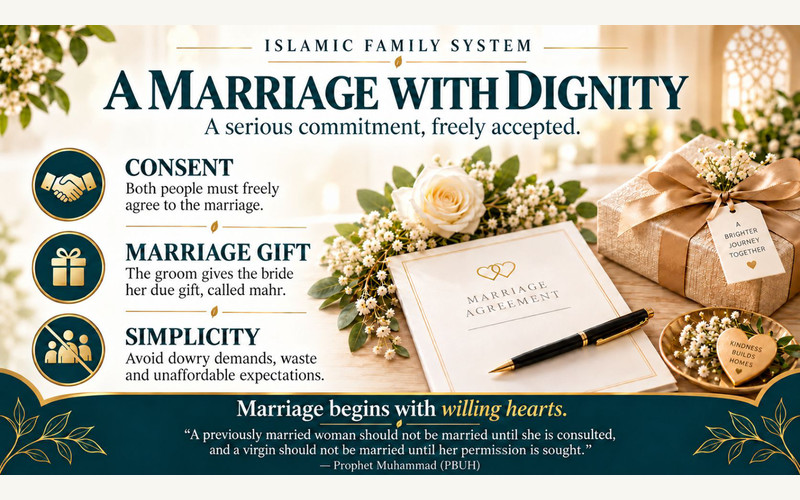
Islam’s answer is a structure built on clear responsibilities, mutual consultation (shura) and God-consciousness (taqwa). A marriage begins with the consent of both partners, a mahr (dower) paid to the bride, and a public declaration. The Prophet encouraged simplicity, and is reported to have said that the most blessed marriage is the one with the least burden.
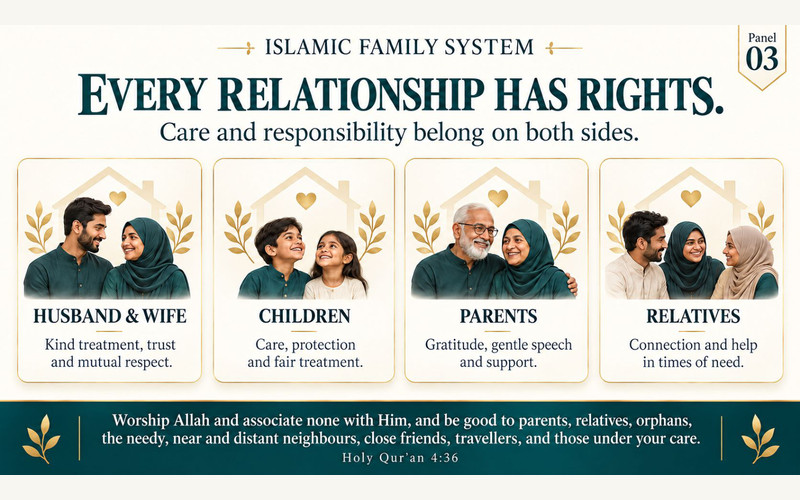
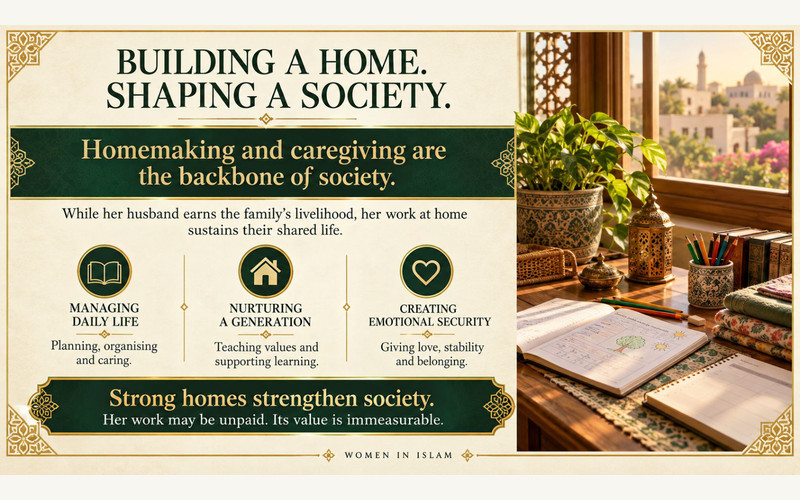
Inside the marriage, the husband carries the duty of maintenance and protection, the wife the duty of managing the home and nurturing the family, and both share the duty of treating each other kindly. The wider family isn’t an afterthought either. Parents, siblings and relatives all have a place in this web of obligations.
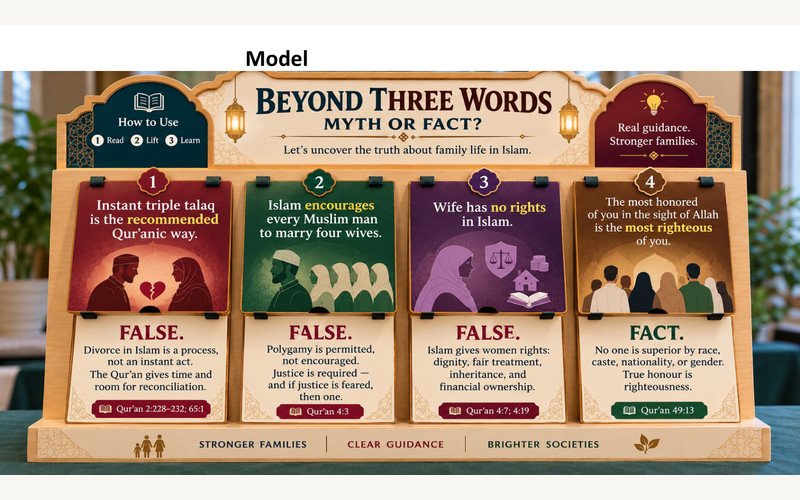
Myth: “In Islam a girl’s family picks her husband and she has no say.”
Reality: A woman’s consent is a condition of a valid marriage. A well-known narration in Bukhari tells of a young woman whose father married her off against her wishes. The Prophet set that marriage aside. Forced marriage is a cultural habit, not an Islamic rule.
2. Rights and Responsibilities
Islam describes marriage as a partnership in which rights and duties mirror each other:
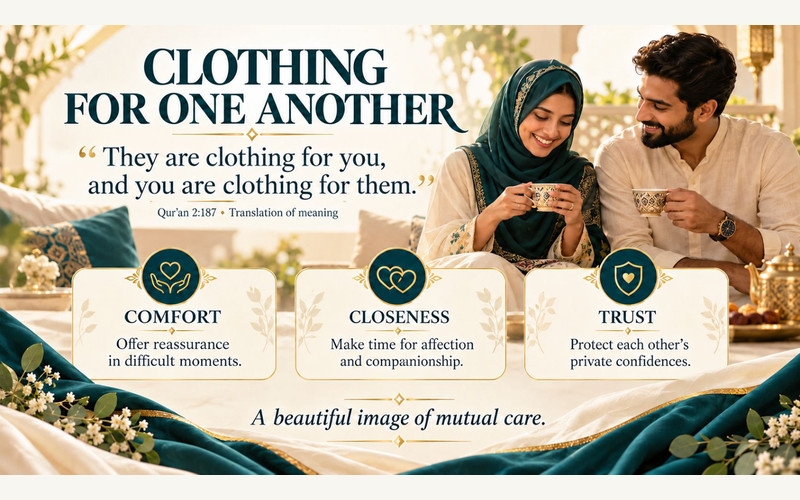
“And they (women) have rights similar to the rights against them, according to what is equitable.” (Quran 2:228)
The key word is equitable. Not identical, but fair. So who owes what to whom?
The husband
The Quran calls the husband qawwam, a protector and maintainer of the family (4:34). Read that word carefully, because it is often translated as “boss”. It describes a responsibility before it describes any privilege. He must provide food, clothing and housing according to his means, treat his wife kindly, and never harm her physically or verbally. The Prophet said that the best of you are those who are best to their wives, and added that he himself was the best of them. In return, he is entitled to loyalty, to be spoken of honourably in his absence, and to cooperation in running the home.
We tend to forget how the Prophet behaved at home. Aisha (may God be pleased with her) was once asked what he did in the house. She said he helped his family with the housework, and when the time for prayer came, he got up and went (Bukhari). The man who led an entire community mended his own clothes. So when someone says “the husband is the head of the house”, it’s fair to ask whether he is following the example of the person he claims to follow.
Myth: “A Muslim wife must obey her husband in everything.”
Reality: Cooperation in a shared home is expected from both sides, but nothing in Islam makes a woman her husband’s property. She keeps her own wealth, her own earnings and her own conscience, and no one, husband included, can command her to disobey God.
The wife
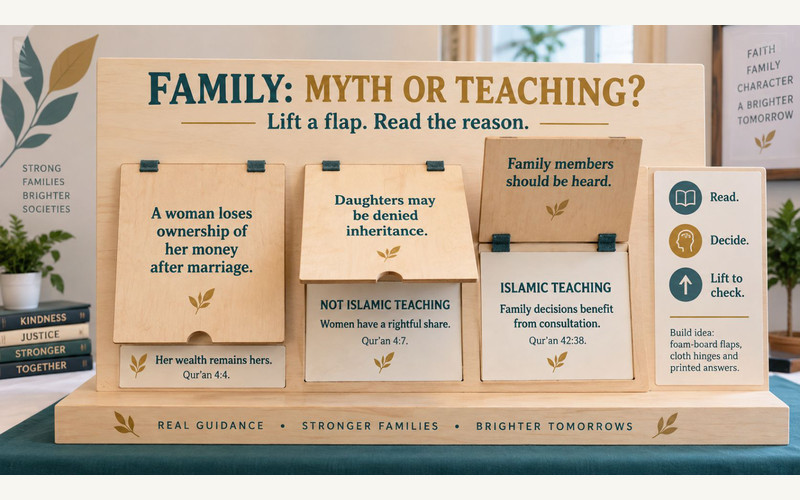
A wife has the right to mahr, which belongs to her alone, not to her father or her husband. She has the right to maintenance even if she is wealthy herself, and her property stays her own. No one can take her earnings without her consent. Many classical jurists held that she is not legally obliged to do the housework, though goodwill and teamwork are obviously part of a healthy home. Her duties are fidelity, protecting the home and family honour, and honest consultation with her husband.
The children
Children have rights before they are even born: a good name, a good upbringing, breastfeeding (the Quran mentions two years, 2:233), education, and fair treatment among siblings. Parents who favour one child over another are specifically warned against it. A child is a trust, not property.
And a child won’t remember the expensive toy as clearly as the parent who actually listened. Most of us can still recall who made us feel safe when we were seven years old, and who didn’t.
Parents and relatives
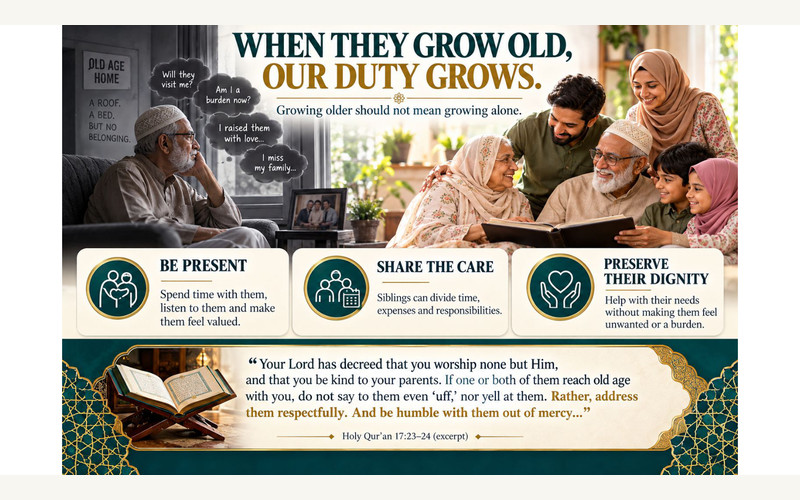
After the worship of One God, the Quran places kindness to parents next (17:23-24), and that applies even when the parents are not Muslim. Old age is handled with striking sensitivity: not even a sigh of irritation is allowed. Beyond parents come relatives. Silat ar-rahm, keeping family ties, is a serious obligation, and the Prophet said that the person who cuts off family ties will not enter Paradise (Bukhari and Muslim). In practice that means staying in touch, visiting the sick, sharing in grief and in celebration, and helping needy relatives.
3. The Ethics of Separation
Islam is realistic. It wants marriages to last, but it does not trap people in misery. A saying attributed to the Prophet puts it this way: of all lawful things, divorce is the most disliked by God. Divorce is allowed, yet it is meant as a last resort and not the first reaction to an argument.
Before things reach that point, the Quran lays out a process: advice, a period of sleeping apart, and above all arbitration, where one representative from each family tries to bring the couple back together (4:35). Even then, there are rules.
Divorce (Talaq)
If reconciliation fails, talaq is the husband’s way out. The correct method is a single pronouncement, made while the wife is clean from menstruation and no intimacy has taken place. Then the iddah (waiting period, about three menstrual cycles) begins. During this time the wife stays in the home, the husband cannot expel her, he remains responsible for her upkeep, and either of them can resume the marriage. The purpose is obvious: give anger time to cool.
Elders in many communities will tell you of couples who arrived at that waiting period furious and certain, and were sitting together again within weeks. It doesn’t always work, of course. But compare it with a divorce announced in anger in the middle of a fight, with no time to breathe.
Triple Talaq
The Quran speaks of divorce “twice” (2:229) and then a third time, after which the separation becomes final (2:230). The design is deliberately spaced out, with room for second thoughts. Saying “talaq, talaq, talaq” in one breath, in a rage, is therefore regarded by many scholars as bid’ah (an innovation) and sinful.
Myth: “A Muslim man can end his marriage by saying ‘talaq’ three times.”
Reality: The Quranic model is spaced, with waiting periods and chances to reconcile. The instant version is considered sinful by many scholars, counted as only one divorce by others, and has been restricted or banned in a number of countries.
Halala
This is probably the most misunderstood idea in the whole subject. The Quran says that after a third and final divorce, the woman is not lawful for her former husband until she marries another man, and if that second husband genuinely divorces her, they may remarry (2:230). Read closely, it is a restriction on the man. It is a deterrent against treating a wife like a toy to be thrown away and picked up again.
What is practised in some places as “nikah halala” is something else entirely: a pre-arranged marriage to a stranger whose only purpose is to divorce her the next day. That is not what the Quran describes. The Prophet cursed the muhallil (the man who does this) and the one for whom it is done (reported in Abu Dawud and Tirmidhi). So the commercial or forced version of halala is condemned by Islam itself, and it has too often been used to humiliate women. If someone tells you it is a “solution”, ask one simple question: would the Prophet, who cursed those involved, have accepted it?
Khula
Islam does not leave the wife without recourse. If she cannot continue the marriage, she may seek khula, returning the mahr, or whatever is agreed, in exchange for release (2:229). The classic example is the wife of Thabit ibn Qays. She came to the Prophet saying she had no complaint about her husband’s character or religion, but she could not stay with him. The Prophet asked her to return the garden Thabit had given her as mahr, and told Thabit to accept it and part ways. Where the husband refuses, she can approach a qadi (judge) or an Islamic council to dissolve the marriage. So both sides have an exit, each through its own door.
4. Polygyny: Why Four Wives?
This is the topic on which people on both sides are least honest. Some treat the verse as a casual licence. Others dismiss it as if it had never been revealed. Neither helps, so let’s read it with its context:
“Marry those that please you of other women, two, three or four; but if you fear that you will not be just, then only one.” (Quran 4:3)
The verse is traditionally understood to have come after the Battle of Uhud, when many Muslim men had been killed and widows and orphans were left without protection. It is usually quoted with that half of the story missing. A few points are worth stating plainly:
Four is a cap, not a target. Before Islam, men in Arabia married any number of women with no obligations at all. Narrations describe new converts with more than four wives being told to keep only four. Islam limited the practice and attached conditions to it.
The central condition is justice in maintenance, housing, time and treatment. The verse itself says that if you fear you cannot be just, marry one.
Perfect equality is acknowledged as impossible. Another verse says you will never be able to treat wives completely equally, even if you wish to (4:129). Scholars read this as referring to emotional inclination, and as a warning not to lean entirely toward one wife and leave the other “hanging”.
It is a permission, not a command or a recommendation. The vast majority of Muslim marriages throughout history have been monogamous. Reasons that scholars mention include widows and orphans after wars, a wife’s chronic illness or infertility, and imbalances in the number of men and women. A woman can also write a monogamy clause into her marriage contract.
It is a serious permission carrying a heavy responsibility. A man who cannot give two households equal time, money and fairness has, by the Quran’s own words, no business marrying a second time.
Myth: “Islam encourages men to collect as many as four wives.”
Reality: It permits it under strict conditions, and the same verse leans toward one wife. The practice is rare and, in the Quran’s own framework, comes with accountability.
5. The Worth of a Woman: Is It Only Fertility?
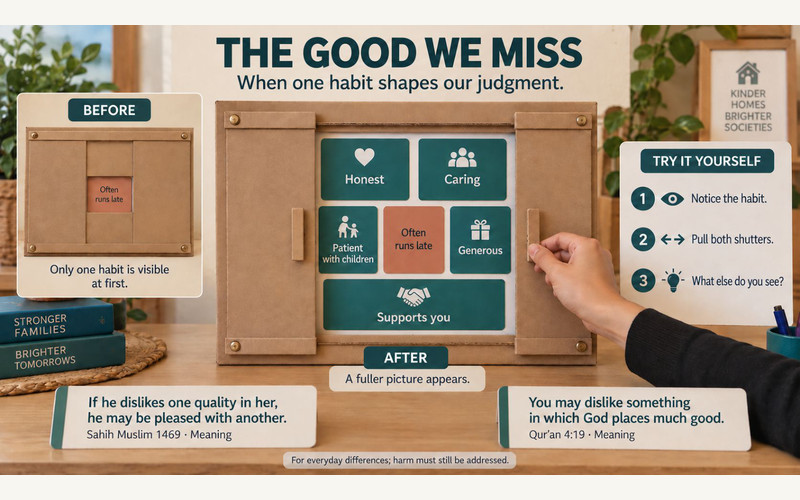
The short answer is no, and the Quran says so directly. It makes no distinction between men and women in spiritual worth:
“Whoever does righteous deeds, male or female, while being a believer, We will surely grant them a good life.” (Quran 16:97)
Another verse (33:35) lists ten qualities of believers, from faith to charity to remembering God, and repeats every one of them for men and women alike. If a woman’s worth were only her fertility, ask yourself why the Quran would say so much about her mind, her faith, her work, her testimony and her reward.
Think about what Islam gave women fourteen centuries ago: the right to own and inherit property, to refuse a marriage proposal, to receive a dower, to seek divorce, to be educated and to do business. Khadijah (may God be pleased with her) was a successful merchant and the Prophet’s first supporter. Aisha was one of the greatest scholars of her age, teaching men and women alike. And in the ninth century, Fatima al-Fihri founded the University of al-Qarawiyyin in Fez, which is still counted among the oldest universities in the world.
Motherhood is honoured in Islam, no doubt about that. The Prophet said that Paradise lies at the feet of mothers, and when a man asked who most deserved his good company, he named the mother three times before the father. But that honour is not a reduction. A woman who is a daughter, a sister, a wife, a scholar or a worker has the same standing before God. So does the woman who chooses not to have children, or cannot. Infertility is never presented as a flaw in Islam. The Quran says God makes barren whom He wills (42:50), which is a matter of His will and not of a woman’s worth.
A woman’s value lies in her faith, her character and her contribution, exactly as a man’s does. Where a society reduces her to her fertility or her service, it is departing from the teaching and not following it.
Conclusion
Put the pieces together and a consistent picture appears: marriage built on mercy, separation handled with ethics instead of anger, rights balanced by duties, permissions bound by conditions, and women honoured as full human beings. Most of the problems we see today come from distance from the teaching, not from the teaching itself.
You don’t have to share the faith to see the logic of the question being asked. What does a family owe its members, and what do its members owe each other? Islam’s answer is demanding, and repairing the family starts by taking it seriously.