
Triple Talaq, Khula and Halala: The Qur’anic Ethics of Separation
Divorce is among the most sensitive matters in family life because it involves not only the end of a relationship, but also questions of dignity, financial security, children’s welfare and the possibility of reconciliation. Islamic teachings approach divorce as a regulated process rather than an impulsive declaration. The Qur’an sets out procedures, waiting periods and responsibilities intended to prevent injustice and allow decisions to be reconsidered where possible.
Understanding this framework requires distinguishing the Qur’anic method of divorce, triple talaq pronounced in one sitting, a woman’s right to seek khula, and the rule concerning remarriage after a final third divorce. These are related, but they are not interchangeable.
1. What method of divorce does Islam prescribe?
The Qur’an presents divorce as a process governed by restraint, reflection and accountability. In Qur’an 2:229, it states that divorce is revocable twice, after which a husband must either retain his wife honourably or release her with kindness. The verse does not present divorce as an opportunity for humiliation, revenge or arbitrary control.
Qur’an 65:1 instructs believers to observe the prescribed waiting period (iddah) and not to expel women from their homes during it. It adds that circumstances may change after the pronouncement. This provision is significant: the waiting period is not merely a formality but creates time for reflection and possible reconciliation.
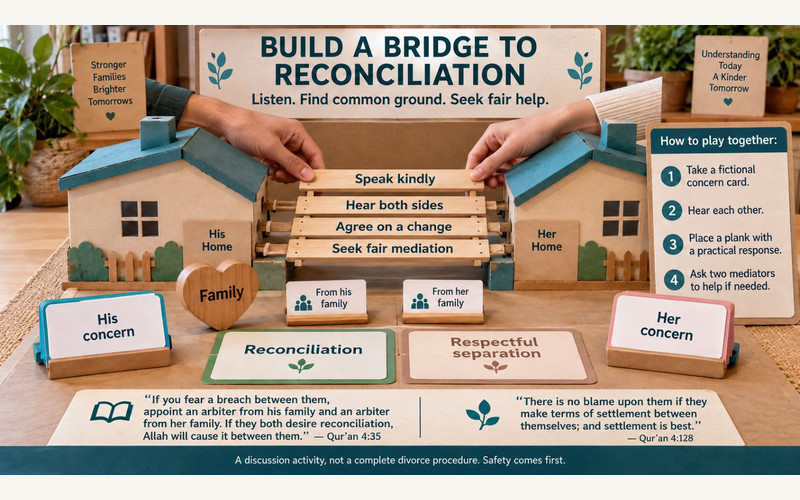
The method commonly called talaq al-sunnah follows this measured approach: a single pronouncement, made in accordance with the relevant conditions, followed by the prescribed waiting period. Classical jurisprudence generally identifies the appropriate time as a period of purity in which marital relations have not occurred, though details and legal interpretations vary. The Qur’an also encourages arbitration when a serious marital breach is feared (4:35).
The underlying principle is that an irreversible decision should not be treated lightly. Divorce may become necessary, but it should be approached with deliberation and respect for the rights of both parties.
2. Triple talaq: Why an instant decision is problematic
The expression triple talaq commonly refers to pronouncing divorce three times in one sitting, intending to make the separation immediate and final. This must be distinguished from the Qur’anic process in which separate pronouncements occur over time.
The Prophet’s ﷺ response to Ibn Umar (RA), who had divorced his wife during menstruation, illustrates the importance of following the prescribed procedure. The Prophet instructed him to take her back and wait for the appropriate time before deciding whether to divorce or retain her (Sahih Muslim 1471c). The incident demonstrates that divorce is subject to procedural guidance, not merely the husband’s impulse.
The deeper ethical point is that the Qur’an does not encourage a person to transform anger into an irreversible decision through repeated words. Its framework creates space for reconsideration and requires that a marriage be ended, if necessary, without injustice.
3. When is divorce permitted, and what responsibilities remain?
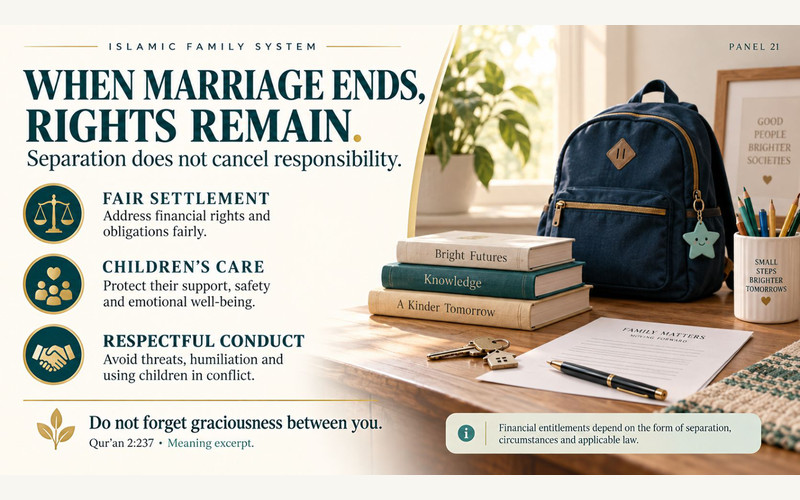
Islam does not require a couple to remain together at any cost. When reconciliation is no longer possible, divorce may be a lawful means of ending a marriage. However, permission to separate does not mean permission to abandon responsibilities.
Qur’an 2:231 instructs husbands either to retain their wives honourably or release them honourably, and forbids retaining them merely to cause harm. Qur’an 65:1 further prohibits expelling a divorced wife from the marital home during the prescribed waiting period, subject to the verse’s stated exception.
Depending on the type of divorce and the applicable legal interpretation, the husband may remain responsible for:
Maintenance and accommodation during the waiting period: The details depend on whether the divorce is revocable or irrevocable and on the circumstances.
Unpaid mahr: Any outstanding dower remains a financial obligation; divorce does not automatically cancel it.
Pregnancy-related support: Qur’an 65:6 instructs that pregnant divorced women be maintained until delivery.
Children’s welfare: A father’s responsibilities towards his children do not end merely because the marriage has ended. Qur’an 2:233 addresses provision and consultation concerning the care of children.
Respectful treatment: Qur’an 2:229 and 2:231 prohibit using divorce or reconciliation as instruments of harm.
These obligations reflect a central principle: ending a marriage does not erase the moral consequences of having entered it. A husband cannot reasonably claim the authority to end the relationship while disregarding the rights that Islamic law attaches to its dissolution. The precise legal entitlements depend on the circumstances and the relevant jurisdiction.
4. Khula: A woman’s right to seek separation
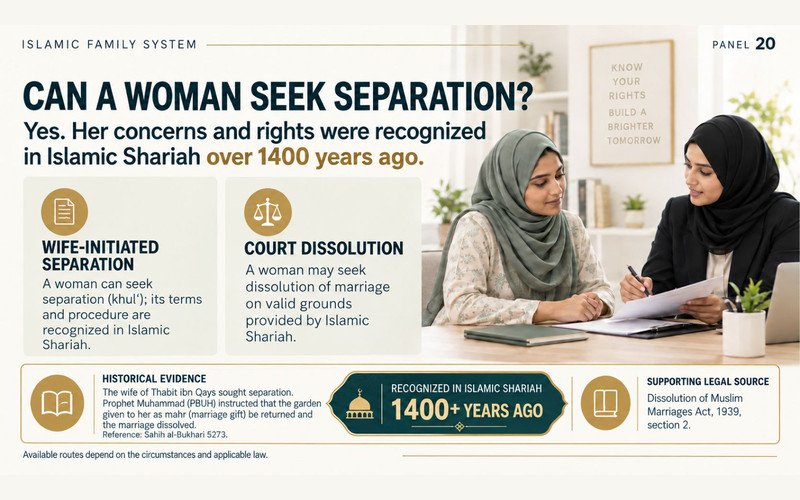
Divorce in Islam is not a framework in which a woman must remain indefinitely in a marriage she can no longer sustain. Khula is a recognised means through which a wife may seek release from the marriage, traditionally involving compensation or the return of mahr.
Qur’an 2:229 explicitly recognises the possibility of a wife ransoming herself when the couple fears they cannot maintain the limits set by Allah. The verse therefore acknowledges that a marriage may become untenable even when the issue is not simply a husband’s unilateral decision to divorce.
A well-known example appears in Sahih al-Bukhari 5273. The wife of Thabit ibn Qays approached the Prophet ﷺ and explained that she did not accuse her husband of defects in his character or religion, but feared she could not continue the marriage properly. The Prophet asked whether she would return the garden given as her mahr; she agreed, and he instructed Thabit to accept it and divorce her.
The significance of this account is profound: a woman did not have to prove that her husband was an evil person before her desire to leave could be considered. The possibility that the marriage could not be sustained honourably was itself taken seriously.
Khula is not identical to every form of judicial dissolution, and the rules governing consent, compensation and court involvement vary across schools and legal systems. Nor should financial compensation be used to exploit a woman’s vulnerability. The underlying principle is that marital life requires meaningful commitment, and a woman’s concerns cannot simply be dismissed because her husband wishes the marriage to continue.
5. 5. What Is Halala, and What Does the Qur’an Actually Permit?
The term halala, refers to the rule associated with Qur’an 2:230 following a final third divorce. Once a marriage has been irrevocably ended by the third divorce, the former spouses cannot simply remarry each other through a new contract as though the final separation had never occurred.
The Qur’an stipulates that the woman must marry another husband before she can become eligible to remarry her former husband. Prophetic tradition clarifies that this intervening marriage must be genuine and consummated; a merely contractual marriage that is never consummated does not fulfil the requirement. If the subsequent marriage later ends independently through divorce or the husband’s death, and the relevant waiting period is completed, the former spouses may enter a new marriage if both freely wish to do so and believe they can uphold Allah’s limits.
This rule must be distinguished from a pre-arranged halala scheme. Arranging a marriage solely to dissolve it afterwards, with the predetermined purpose of making the woman lawful again for her first husband, is condemned in Prophetic tradition. Sunan Abi Dawud 2076 reports the condemnation of both the man who enters such a marriage for this purpose and the former husband for whose benefit it is arranged.
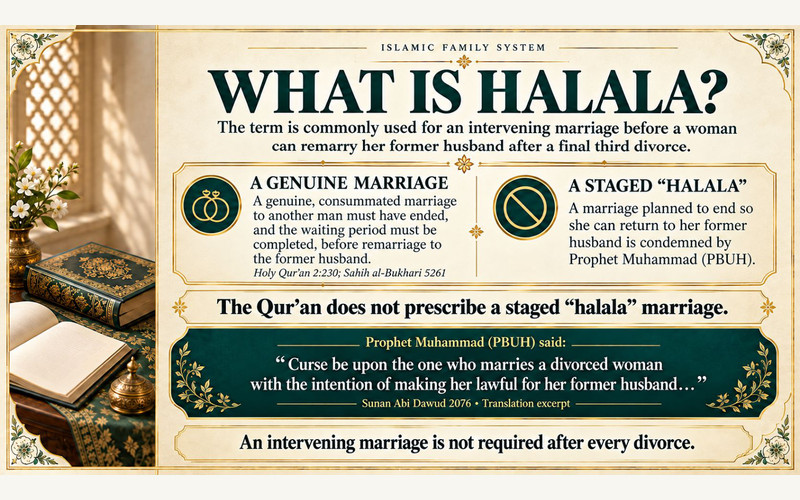
The distinction is fundamental: the Qur’an establishes a condition for remarriage; it does not prescribe a ritual marriage to circumvent that condition. The intervening marriage must be a real marital relationship, not a temporary device designed to reverse the consequences of a final divorce.
The provision therefore places a serious boundary on repeated, final divorce decisions. It does not guarantee reunion, nor does it authorise coercion or the instrumental use of a woman to restore a former marriage. Its legal purpose must be understood within the broader Qur’anic emphasis on
Conclusion: Divorce as accountability, not control
Islamic teachings on divorce bring together several principles: separation is permitted, reconciliation is encouraged where possible, women have avenues to seek release, and financial and parental responsibilities survive the end of a marriage. Triple talaq pronounced in one sitting must be distinguished from the Qur’anic procedure, while khula demonstrates that a woman is not without recourse when a marriage becomes unsustainable.
Likewise, the rule in Qur’an 2:230 must be understood in its proper context. It concerns the consequences of a final third divorce, not a ritual that couples can organise to guarantee reunion. A genuine subsequent marriage is fundamentally different from a pre-arranged halala scheme.
Ultimately, the Islamic ethics of divorce rest on a principle broader than the technical validity of a pronouncement: neither marriage nor its dissolution should become an instrument of humiliation, coercion or injustice. The rights of both spouses, the welfare of children and accountability before Allah remain central, even when the relationship itself has ended.
References
The Qur’an: 2:229–233; 2:231; 4:35; 65:1–6.
Sahih Muslim 1471c — the incident of Ibn Umar (RA) and the prescribed divorce procedure.
Sahih al-Bukhari 5273 — the khula of the wife of Thabit ibn Qays.
Sahih Muslim 1433a — the conditions for remarriage following a final third divorce.
Sunan Abi Dawud 2076 — condemnation of a marriage arranged solely to make a woman lawful for her former husband.