
Spiritual Equality
The Quran repeatedly affirms that men and women are accountable for their faith and deeds. Quran 4:124 states that whoever does righteous deeds, male or female, while believing, will enter Paradise and will not be wronged. See also Quran 16:97 and 33:35.
“For Muslim men and women, believing men and women … Allah has prepared forgiveness and a great reward.” (Quran 33:35; abbreviated quotation).
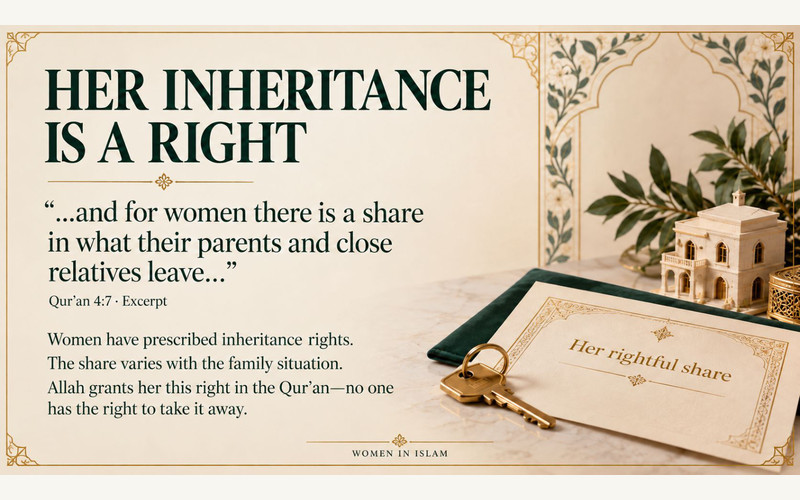
Inheritance (Quran 4:7, 4:11)
Quran 4:7 states that men and women each have a legally determined share of what parents and relatives leave. Quran 4:11 sets out specific shares, including cases in which a son receives the share of two daughters. The applicable share depends on the surviving relatives and circumstances. A woman’s inheritance is her own property and is separate from her mahr or gifts.
Marriage and Guardianship
Quran 4:34 uses the term qawwamun in describing men’s responsibility in relation to women, linking it in the verse to what God has given and to men’s financial spending. Interpretations of this verse differ. It is important to distinguish the verse’s stated financial responsibilities from claims of unrestricted privilege or authority.
The verse also discusses marital discord and has been interpreted in different ways by Muslim scholars. Any public- facing explanation should acknowledge interpretive diversity and the Prophetic model of not harming wives. The verse should not be presented as an endorsement of domestic abuse.
Consent and Equality
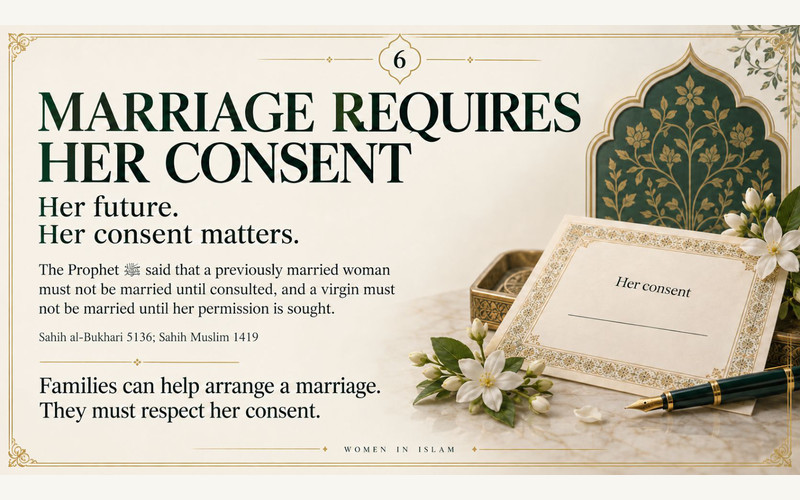
Hadith in Sunan Abi Dawud and other collections state that a previously married woman has more right over her own marriage decision than her guardian, and that a virgin’s permission must be sought. These reports are cited as evidence that a woman’s consent matters in marriage.
A commonly quoted report says, “Seeking knowledge is obligatory upon every Muslim.” The chain and grading of this specific wording have been debated; the broader emphasis on learning is supported by Islamic texts and history. Aisha رضی الل عن ا ہ ہ and Hafsa رضی الل عن ا ہ ہ are among the women remembered for teaching and transmitting knowledge.
Protection of Rights
Quran 4:19 instructs believers to live with women in kindness and prohibits treating women as inheritable property against their will. Quran 2:228 discusses rights and responsibilities in divorce, in a passage that also addresses waiting periods and reconciliation. These texts are interpreted within a wider framework of marital duties and justice.
Quotations and Commentary
Quran 4:7: establishes a determined share of inheritance for women and men. Quran 4:34: addresses family responsibilities and marital discord; interpretations differ, and it should be discussed in context. Jamiʿ at-Tirmidhi 3895: commonly cited for the teaching that the best people are those best to their wives; verify numbering and grading against the edition used. Authentic Hadith in Sahih al-Bukhari and Sahih Muslim repeatedly emphasizes the mother’s special claim to good companionship. The exact wording “Paradise lies at the feet of mothers” should not be attributed to Sahih Muslim without verifying its source.
Facts & Figures
The supplied draft reports Muslim women’s literacy in India as 62.1% and Muslim men’s literacy as 74.8%. Verify the source table, census year and age group before publication.
Common Misunderstandings
Misconception: “Islam relegates women by saying they inherit half of men.” Clarification: inheritance shares differ according to the heirs and circumstances. In some common cases, a son receives twice a daughter’s share; the Quran nevertheless establishes women’s inheritance as a legal right. Explanations often refer to men’s financial obligations, but individual outcomes vary. Misconception: “Quran 4:34 allows wife-beating.” Clarification: interpretations of the verse differ. Prophetic reports discourage harming women, and the Prophet ﷺ is reported not to have struck his wives. The verse should not be used to excuse domestic violence.
Sources and Further Reading
Quran 4:7, 4:11, 4:19, 4:34; Quran 16:97 and 33:35. Jamiʿ at-Tirmidhi, report commonly numbered 3895, on treating wives well; verify numbering and grading. W. Montgomery Watt, Muhammad at Mecca (1984) – verify edition and relevance. Alice Hofstadter, “Righteous Women in Islam” (1997) – bibliographic details should be verified before publication.
Related Articles
Women in Pre-Islamic Arabia (Article 1) Marriage, Divorce and Family (Article 3)
Article 3: Marriage, Divorce and Family – Rights of Women
In Brief
Islamic law sets out rules for marriage and family life that include rights and responsibilities for women. Marriage is a contract requiring consent, and the mahr belongs to the wife. A woman may seek khulʿ or other forms of judicial dissolution under applicable rules. Quran 4:3 permits polygyny subject to justice, while the verse directs that a man who fears he cannot act justly should marry only one. This article outlines rights in marriage, divorce and child custody, while noting differences in jurisprudence and modern law.
Marriage Contract (Nikah)
A nikah is a marriage contract. Its requirements, including consent, offer and acceptance, witnesses and the role of a guardian, are detailed differently across Islamic legal schools. Forced marriage is rejected in Islamic teaching, and Hadith reports require the woman’s permission.
The mahr is a gift owed by the groom to the bride and belongs to her. She may keep or use it as she chooses. Quran 4:4 instructs men to give women their bridal gifts graciously.
Divorce
Islamic law recognizes several routes by which a marriage may end. Talaq is one form of divorce initiated by a husband and is subject to rules and waiting periods. A wife may seek khulʿ or judicial dissolution, including in circumstances such as harm or neglect; the exact grounds and procedures vary by school and legal system.
Financial maintenance, the return or retention of mahr, and post-divorce arrangements depend on the circumstances and applicable law. These should not be presented as identical in every case or jurisdiction.