
Related slides 39–41
Religious life includes relationships
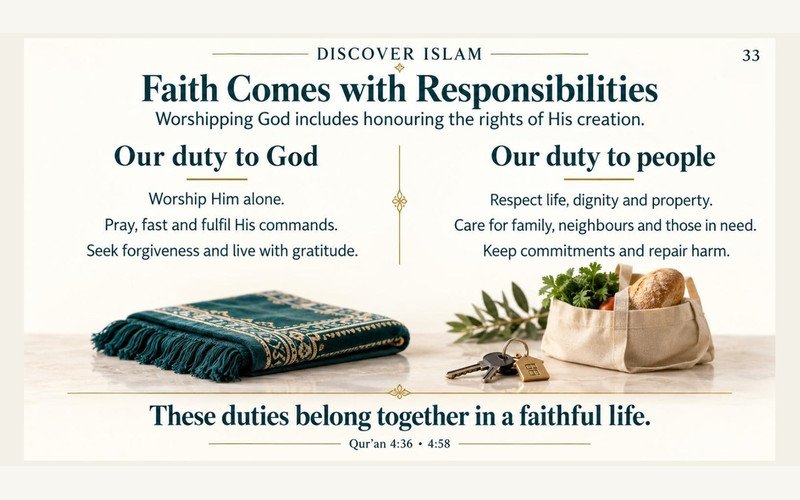
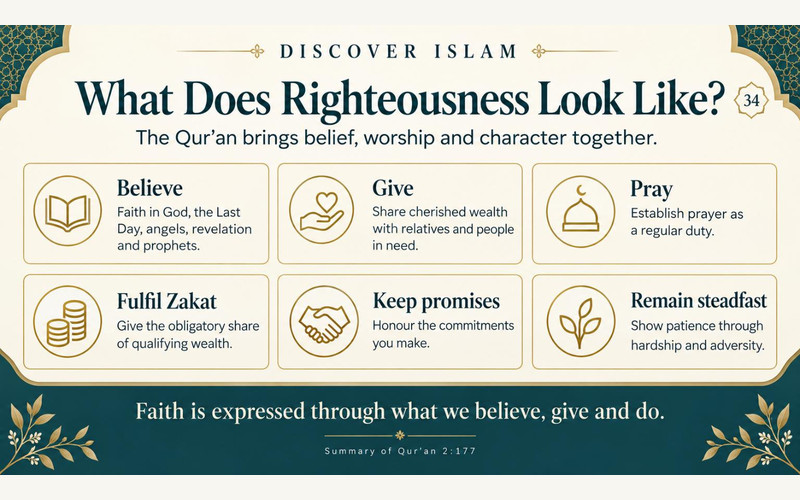
The Qur'an brings worship of God together with care for parents, relatives, orphans, people in need and neighbours. Verse Qur'an 2 : 177 explains righteousness through belief, giving, prayer, keeping commitments and endurance. Religious identity alone is not a complete account of good character.
Can worship cancel wrongdoing
Prophet Muhammad (PBUH) — Sahih Muslim 2581 — describes a person who arrives at judgment with prayer, fasting and zakat, but has abused people, slandered them, taken their wealth or hurt them. The person's good deeds are used to answer those claims; the warning continues to describe the seriousness of unresolved harm. The report connects worship with responsibility towards other people.
Its ethical point is direct. A person cannot treat religious observance as permission to mistreat others. A salary withheld unfairly remains a wrong even if the employer gives generously elsewhere. A harmful accusation remains serious even if its author regularly attends worship.
What repair can involve
Stopping the harm comes first. Repair may mean returning money, correcting false information, compensating for damage or giving someone a fair hearing. Repentance to God and responsibility towards the person harmed belong together. A victim's rights should not be dismissed with advice to be patient or forgiving.
Religious texts sometimes address historical institutions unfamiliar to a modern reader. For example, the full translation of Qur'an 4 : 36 mentions people held in slavery. This reflects the society the text addressed and its duties towards dependent people; it should not be silently edited out or turned into a modern licence to enslave. The article's central point is the connection between devotion and the treatment of other human beings.
Qur’anic verses
Qur'an 4 : 36
Worship God and give Him no partner. Be kind to parents, relatives, orphans, people in need, the neighbour who is close and the neighbour who is distant, the companion at your side, the traveller and those held in your possession as slaves. God does not love the arrogant and boastful.
Context: The slavery reference reflects an institution present in the society addressed by the text. It has been retained openly rather than silently removed. This article does not offer a comprehensive history of slavery or a licence to enslave.
Read the verse and Arabic text
Qur'an 4 : 58
God commands you to return what is entrusted to you to its rightful owners, and to judge fairly when you judge between people. How excellent is the instruction God gives you. God hears everything and sees everything.
Read the verse and Arabic text
Qur'an 2 : 177

Righteousness does not consist merely in turning your faces towards the east or the west. The righteous person believes in God, the Last Day, the angels, the Scripture and the prophets; gives cherished wealth to relatives, orphans, people in need, travellers, those who ask for help and to free people from slavery; establishes prayer and gives zakat. The righteous keep their agreements and remain patient in poverty, hardship and times of conflict. These are the truthful, and these are the people mindful of God.
Read the verse and Arabic text
Hadith
Saying of Prophet Muhammad (PBUH) — Sahih Muslim 2581
Relevant passage — plain-English meaning
A person may arrive at judgment with prayer, fasting and charity, yet have harmed others. Their good deeds are used to compensate those harmed; if exhausted, the victims’ sins are placed on them, and they are cast into the Fire.
Sources: Prophet Muhammad (PBUH) — Sahih Muslim 2581 [11]
Read next: Truthfulness and keeping trust