
Related slides 16–18, 20
The journey described by Islam
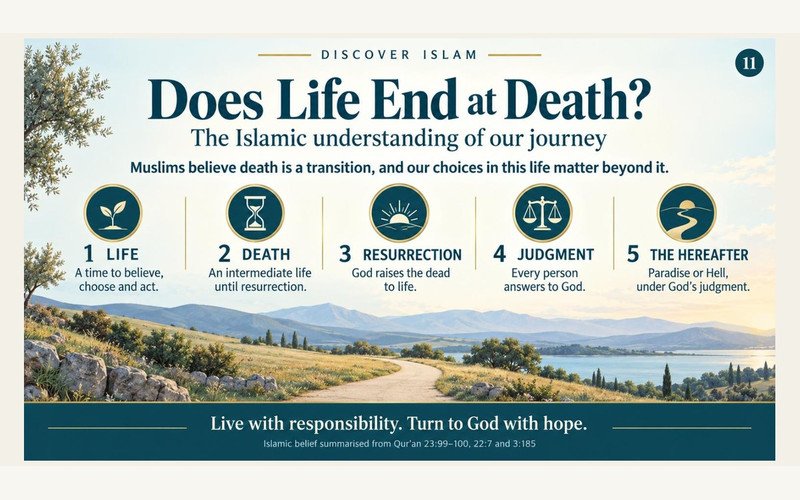
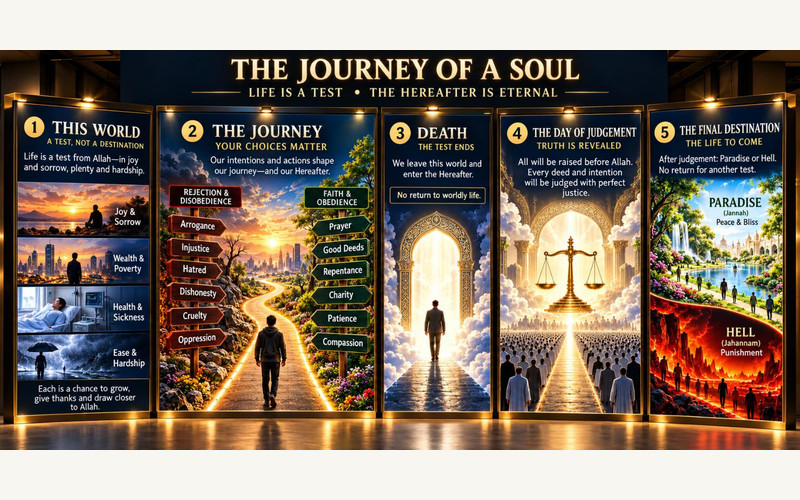
Islam teaches one earthly life, followed by death, an intermediate state, resurrection and judgment. The intermediate state is often called barzakh, a barrier or interval before resurrection. God then raises people and judges them. Paradise and Hell express the seriousness of final reward and accountability. This belief gives lasting importance to how people live and treat others.
Why actions matter
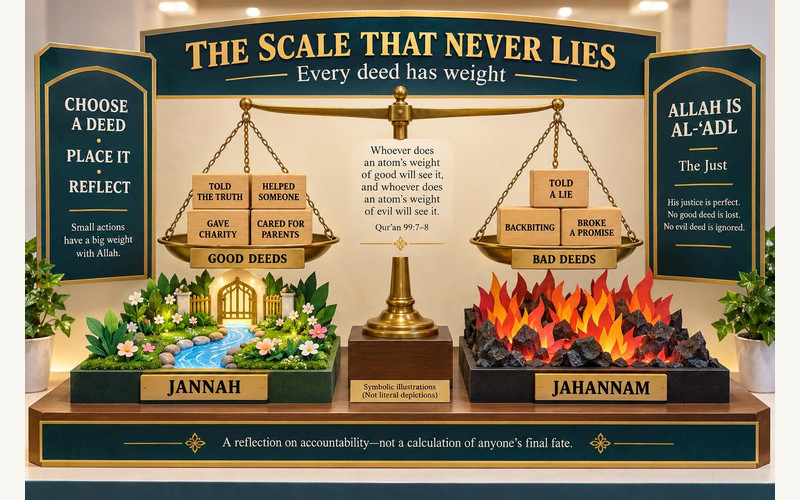
The Qur'an describes people facing a record of what they have done. It says that even an atom's weight of good or evil will be seen. The point is that small acts are not beneath God's knowledge. The unpaid wage, the private act of kindness and the injury no one reported matter.
The teaching also addresses an ordinary concern: many wrongs are never fully answered in this life. Faith in final judgment gives believers hope that injustice will not have the last word. That hope should strengthen efforts to secure justice now, rather than justify waiting passively while people suffer.
Reading the gallery models carefully
The balance model illustrates accountability. It cannot calculate anyone's final fate by adding a few good and bad deeds. Islamic teaching also includes intention, repentance, people's rights and God's mercy. Visitors should not use it to pronounce judgment on named people or communities.
The model's stages are a simplified teaching aid. Its ‘journey’ is the period of choices within earthly life, not a separate revealed stage. Death is followed by the intermediate state before resurrection. Pictures of gates, fire or gardens are illustrative, not eyewitness images of the afterlife.
What the record means
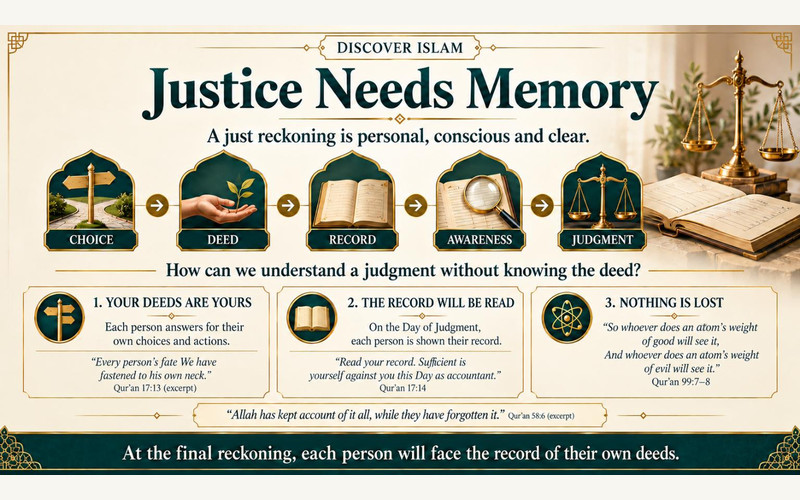
The gallery’s phrase ‘Justice needs memory’ highlights the importance of accountability. The Qur'an teaches that people will be confronted with their deeds even when they have forgotten them. It does not require a claim that ordinary memory survives death unchanged. For a reader outside the faith, the central idea is understandable: each person matters, choices carry responsibility, and final judgment belongs to God.
Qur’anic verses
Qur'an 3 : 185
Every soul will taste death. You will receive your reward in full on the Day of Resurrection. Whoever is kept away from the Fire and admitted to Paradise has truly succeeded. The life of this world is only a deceptive enjoyment.
Read the verse and Arabic text
Qur'an 23 : 99
When death comes to one of them, the person says: My Lord, send me back,
Read the verse and Arabic text
Qur'an 23 : 100
so that I may do good in what I left behind. No! These are only words the person speaks. Beyond them is a barrier until the day they are raised.
Read the verse and Arabic text
Qur'an 22 : 7
The Hour will certainly come; there is no doubt about it. God will raise those who are in the graves.
Read the verse and Arabic text
Qur'an 17 : 13
We have fastened every person's deeds to their own neck. On the Day of Resurrection, We will bring out a record for them that they will find laid open.
Read the verse and Arabic text
Qur'an 17 : 14
Read your record. Today you are enough to call yourself to account.
Read the verse and Arabic text
Qur'an 58 : 6
On the day God raises them all, He will tell them what they did. God kept a record of it while they forgot it. God is witness to everything.
Read the verse and Arabic text
Qur'an 99 : 7
Whoever does an atom's weight of good will see it.
Read the verse and Arabic text
Qur'an 99 : 8
Whoever does an atom's weight of evil will see it.
Read the verse and Arabic text
Hadith
Saying of Prophet Muhammad (PBUH) — Sahih Muslim 2581
Relevant passage — plain-English meaning
A person may arrive at judgment with prayer, fasting and charity, yet have harmed others. Their good deeds are used to compensate those harmed; if exhausted, the victims’ sins are placed on them, and they are cast into the Fire.
Sources: Prophet Muhammad (PBUH) — Sahih Muslim 2581 [11]
Read next: Responding to suffering without blaming the sufferer