
Related slides 58–59
Diversity and shared human dignity
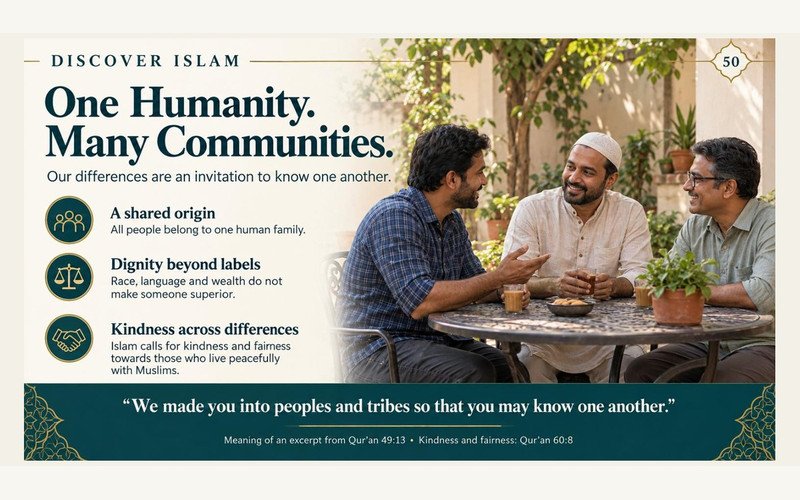
Qur'an 49 : 13 addresses humanity and describes peoples and tribes as an opportunity to know one another. It rejects inherited status as the measure of worth before God. This does not mean that religions have no differences. It means that difference need not prevent respectful relationships or become a reason for contempt.
Kindness across religious difference
Qur'an 60 : 8 permits and encourages kindness and justice towards people who have not fought Muslims because of their religion or driven them from their homes. The verse belongs to a context of conflict and helps distinguish hostile action from religious difference itself. It cannot fairly be reduced to a claim that kindness is reserved for Muslims.
In an Indian neighbourhood, the principle can be expressed through everyday reliability: checking on an elderly neighbour, responding fairly to a dispute or helping during an emergency. Such actions do not require people to hide their beliefs or pretend agreement.
Faith and freedom of thought
Qur'an 2 : 256 states that there is no compulsion in religion. The full verse also expresses a religious judgment about truth and error. Respecting a reader's freedom does not require removing those convictions from a faithful translation. At the same time, one verse should not be presented as a complete description of every historical Muslim state's practice. Teachings, interpretations and conduct must each be examined honestly.
An invitation to keep asking
The exhibition offers an introduction, not an answer to every question about Islam. A visitor might leave with one clarified term, one assumption reconsidered or a new question about a teaching. Understanding need not result in conversion or agreement.
A useful conversation asks about the specific belief or action being discussed and listens to the answer. It avoids making an entire community responsible for an individual's wrongdoing. Shared life becomes more trustworthy when people can explain their convictions clearly, acknowledge mistakes and treat one another fairly.
Qur’anic verses
Qur'an 49 : 13
People, We created you from a male and a female and made you into peoples and tribes so that you may know one another. The most honoured of you before God is the one most mindful of Him. God knows everything and is fully aware.
Context: Moral standing before God cannot be reliably measured from someone’s wealth, name, clothing or community label.
Read the verse and Arabic text
Qur'an 60 : 8
God does not forbid you to be kind and fair towards those who have not fought you because of religion or driven you from your homes. God loves those who act justly.
Read the verse and Arabic text
Qur'an 2 : 256
There is no compulsion in religion. The right way has become clear from error. Whoever rejects false objects of worship and believes in God has grasped the strongest handhold, which will never break. God hears everything and knows everything.
Read the verse and Arabic text
Read next: Understanding Islam for the first time