
Related slides 52
A check against specified religious requirements
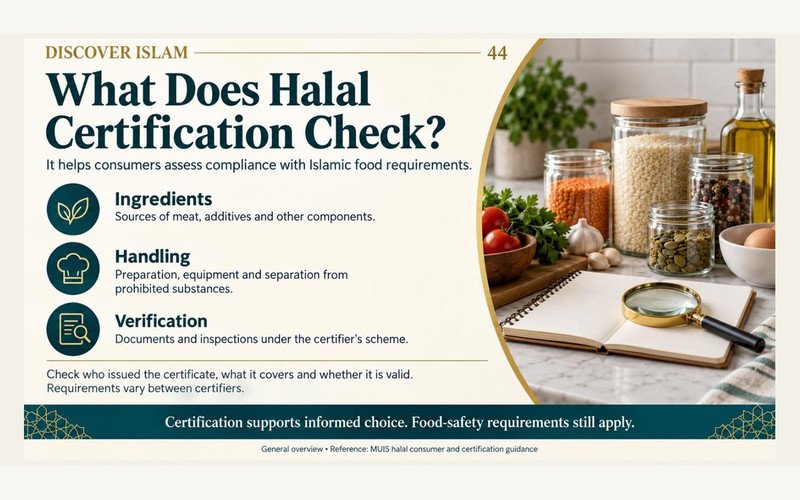
Halal certification is a process through which a certifying organisation assesses whether a product or process meets the requirements of its scheme. Depending on the product, checks may include ingredients, animal sources, processing aids, preparation, storage and separation from prohibited substances. Documents and inspections form part of the assessment.
What a label does and does not tell you
A label is useful only when its issuer, scope and validity are clear. A certificate for one product does not necessarily cover everything made by the company. Different schemes can have different requirements, and a certificate can expire.
Halal certification is not a substitute for food-safety controls, accurate ingredient declarations or other applicable requirements. It also does not certify that a product is vegetarian, environmentally sustainable or nutritionally superior. These are separate questions requiring separate information.
The Indian context
The Quality Council of India describes an India Conformity Assessment Scheme for halal meat and meat products for exports, with certification bodies accredited through NABCB. This is a specific export framework. It should not be described as proof that every halal label in every Indian shop has identical official status. Domestic requirements and restrictions need to be checked for the relevant place and product.
For a consumer, the straightforward questions are: who issued the certificate, what exactly does it cover, and is it valid? For a manufacturer, responding accurately to these questions supports informed choice. A food label does not change a buyer's religion. Questions about a particular certifier's conduct or finances should be investigated on evidence rather than inferred from the word halal alone.
Sources: QCI halal scheme [33]; MUIS consumers [34]; MUIS certification [35]