
Related slides 25–26
A rhythm of remembrance
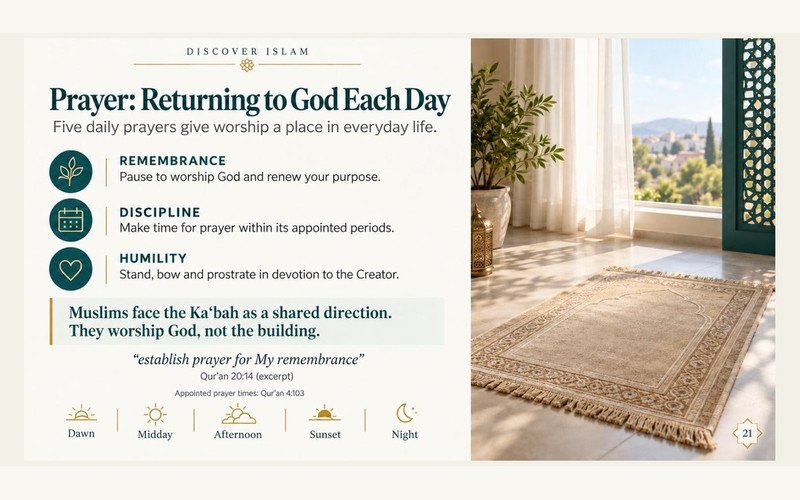
Salah is the prescribed form of Muslim prayer, commonly called namaz in India. Its five daily periods are dawn, midday, afternoon, sunset and night. Prayer includes recitation, standing, bowing and prostration, with adaptations for people who cannot perform the usual movements. Muslims understand it as worship of God and a regular return to life's deeper purpose.
Direction and preparation
Worshippers face the Ka'bah in Makkah. This direction is called the qiblah. Facing the same point expresses a shared direction; it does not make the building an object of worship. Someone in India may face westward or north-westward depending on location, but the precise direction is towards Makkah rather than simply towards the west.
Before prayer, Muslims observe requirements of cleanliness and ritual purification. Wudu is the usual washing preparation, involving parts of the face and limbs. The Qur'an's verse Qur'an 5 : 6 also describes alternatives when water cannot be used or found under the relevant conditions. The purpose is religious preparation; ritual purity is not a claim that other people are dirty.
Why repeat it throughout the day
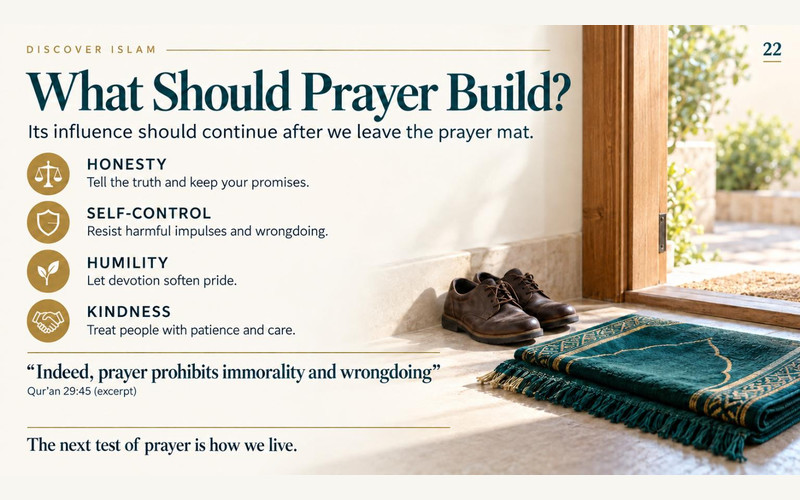
Regular prayer interrupts the assumption that work, money or entertainment should occupy every moment. It can help a person practise attention and humility. The Qur'an connects prayer with remembrance and restraint from wrongdoing. These are religious purposes, not a claim that every person who prays behaves well.
The practical question is what happens afterwards. Does the worshipper return a borrowed item, speak honestly or treat a worker with respect? Prayer and ethical responsibility belong together. A dishonest worshipper's behaviour can rightly be criticised without pretending that dishonesty is what prayer teaches. Personal requests to God can also be made outside these five prayers, in one's own words.
Qur’anic verses
Qur'an 20 : 14
I am God. There is no deity worthy of worship except Me. So worship Me and establish prayer to remember Me.
Context: The speaker addresses Moses in the surrounding account. The statement is relevant to worship and remembrance beyond that setting.
Read the verse and Arabic text
Qur'an 4 : 103
When you have completed prayer, remember God while standing, sitting or lying down. When you are secure, establish regular prayer. Prayer has been prescribed for believers at fixed times.
Context: The surrounding passage discusses prayer amid danger. The final statement establishes appointed prayer times; it does not itself list all five by name.
Read the verse and Arabic text
Qur'an 29 : 45
Recite what has been revealed to you from the Book, and establish prayer. Prayer restrains shameful behaviour and wrongdoing. Remembering God is greater still. God knows what you do.
Read the verse and Arabic text
Qur'an 2 : 144
We have seen you turn your face towards heaven. We will now turn you towards a prayer direction that pleases you. So turn your face towards the Sacred Mosque. Wherever you are, turn your faces towards it. Those who received the Scripture know that this is the truth from their Lord. God is fully aware of what they do.
Read the verse and Arabic text
Qur'an 5 : 6
You who believe, when you prepare for prayer, wash your faces and your arms up to the elbows, wipe your heads and wash your feet up to the ankles. If you are in a state requiring a full ritual bath, purify yourselves. If you are ill or travelling, or have relieved yourselves, or have had contact with women, and cannot find water, use clean earth and wipe your faces and hands with it. God does not wish to place you in difficulty. He wishes to purify you and complete His favour upon you so that you may be thankful.
Read the verse and Arabic text
Hadith
Saying of Prophet Muhammad (PBUH) — Sahih al-Bukhari 8
Plain-English meaning
Islam rests on five foundations: declaring that only God deserves worship and Muhammad is His messenger; maintaining prayer; giving zakat; performing Hajj; and fasting in Ramadan.
Sources: Prophet Muhammad (PBUH) — Sahih al-Bukhari 8 [5]
Read next: Where Muslims pray and why public consideration matters