
Related slides 32–33
A duty rather than an optional gift
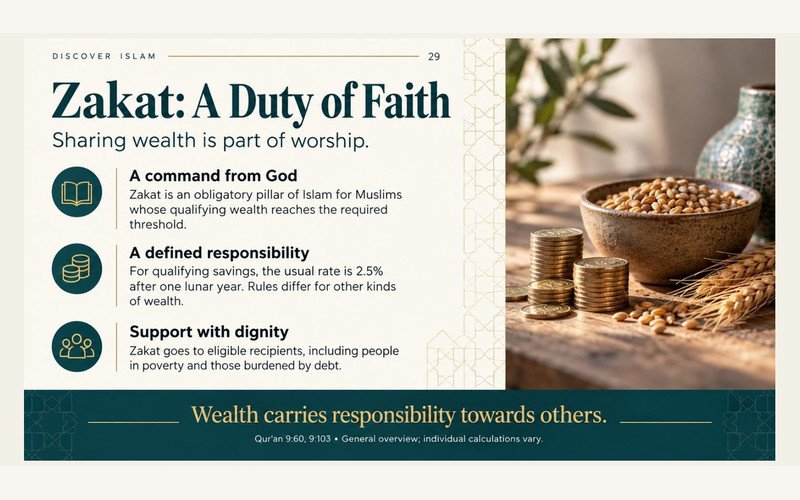
Zakat is obligatory giving from qualifying wealth to specified recipients. It is one of Islam's five pillars. Its religious purpose includes recognising responsibility towards people in need and resisting the idea that wealth carries no duties. It is required of Muslims who meet its conditions, not of non-Muslim visitors.
How the amount is understood
For qualifying money and savings, the usual rate is 2.5% after the relevant lunar-year condition is met. The minimum threshold is called the nisab. It is linked to measures of gold or silver, whose monetary value changes. Rules for agricultural produce, livestock and other assets differ. It would therefore be inaccurate to say that every Muslim gives 2.5% of every kind of income or of everything they own.
Who receives it
Qur'an 9 : 60 lists eight recipient categories, including people in poverty, people in need, administrators, those whose hearts are to be reconciled, freeing people from bondage, people in debt, God's cause and stranded travellers. Zakat is not an unrestricted fund for any project described as good.
Many mainstream rulings direct the ordinary poor-and-needy allocation to Muslims. Voluntary charity, called sadaqah, has a wider scope and can help non-Muslims. It is more honest to explain this distinction than to imply that every zakat programme serves everyone on identical terms.
Relief with dignity
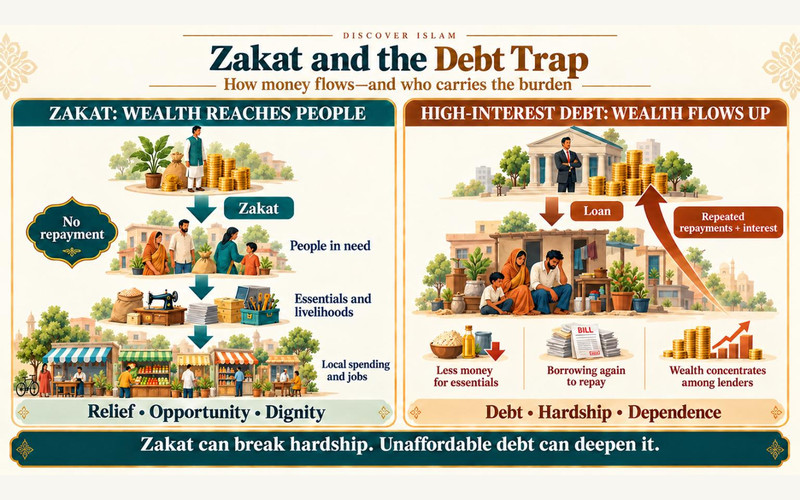
An eligible recipient does not repay zakat as a loan. It may help meet an urgent need or support a livelihood, depending on the programme and religious rules. Its effectiveness depends on fair selection, responsible administration and local conditions. It can reduce hardship without being presented as a guaranteed solution to poverty.
Qur’anic verses
Qur'an 9 : 60
Zakat is for the poor, the needy, those who administer it, those whose hearts are to be reconciled, freeing people from bondage, those in debt, God's cause and the stranded traveller. This is a duty laid down by God. God knows everything and is Wise.
Read the verse and Arabic text
Qur'an 9 : 103
Take charity from their wealth to cleanse and purify them through it, and pray for them. Your prayer brings them reassurance. God hears everything and knows everything.
Read the verse and Arabic text
Sources: Zakat guidance [19]; Zakat recipients [20]
Read next: Zakat in action in India