
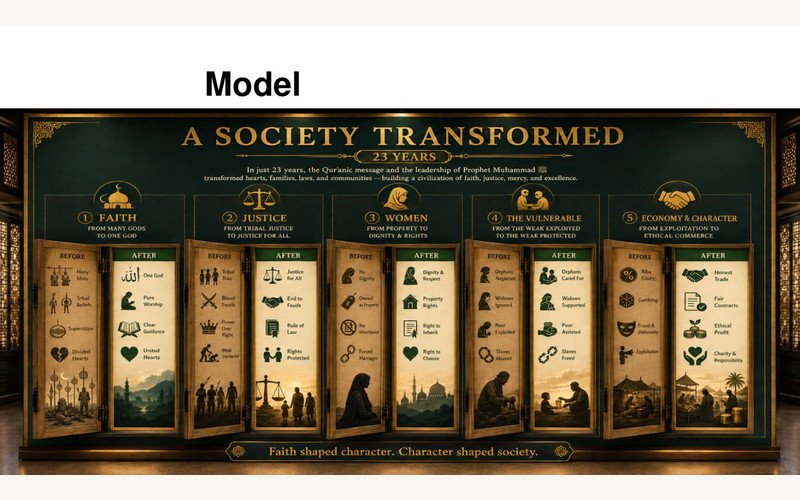
| IN BRIEF The gallery shows five areas of change in the twenty-three years of the Prophet’s mission: from many gods to one, from tribal justice to law for all, from denial of women’s dignity to recognised rights, from exploitation of the weak to their protection, and from exploitative dealings to ethical trade. The Qur’an and hadith record concrete reforms in each area, from inheritance shares for women to the prohibition of interest. |
|---|
Detailed Story
Faith: one God
The Qur’an’s core demand was tawhid. By the end of the Prophet’s life most of the Arabian Peninsula had accepted his leadership, with delegations arriving in 630–631 (the “Year of Delegations”). Jews and Christians who kept their faith were given treaty protection (for example, the covenant with the Christians of Najran).
Justice: from feud to law
In the Arabian system, justice depended on kin: harm to one tribesman called for revenge on another group, sometimes leading to long wars. The Qur’an regulates retaliation and encourages forgiveness (2:178–179; 42:40). In the Farewell Sermon the Prophet ﷺ cancelled pre-Islamic blood claims. Justice before a common law became an ideal.
Women: rights in property, marriage and inheritance
The Qur’an gave women a share of inheritance (4:7, 4:11–12), required the dower to be paid to the bride herself (4:4), and forbade inheriting women against their will (4:19). Hadith require a woman’s consent in marriage (Sahih al-Bukhari 5136). The Qur’an condemned burying infant girls (81:8–9; 16:58–59).
Women of Makkah were not without standing: Khadijah ran a trading business, and Hind bint ‘Utba held social authority. The Qur’an built on such dignity and gave women legally protected rights of inheritance and dower.
The vulnerable: orphans, widows, the poor and the enslaved
The Qur’an warns repeatedly against consuming orphans’ property (4:2, 4:10) and makes charity a duty (zakat, 9:60). It encourages freeing slaves as an act of piety (90:13; 24:33) and as expiation (4:92), and counts freeing slaves among the uses of zakat (9:60). The Prophet ﷺ said of those under one’s authority, “They are your brothers; God has placed them under your hands” (Sahih al-Bukhari 30), honoured freed men such as Bilal and Zayd, and freed many himself.
The economy: from exploitation to ethics
Interest (riba) was prohibited (2:275–279), gambling forbidden (5:90) and fair weights commanded (83:1–3). The Qur’an’s longest verse (2:282) orders that debts be written down and witnessed. The Prophet ﷺ is reported to have said that one who cheats is not one of us (Sahih Muslim 101). Zakat is a wealth-based charity, traditionally 2.5% of qualifying savings annually.
How to read “before and after”
Faith shaped character, and character shaped society. Within twenty-three years the Prophet’s teaching had introduced new rights and protections, especially for orphans, women and the poor, and these remain living obligations for Muslims today.
| FACTS & FIGURES Zakat: traditionally 2.5% of qualifying wealth held for a lunar year. Qur’an 90:13, 24:33, 4:92 and 9:60 repeatedly encourage freeing slaves. The Qur’an’s longest verse is 2:282, on written contracts. By 632 CE most of the Arabian Peninsula accepted the Prophet’s leadership. |
|---|
| IMPORTANT DISTINCTION: Rights rooted in revelation, not in custom The rights described in this article, such as women’s inheritance, the protection of orphans and fair trade, come from the Qur’an and the Sunnah and not from tribal custom. They were given by God and bind every Muslim community. |
|---|
Related Topics
• Article 5: The Mission of the Prophet: One God, Justice, Mercy and Moral Character
• Article 10: The Charter of Madinah: Pluralism, Citizenship and Coexistence
• Article 20: The Farewell Sermon: A Charter of Human Dignity
Sources & Further Reading
• Qur’an 2:178–179, 2:275–282, 4:2–4, 4:7, 4:11–12, 4:19, 4:92, 5:90, 9:60, 16:58–59, 24:33, 81:8–9, 83:1–3, 90:13. https://quran.com
• Sahih al-Bukhari 5136 (consent in marriage). https://sunnah.com/bukhari:5136
• Sahih Muslim 101 (honesty in trade). https://sunnah.com/muslim:101
• Barbara Freyer Stowasser, Women in the Qur’an, Traditions, and Interpretation (Oxford University Press, 1994).
• Jonathan A. C. Brown, Slavery and Islam (Oneworld, 2019).
• Mahmoud A. El-Gamal, Islamic Finance: Law, Economics, and Practice (Cambridge University Press, 2006).
• Mohammad Hashim Kamali, Freedom, Equality and Justice in Islam (Islamic Texts Society, 2002).
Theme 4: The Prophet’s Household
Family life, the marriages and the scholarship of Hazrat A’ishah (RA).