
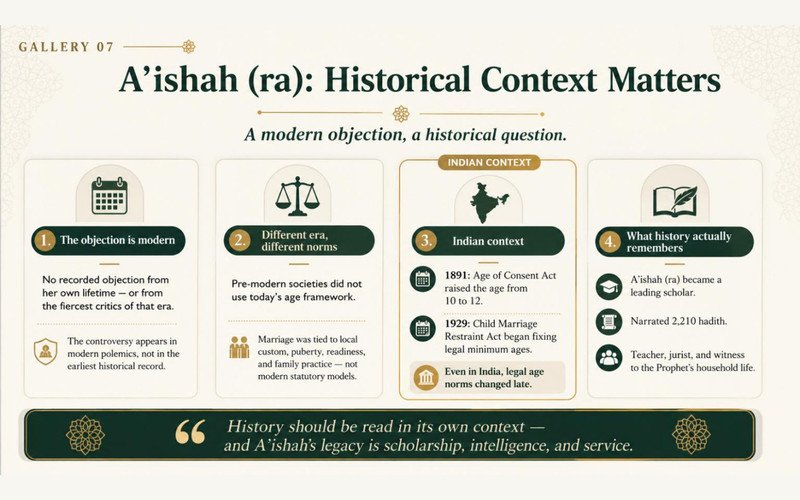
| IN BRIEF A’ishah (RA) bint Abi Bakr (RA) was the beloved wife of the Prophet ﷺ, one of the greatest scholars of the early community and a teacher of its jurists. Authentic reports in Bukhari and Muslim describe her marriage contract and her move to the Prophet’s ﷺ home in Madinah. A’ishah (RA) herself remembered her marriage with gratitude, and her knowledge, memory and judgement shaped Islamic learning for centuries. |
|---|
Detailed Story
Who she was
A’ishah (RA) (c. 614–678 CE), daughter of Abu Bakr (RA), grew up in a Muslim household and became known for her memory, eloquence and judgement. She is credited with 2,210 hadith, of which about 174 are agreed upon by Bukhari and Muslim. Prominent successors such as Urwa ibn al-Zubayr learned from her, and senior Companions came to her with questions of law and of the Prophet’s ﷺ practice.
The marriage
Sahih al-Bukhari (3894, 5133–5134) and Sahih Muslim (1422) report that the marriage was contracted when she was young and that she joined the Prophet’s ﷺ household in Madinah some years later. Marriage at an early age was customary in seventh-century Arabia and in societies across the world. The Quraysh, who opposed the Prophet ﷺ on every other matter, never raised any objection to it, and A’ishah (RA) herself recalled the marriage with pride, asking which of the Prophet’s ﷺ wives was more favoured by him than she (Sahih Muslim 1423).
The Prophet’s ﷺ love for her
When ‘Amr ibn al-‘As asked the Prophet ﷺ which person was dearest to him, he answered, “A’ishah” (Sahih al-Bukhari 3662; Sahih Muslim 2384). She was the only wife in whose home revelation came while the Prophet ﷺ was beside her under one blanket, as she reported, and he spent his final illness in her room, where he died and was buried.
Teacher of the community
Our scholars regard A’ishah (RA) as one of the foremost jurists among the Companions. Her narrations on prayer, purification, marriage, inheritance and the Prophet’s ﷺ private conduct are indispensable to Islamic law. She also corrected statements made by other Companions, and the later scholar al-Zarkashi (d. 1392) compiled these corrections in a dedicated work. Mohammad Akram Nadwi’s Al-Muhaddithat and Shibli Nomani and Sulaiman Nadwi’s Sirat-un-Nabi honour her place among the women scholars of Islam.
A role beyond the home
After the Prophet’s ﷺ death, A’ishah (RA) remained a teacher of the Muslim community in Madinah for almost half a century. Students travelled from distant lands to learn from her, and her house became a school. Denise Spellberg’s study of her legacy shows how deeply her memory has shaped Muslim culture.
Her legacy
A’ishah’s (RA) legacy is one of knowledge. She was a jurist, teacher and narrator of the Prophet’s ﷺ life, and the scholarly tradition she founded stands as proof of the dignity and learning that Islam gave to women from its earliest days.
| FACTS & FIGURES 2,210 hadith narrated; about 174 agreed on by Bukhari and Muslim. Died 58 AH (678 CE) in Madinah and was buried in al-Baqi‘. The Prophet ﷺ named A’ishah (RA) as the person dearest to him (Sahih al-Bukhari 3662). The Prophet ﷺ died in her room on 8 June 632 and was buried there. |
|---|
| IMPORTANT DISTINCTION: A scholar and teacher, not only a wife A’ishah (RA) is remembered above all as a jurist and teacher who instructed the Companions and successors. A large part of what we know about the Prophet’s ﷺ private life and worship comes from her. |
|---|
Related Topics
• Article 13: The Prophet’s Marriages: Purposes and Wisdom
• Article 12: The Prophet at Home: Family Life and Everyday Character
• Article 11: A Society Transformed: What Changed in Twenty-Three Years?
Sources & Further Reading
• Sahih al-Bukhari 3662, 3894, 5133–5134. https://sunnah.com/bukhari:3662
• Sahih Muslim 1422, 1423, 2384. https://sunnah.com/muslim:1423
• Mohammad Akram Nadwi, Al-Muhaddithat: The Women Scholars in Islam (Interface Publications, 2007).
• Shibli Nomani and Sulaiman Nadwi, Sirat-un-Nabi (Dar al-Musannifin, Azamgarh; English translation, Kitab Bhavan, New Delhi).
• Ibn Hajar al-‘Asqalani, Fath al-Bari bi-Sharh Sahih al-Bukhari (15th century).
• Badr al-Din al-Zarkashi, al-Ijaba li-Irad ma Istadrakathu ‘A’isha ‘ala al-Sahaba (14th century).
• Denise A. Spellberg, Politics, Gender, and the Islamic Past: The Legacy of ‘A’isha bint Abi Bakr (Columbia University Press, 1994).
Theme 5: War, Peace and Mercy
The conflicts after the Hijrah, the Islamic ethics of conflict, prisoners, the conquest of Makkah and the question of casualties.