
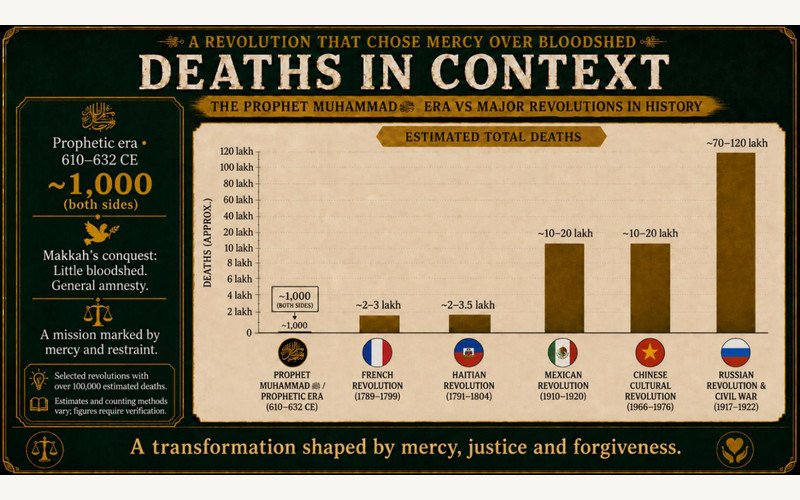
| IN BRIEF The gallery compares the roughly 1,000 battle deaths of the Prophetic era with the far higher tolls of major revolutions. The figure is a widely cited total of reported deaths on both sides in the Prophet’s ﷺ battles and expeditions, and it shows how restrained the fighting was compared with later upheavals. |
|---|
Detailed Story
Where the figure comes from
The figure of 1,018 deaths, 259 Muslims and 759 opponents, is a widely cited total obtained by adding the casualty figures that the classical sira literature gives for each battle and expedition. Estimates run from about 900 to 1,600 depending on which expeditions are counted: in every case, about a thousand or so deaths across twenty-two years.
What the figure leaves out
• Judgment on the Banu Qurayza: The Banu Qurayza, a Jewish clan of Madinah, broke their covenant with the Prophet ﷺ and sided with the besieging armies at the Trench in 627. After the siege they accepted the arbitration of Sa‘d ibn Mu‘adh, their own former ally, who ruled that their fighting men be executed, a ruling the Prophet ﷺ is reported to have said accorded with God’s judgment (Sahih al-Bukhari 3043). Ibn Ishaq gives figures of about 600–900, so counting them the total would exceed 1,000. Our scholars explain the sentence as the penalty for treason in wartime, imposed by an arbiter the tribe itself had accepted.
• Events after 632: The wars of the Ridda (632–633) and later conquests belong to a later period.
• Non-battle deaths: Civilian deaths from famine or disease are not counted in either column.
Comparing with revolutions
The gallery’s chart contrasts the Prophetic era with five episodes. Commonly cited scholarly estimates are shown below. One lakh is 100,000; ten lakh is one million.
| Episode | Commonly cited estimate | Basis |
|---|---|---|
| Prophetic era (610–632) | c. 1,000 (900–1,600) | Reported battle deaths on both sides; Qurayza judgment discussed above |
| French Revolution (1789–99) | c. 2–3 lakh | Terror c. 17,000 sentenced (Greer 1935); Vendée figures range from c. 117,000 to 250,000; excludes foreign wars |
| Haitian Revolution (1791–1804) | c. 1–3.5 lakh | Estimates vary with inclusion of disease deaths among soldiers |
| Mexican Revolution (1910–20) | c. 10–20 lakh | Includes disease and famine; Alan Knight gives about one million |
| Chinese Cultural Revolution (1966–76) | c. 10–16 lakh | Walder estimates 1.1–1.6 million (2014) |
| Russian Revolution and Civil War (1917–22) | c. 70–120 lakh | Includes famine and epidemic deaths; range 5–12 million |
How to read the comparison
The comparison shows how small and restrained the fighting of the Prophetic era was. Seventh-century Arabia was sparsely populated and the Prophet’s ﷺ army fought by strict rules, while the modern revolutions listed here unleashed violence on an industrial scale. The gallery rightly presents these figures as estimates.
| FACTS & FIGURES Widely cited modern tally: 1,018 deaths, 259 Muslims and 759 opponents, in the Prophet’s ﷺ battles and expeditions. Banu Qurayza (627): traditional accounts give about 600–900 men executed after the judgment of Sa‘d ibn Mu‘adh. Cultural Revolution: Walder (2014) estimates 1.1–1.6 million deaths; Walder and Su (2003) estimate 0.75–1.5 million in the countryside. 1 lakh = 100,000; 10 lakh = 1 million. |
|---|
| IMPORTANT DISTINCTION: Battle deaths and the judgment on Qurayza The figure of about 1,000 counts deaths in battle. The separate judgment on the Banu Qurayza is explained above as a wartime penalty for treason. |
|---|
Related Topics
• Article 15: Hostility After the Hijrah: Badr, Uhud, the Trench and Hudaybiyyah
• Article 17: Prisoners of War: Dignity, Release and Ransom
• Article 18: The Conquest of Makkah and the General Amnesty
Sources & Further Reading
• Ibn Hisham / Ibn Ishaq, The Life of Muhammad, trans. A. Guillaume (Oxford, 1955), pp. 461–466.
• Andrew G. Walder, “Rebellion and Repression in China, 1966–1971”, Social Science History 38 (2014). https://fsi.stanford.edu/node/27939
• Andrew G. Walder and Yang Su, “The Cultural Revolution in the Countryside”, The China Quarterly 173 (2003), 74–99. https://doi.org/10.1017/S0009443903000068
• Donald Greer, The Incidence of the Terror during the French Revolution (Harvard University Press, 1935).
• Alan Knight, The Mexican Revolution (Cambridge University Press, 1986).
• Philippe Girard, The Slaves Who Defeated Napoleon (University of Alabama Press, 2011).
• Orlando Figes, A People’s Tragedy: The Russian Revolution 1891–1924 (Jonathan Cape, 1996).
• Safiur Rahman al-Mubarakpuri, The Sealed Nectar (Ar-Raheeq Al-Makhtum) (Darussalam, 1996).
• Ibn Kathir, The Life of the Prophet Muhammad (al-Sira al-Nabawiyya), trans. Trevor Le Gassick (Garnet Publishing, 1998–2000).
Theme 6: The Final Message and Personal Example
The Farewell Sermon and the Prophet’s way of life.