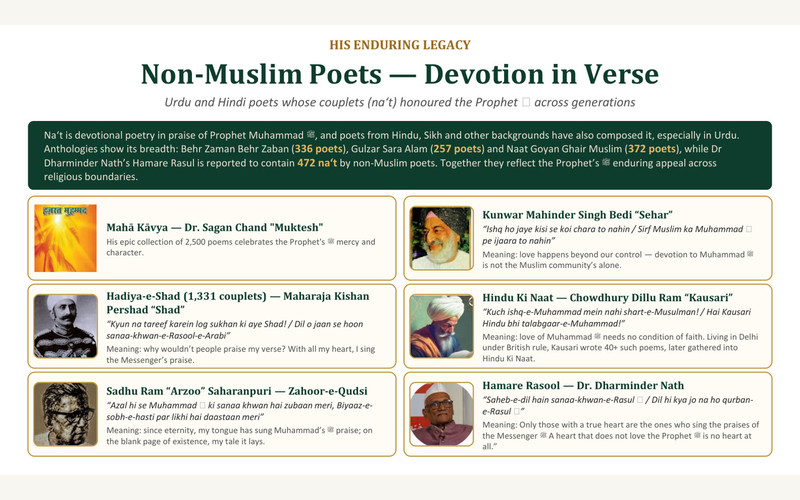
| IN BRIEF Na‘t is devotional poetry in praise of Prophet Muhammad ﷺ. In the Indian subcontinent, large number of poets from Hindu, Sikh and other backgrounds have also composed na‘t, especially in Urdu, among them Maharaja Kishen Pershad “Shad” of Hyderabad, Firaq Gorakhpuri and Kunwar Mahender Singh Bedi “Sahar”. The breadth of this tradition is reflected in anthologies such as Behr Zaman Behr Zaban (336 poets), Gulzar Sara Alam (257 poets) and Naat Goyan Ghair Muslim (372 poets) Hamare Rasul, by Dr Dharminder Nath, is reported to contain 472 na‘t by non-Muslim poets. These collections preserve a remarkable body of poetry that reflects the Prophet’s ﷺ enduring appeal across religious boundaries and forms a distinctive part of the subcontinent’s shared literary heritage. |
|---|
Detailed Story
What is na‘t?
Na‘t (from Arabic, “description”) is poetry in praise of the Prophet ﷺ. Its origins are linked to early poets such as Hassan ibn Thabit and Ka‘b ibn Zuhayr, who recited before him. In South Asia it became a major genre in Persian and Urdu, from Amir Khusrau onward, and is traditionally performed at religious gatherings and at the opening of mushairas.
Poets beyond the Muslim community
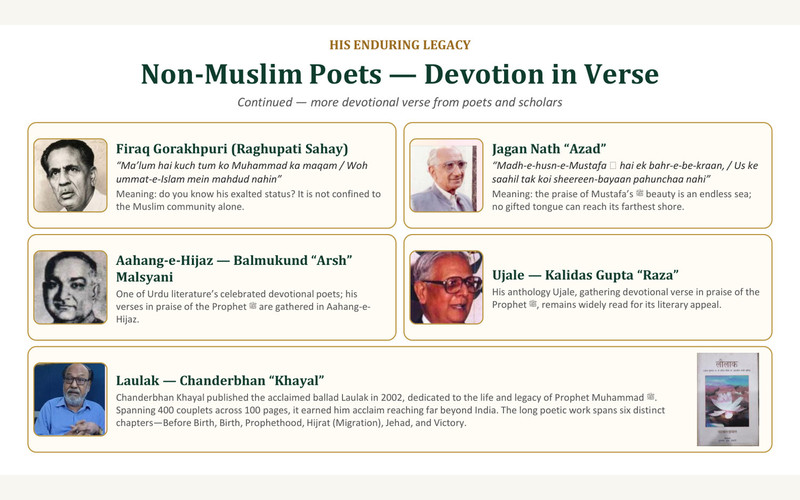
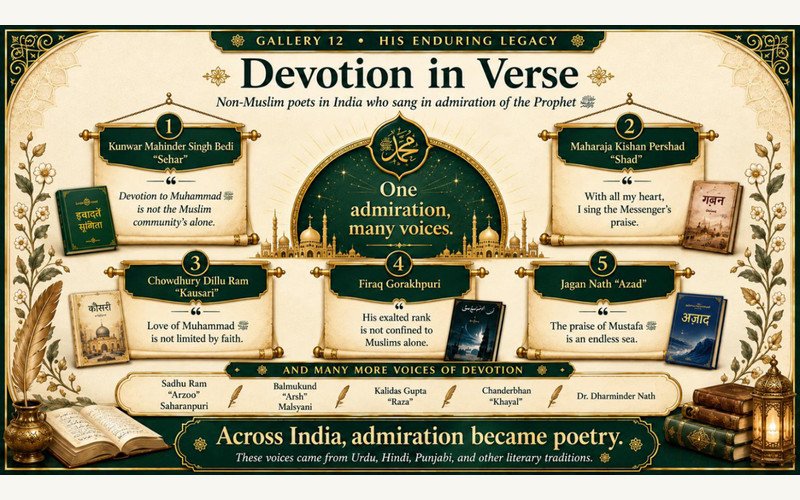
In India, poets from other faiths also wrote na‘t in Urdu, a language of shared literary culture. A Selçuk University study notes that this practice is very common in the Indian peninsula compared with other regions, and attributes it to admiration for the Prophet’s ﷺ character as well as cultural and political circumstances. Examples named in the exhibition include Maharaja Kishen Pershad “Shad” (1864–1940), Firaq Gorakhpuri (1896–1982), Sadhu Ram “Arzoo” Saharanpuri, Balmukund “Arsh” Malsiyani, Kalidas Gupta “Raza”, Chanderbhan “Khayal” and Kunwar Mahender Singh Bedi “Sahar”. Their verses speak of a devotion to the Prophet ﷺ that is not limited to one community.
The Hyderabad link
Kishen Pershad, who served twice as Prime Minister of the Nizam’s Hyderabad State, was a poet in Urdu and Persian, a pupil of Dagh Dehlvi, and is remembered for na‘t verse. His career illustrates the cultural pluralism of the Deccan under Asaf Jahi rule.
Anthologies
A modern collection, Hamare Rasul, compiled by Dr Dharminder Nath, is reported to contain 472 na‘t by non-Muslim poets. Another compilation by Abdul Mannan Tarazi is reported to gather the work of 372 such poets. These counts come from secondary writing and should be treated as reported figures. A 2022 Frontline report described a mushaira in which only Hindu poets were invited to recite in praise of the Prophet ﷺ, and noted poets such as Uddhav Mahajan “Bismil” of Pune, whose collection of 54 na‘t, Muhammad Sab Ke Liye, won an award from the Uttar Pradesh Urdu Akademi.
A shared devotion
The poets generally remained within their own faiths, writing as admirers, and many used Muslim idioms of reverence. Their verses are cherished in Urdu literature as a sign of the Prophet’s ﷺ universal appeal.
Why it matters
This poetic tradition shows that the Prophet’s ﷺ figure has been part of India’s shared literary and cultural life. It does not mean that all Indians share a single view of him, but it records an important and often overlooked dimension of Indian composite culture.
| FACTS & FIGURES Hamare Rasul (Dharminder Nath): reported 472 na‘t by non-Muslim poets. Naat Goyan Ghair Muslim (Abdul Mannan Tarazi): reported 372 poets. Kishen Pershad (1864–1940): Prime Minister of Hyderabad State in 1901–1912 and 1926–1937. Firaq Gorakhpuri (Raghupati Sahay) received the Jnanpith Award in 1969. |
|---|
| IMPORTANT DISTINCTION: Devotional poetry ≠ religious conversion Writing na‘t does not imply that a poet adopted Islam; these poets wrote as admirers of the Prophet’s ﷺ character. |
|---|
Related Topics
• Article 22: Prophet Muhammad in Indian Hearts: Scholars, Reformers and Writers
• Article 24: Western Scholars and Writers on the Prophet: What They Said and How to Read It
• Article 1: Prophet Muhammad: A Life at a Glance
Sources & Further Reading
• Selçuk University repository, Urdu Şiirinde Öne Çıkan Gayrimüslim Naat Şairleri (non-Muslim naat poets in Urdu poetry). https://acikerisim.selcuk.edu.tr/items/869209cc-5ae7-4d96-8fb7-847516d5e171/full
• Muhammad Azam, “Study of the Prophet Muhammad’s Biography: Research Study on Non-Muslim Writers”, Anwar al-Sirah (Islamia University of Bahawalpur). https://journals.iub.edu.pk/index.php/anwaralsirah/article/download/3818/2002/13652
• “Songs of a composite culture”, Frontline, 18 November 2022. https://www.pressreader.com/india/frontline/20221118/282510072519648
• Islam on Web, “The Portrayal of Prophet Muhammad in the Eulogies of Non-Muslim Poets” (secondary source for anthology counts). https://en.islamonweb.net/the-portrayal-of-prophet-muhammad-in-the-eulogies-of-non-muslim-poets
• Annemarie Schimmel, And Muhammad Is His Messenger: The Veneration of the Prophet in Islamic Piety (University of North Carolina Press, 1985).