
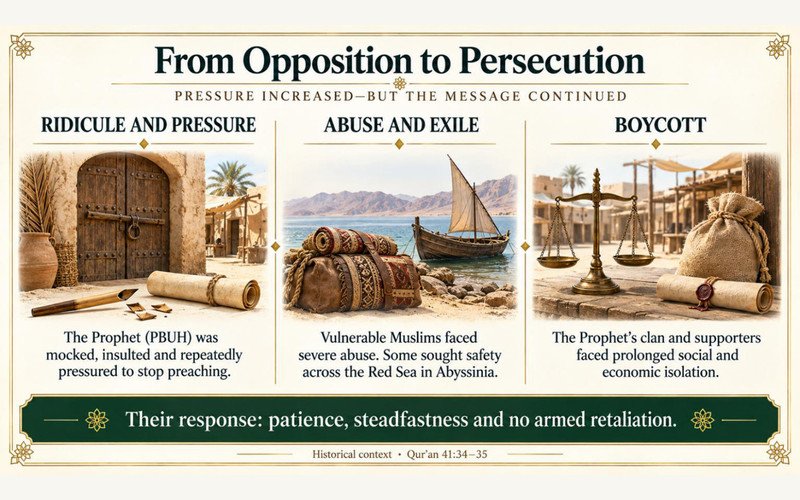
| IN BRIEF Opposition in Makkah escalated from ridicule to physical abuse, then to a social and economic boycott of the Prophet’s clan lasting about three years (c. 616–619). Vulnerable converts such as Bilal and Sumayyah suffered torture, and some Muslims sought refuge in Abyssinia. Islamic tradition stresses that the response was patience, summed up in the Qur’anic advice to repel evil with what is better (41:34–35). |
|---|
Detailed Story
Ridicule and pressure
The first response of the Quraysh was mockery and pressure on his protector, Abu Talib, to silence him. They offered, according to tradition, wealth and leadership if he would stop. He is reported to have declined. Physical hostility followed. Ibn Abbas and Urwa report an incident at the Ka‘bah when Uqba ibn Abi Mu‘ayt wrapped a cloth around the Prophet’s neck while he prayed, and Abu Bakr intervened saying: would you kill a man because he says my Lord is God? (Sahih al-Bukhari 3678, 3856).
The weak and the enslaved
Clan protection shielded people with powerful relatives, but converts without such protection were beaten, starved or tortured. Bilal, an enslaved Abyssinian, was reportedly laid on hot ground with a rock on his chest until Abu Bakr purchased his freedom. Sumayyah bint Khayyat, traditionally the first martyr of Islam, died under torture, together with her husband Yasir (Ibn Hisham). In about 615 CE a group of Muslims emigrated across the Red Sea to Abyssinia; see the next article.
The boycott
Around 616, Quraysh clans agreed on a written pact to boycott the Banu Hashim and Banu al-Muttalib, refusing trade and marriage with them until they surrendered the Prophet ﷺ. The clans withdrew to a ravine owned by Abu Talib, and sources describe hunger and hardship. After about three years, some Quraysh leaders challenged the boycott and it collapsed. Ibn Ishaq adds that the document was found eaten by termites.
The Year of Sorrow and Ta’if
In 619 both Khadijah and Abu Talib died, taking away his closest supporter and his clan protector. He travelled to Ta’if, a nearby town, seeking support, and was rejected and driven out with stones thrown at him. Aisha R.A later asked whether any day had been harder than the day of Uhud. He replied that Ta’if was harder. An angel of the mountains offered to crush the town; he declined, saying he hoped God would bring from them people who would worship God alone (Sahih al-Bukhari 3231; Sahih Muslim 1795).
“Repel evil with what is better”
The Qur’an advises the Prophet ﷺ that good and evil are not equal and that repelling evil with something better can turn an enemy into a close friend (41:34–35). Our tradition presents the Makkan period as one of patience in which no fighting was allowed; permission to fight came only after the migration to Madinah (22:39). No fighting is reported in the Makkan period: patience was the believers’ way.
| FACTS & FIGURES Boycott: about three years (c. 616–619 CE), according to Ibn Ishaq. 619 CE: deaths of Hazrat Khadijah RA and Abu Talib, traditionally called the Year of Sorrow. First emigration to Abyssinia: c. 615 CE. No armed fighting by Muslims is reported in the Makkan period; the first permission to fight is linked to 22:39 after the Hijrah. |
|---|
| IMPORTANT DISTINCTION: Persecution ≠ the whole Quraysh Persecution was led by particular leaders such as Abu Jahl and Abu Lahab. Others, including non-Muslim relatives such as Abu Talib and later some who ended the boycott, protected or defended the Muslims. |
|---|
Related Topics
• Article 6: The Call in Makkah: Why the Message Challenged the Quraysh
• Article 8: Refuge in Abyssinia: Ja‘far ibn Abi Talib at the Court of the Negus
• Article 9: The Hijrah: Why the Prophet Migrated to Madinah
Sources & Further Reading
• Qur’an 22:39, 41:34–35. https://quran.com
• Sahih al-Bukhari 3231, 3678, 3856. https://sunnah.com/bukhari:3231
• Sahih Muslim 1795. https://sunnah.com/muslim:1795
• Ibn Hisham / Ibn Ishaq, The Life of Muhammad, trans. A. Guillaume (Oxford, 1955).
• Ibn Sa‘d, Kitab al-Tabaqat al-Kabir, trans. S. Moinul Haq (Kitab Bhavan, 1972).
• W. Montgomery Watt, Muhammad at Mecca (Oxford, 1953).
• Martin Lings, Muhammad: His Life Based on the Earliest Sources (Allen & Unwin, 1983).
• Safiur Rahman al-Mubarakpuri, The Sealed Nectar (Ar-Raheeq Al-Makhtum) (Darussalam, 1996).
• Ibn Qayyim al-Jawziyya, Zad al-Ma‘ad fi Hady Khayr al-‘Ibad (14th century).