
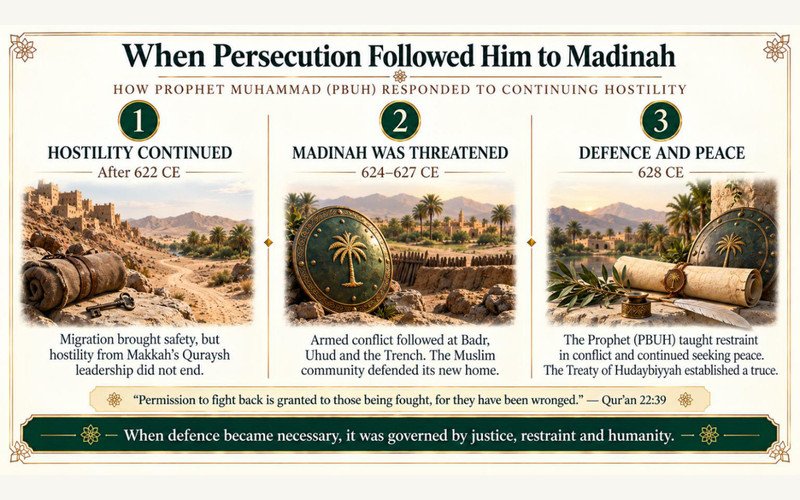
| IN BRIEF Migration to Madinah did not end hostility with the Quraysh. Between 624 and 627 CE the Muslims fought at Badr, Uhud and the Trench, and in 628 the Treaty of Hudaybiyyah established a ten-year truce. These conflicts were forced on a community that had been expelled from its homes and stripped of its property. |
|---|
Detailed Story
Why conflict continued
The emigrants had left Makkah and lost their property there, and the Quraysh remained at war with them. The Qur’an gives permission to fight those who have been wronged and driven from their homes (22:39–40). The tradition understands the early expeditions against Quraysh caravans as lawful retaliation for confiscated property and as a way of pressing Makkah to end its hostility.
Badr (March 624)
A Muslim force of about 313 met a Quraysh army of roughly 950–1,000 at the wells of Badr, after the Muslims had gone out to intercept a caravan led by Abu Sufyan. The Muslims won. Fourteen Muslims were killed; reports give about 70 Quraysh dead and 70 captured. The Qur’an refers to Badr as a day of decisive distinction (8:41).
Uhud (March 625)
The Quraysh returned with about 3,000 men to avenge Badr. At Uhud, near Madinah, the Muslim archers on a hill left their positions and the battle turned. About 70 Muslims died, including the Prophet’s uncle Hamza, and the Prophet ﷺ was wounded. The Quraysh did not press on to Madinah.
The Trench (March 627)
A coalition of Quraysh and allied tribes, around 10,000 men, besieged Madinah. On the advice of Salman al-Farisi (RA), the Muslims dug a trench along the open northern side. After a siege of several weeks, cold winds and divisions among the allies led them to withdraw. Casualties were very low on both sides. During the siege the Banu Qurayza, a Jewish clan of Madinah, broke their covenant by siding with the besiegers, and their subsequent punishment is discussed in the article on casualties.
Hudaybiyyah (March 628)
In 628 the Prophet ﷺ set out with about 1,400 followers to perform the lesser pilgrimage (‘umra), unarmed except for travel weapons. The Quraysh stopped them at Hudaybiyyah, outside Makkah, and a treaty was negotiated. Its terms, a ten-year truce, return of Makkans who came to Madinah without permission and a pilgrimage the next year, seemed to many Companions unfavourable. The Qur’an calls it a “clear victory” (48:1). Within two years it enabled peaceful contacts, and tribes allied with both sides (Sahih al-Bukhari 2731–2732).
| Event | Date | Approx. forces | Reported outcome |
|---|---|---|---|
| Badr | March 624 | 313 vs c. 950–1,000 | 14 Muslims killed; c. 70 Quraysh killed, 70 captured |
| Uhud | March 625 | c. 700 vs c. 3,000 | c. 70 Muslims killed; Quraysh losses fewer |
| The Trench | March 627 | c. 3,000 vs c. 10,000 | Very few killed; siege lifted |
| Hudaybiyyah | March 628 | c. 1,400 pilgrims | Ten-year truce |
What the sources record
The numbers above are those preserved in the classical biographies of Ibn Ishaq and Ibn Kathir and in al-Mubarakpuri’s The Sealed Nectar. The picture they give is of a small community, repeatedly outnumbered, that held to restraint in war and accepted peace at Hudaybiyyah.
| FACTS & FIGURES Badr: 17 Ramadan 2 AH, March 624 CE. Uhud: Shawwal 3 AH, March 625. Trench: Shawwal 5 AH, March 627. Hudaybiyyah: Dhu al-Qa‘da 6 AH, March 628, a ten-year truce. About 14 Muslims and about 70 Quraysh were killed at Badr; about 70 Muslims at Uhud (traditional figures). |
|---|
| IMPORTANT DISTINCTION: Jihad means striving The Arabic word jihad means striving and covers many forms of effort, from self-discipline to the defence of the community. The Muslims’ fighting in the Prophet’s ﷺ time was defensive and bound by strict rules of conduct. |
|---|
Related Topics
• Article 9: The Hijrah: Why the Prophet Migrated to Madinah
• Article 16: The Ethics of Conflict: Restraint, Peace and Protection of Non-Combatants
• Article 19: Deaths in Context: Counting Casualties in the Prophetic Era
Sources & Further Reading
• Qur’an 8:41, 22:39–40, 48:1. https://quran.com
• Sahih al-Bukhari 2731–2732 (Hudaybiyyah). https://sunnah.com/bukhari:2731
• Ibn Hisham / Ibn Ishaq, The Life of Muhammad, trans. A. Guillaume (Oxford, 1955).
• al-Tabari, The History of al-Tabari, vol. 7: The Foundation of the Community, trans. M. V. McDonald and W. M. Watt (SUNY Press, 1987).
• W. Montgomery Watt, Muhammad at Medina (Oxford, 1956).
• Safiur Rahman al-Mubarakpuri, The Sealed Nectar (Ar-Raheeq Al-Makhtum) (Darussalam, 1996).
• Ibn Qayyim al-Jawziyya, Zad al-Ma‘ad fi Hady Khayr al-‘Ibad (14th century).