
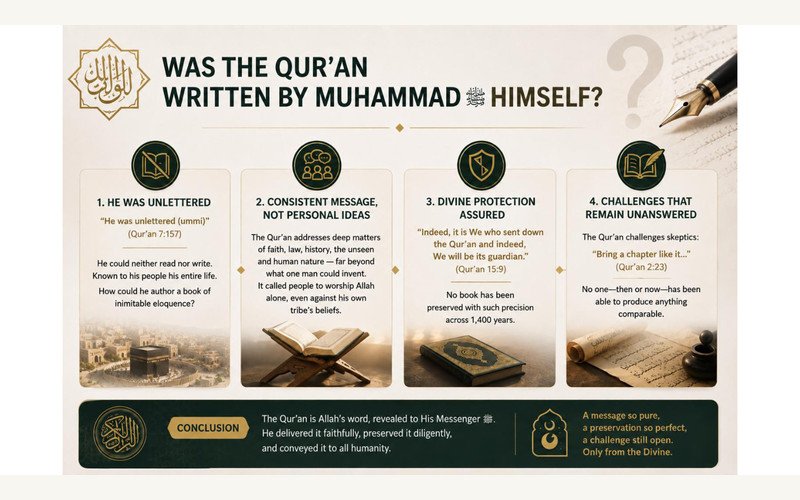
| IN BRIEF The Qur’an is the word of God and not the composition of Muhammad ﷺ. Four signs point to this: he was unlettered; he delivered a message that cost him comfort and status; the Qur’an has been divinely preserved; and its open challenge to produce anything like it still stands after fourteen centuries. The Qur’an itself records the accusation of human authorship and answers it. |
|---|
Detailed Story
An old claim, answered in the Qur’an
Even in Makkah some people said that a human being was teaching him (16:103) or that he had invented the Qur’an with help (25:4–5). The Qur’an answered each charge, and the Makkans, who had known him for forty years, never found in his earlier life any sign of poetry, preaching or scholarship that could explain what they now heard.
Sign 1: the unlettered prophet
The Qur’an calls him the ummi Prophet (7:157–158) and says that he never read a book before it, nor wrote one with his right hand (29:48). In the earliest account of revelation, when the angel commanded him to read, he answered, “I am not one who reads” (Sahih al-Bukhari 3). A man who had never studied under any teacher then brought a book of unmatched eloquence, law, history and wisdom. For us this is a clear sign that its source is God.
Sign 2: a message at great cost
Muhammad’s call to abandon ancestral gods cost him standing in a society that prized ancestry. The Quraysh offered him wealth, rank and kingship if he would stop; he refused. Academic historians such as W. Montgomery Watt concluded that he was entirely sincere. The Qur’an confirms the earlier scriptures (3:3–4), and he himself said that he was only a servant and messenger, conveying what he was given (18:110).
Sign 3: a book guarded by God
God promised, “It is We who sent down the Reminder, and We will guard it” (15:9). The text was memorised and written in the Prophet’s lifetime, collected under Abu Bakr and standardised under Uthman (see the article on the Qur’an’s transmission). Radiocarbon dating of the Birmingham parchment places it between 568 and 645 CE. Today millions of Muslims have memorised the whole Qur’an, and a copy printed in India reads the same as a copy printed in Morocco or Indonesia.
Sign 4: the open challenge
The Qur’an challenges anyone in doubt to bring a chapter like it (2:23; 10:38), ten chapters (11:13), or a book equal to it (17:88; 52:33–34). The Arabs of the Prophet’s day were masters of poetry and speech, yet none answered the challenge. Our scholars developed the science of i‘jaz, the inimitability of the Qur’an, and the translator Arthur Arberry wrote of the power of its rhythm and rhetoric. The Qur’an also describes itself as free of contradiction, though it was revealed over twenty-three years (4:82).
The Qur’an and the Prophet’s own words
Scholars have always distinguished between the Qur’an and the Prophet’s own sayings, which were recorded separately as hadith. The two differ in style and in status, and the Companions never confused them. This is why the Qur’an has been preserved word for word, while the hadith are preserved with chains of narrators.
| FACTS & FIGURES The Qur’an records the accusation of human authorship at least twice (16:103; 25:4–5) and answers it. Five Qur’anic passages issue an open challenge: 2:23, 10:38, 11:13, 17:88, 52:33–34. Birmingham Qur’an leaves: parchment radiocarbon-dated to 568–645 CE at 95.4% probability (University of Birmingham, 2015). The Qur’an has 114 surahs; the shortest (108) has three verses. |
|---|
| IMPORTANT DISTINCTION: Unlettered ≠ unintelligent Being unable to read or write says nothing about intelligence or wisdom. Muhammad ﷺ was a respected arbiter and merchant known as al-Amin, whose judgement his own people trusted. The Qur’an’s eloquence and wisdom are signs that it came from God. |
|---|
Related Topics
• Article 3: The Qur’an and Its Messenger: Receiving, Conveying and Preserving Revelation
• Article 2: Prophethood in Islam: Revelation, the Chain of Messengers and Why a Human Prophet
• Article 5: The Mission of the Prophet: One God, Justice, Mercy and Moral Character
Sources & Further Reading
• Qur’an 2:23, 3:3–4, 4:82, 7:157, 10:38, 11:13, 15:9, 16:103, 17:88, 18:110, 25:4–5, 29:48, 52:33–34. https://quran.com
• Sahih al-Bukhari 3. https://sunnah.com/bukhari:3
• M. A. S. Abdel Haleem, Understanding the Qur’an: Themes and Style (I. B. Tauris, 1999).
• Muhammad Asad, The Message of the Qur’an (Dar al-Andalus, 1980).
• Arthur J. Arberry, The Koran Interpreted (George Allen & Unwin, 1955).
• M. M. al-A‘zami, The History of the Qur’anic Text from Revelation to Compilation (UK Islamic Academy, 2003).
• W. Montgomery Watt, Muhammad at Mecca (Oxford University Press, 1953).
• University of Birmingham, Birmingham Qur’an manuscript dated among the oldest in the world (2015). https://www.birmingham.ac.uk/news/2015/birmingham-quran-manuscript-dated-among-the-oldest-in-the-world
• Safiur Rahman al-Mubarakpuri, The Sealed Nectar (Ar-Raheeq Al-Makhtum) (Darussalam, 1996).
Theme 2: The Mission and the Makkan Years
The message, the opposition it met in Makkah, the refuge in Abyssinia and the migration to Madinah.