| IN BRIEF The Qur’an tells Muslims to feed captives (76:8) and, after fighting ends, to release them as a favour or for ransom (47:4). Reports describe Badr prisoners fed before their captors, Thumamah ibn Uthal released without condition, Hawazin captives returned, and literate prisoners freed for teaching children. Together these examples show how the Prophet ﷺ treated those who were in his power. |
|---|
Detailed Story
What the Qur’an says
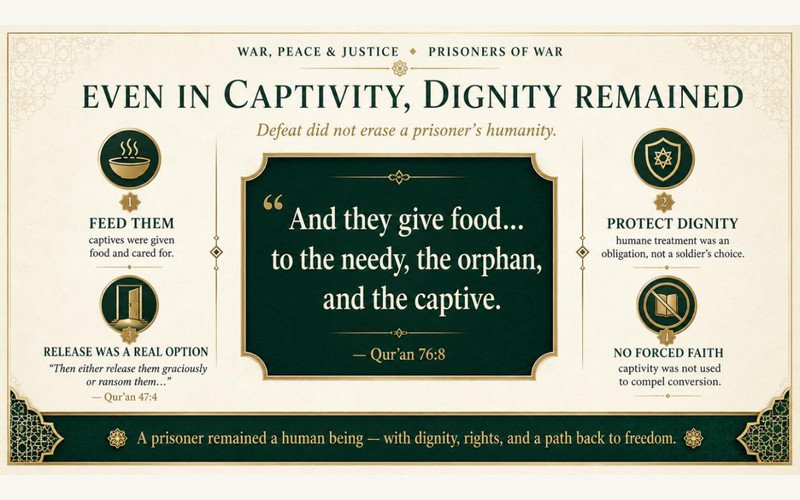
Among the traits of the righteous is that they give food, though they love it, to the poor, the orphan and the captive (76:8). Qur’an 47:4 says that after the fighting is over captives are to be released either as a favour or for ransom. The verse does not mention execution or enslavement, which later jurists discussed.
Four moments
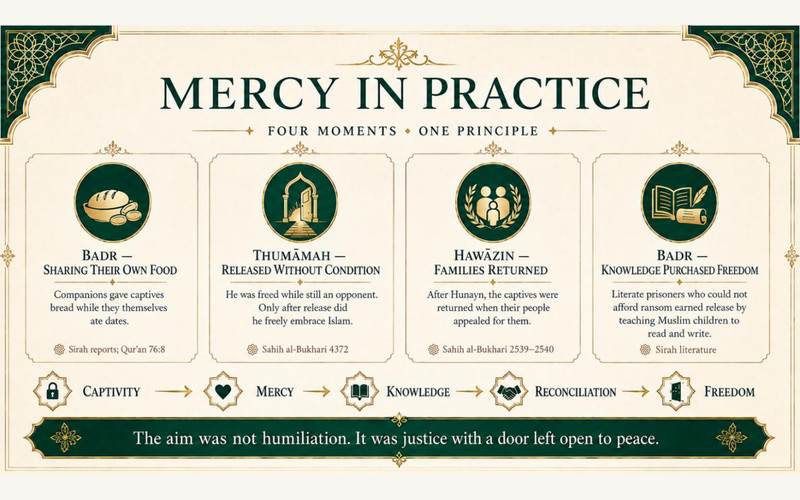
• Badr (624): About 70 Quraysh were captured. Ibn Ishaq transmits an account from a prisoner, Abu ‘Aziz, that the Ansar and emigrants gave him bread and kept dates for themselves, following the Prophet’s ﷺ instruction to treat captives well. Ransom was set according to ability.
• Education as ransom: Literate prisoners who could not pay were reportedly released after each taught ten Madinan children to read and write (Musnad Ahmad 2216; Ibn Sa‘d).
• Thumamah ibn Uthal: Chief of the Banu Hanifa, captured and tied in the mosque of Madinah. He was asked what he expected, said that if killed he had blood, if freed he would be grateful. The Prophet ﷺ released him unconditionally. Thumamah then bathed and declared Islam (Sahih al-Bukhari 4372; Sahih Muslim 1764).
• Hawazin (630): After the Battle of Hunayn about 6,000 captives were taken. When a Hawazin delegation came as Muslims, the Prophet ﷺ offered the choice between captives and property, and the captives were returned (Sahih al-Bukhari 2307–2308; Ibn Ishaq).
Not forced to convert
The Qur’an states that there is no compulsion in religion (2:256). Conversion of captives was not a condition of release, as the case of Thumamah, who converted after his release, illustrates. Ransom, exchange and release by favour were the main routes.
The scholars’ understanding
Classical jurists drew on 47:4 and on the Prophet’s ﷺ own practice in setting the rules for captives. Their works require that prisoners be fed, clothed and protected from harm, and they encourage release, exchange and ransom, as at Badr and Hawazin. Some early scholars such as Hasan al-Basri and ‘Ata’ held that release or ransom were the only outcomes the Qur’anic verse permitted. The mercy shown to Thumamah and to the Hawazin remains the example believers cite.
Comparison with modern law
The Third Geneva Convention (1949) requires humane treatment, food and protection from violence for prisoners of war. The reports above show that these concerns were central in the Prophet’s ﷺ time.
| FACTS & FIGURES Badr: about 70 prisoners (traditional figure). Hawazin after Hunayn: about 6,000 captives returned (Ibn Ishaq). Qur’an 76:8 (feed captives); 47:4 (release or ransom); 2:256 (no compulsion). Third Geneva Convention: 1949. |
|---|
| IMPORTANT DISTINCTION: Mercy and dignity as the standard Our sources present kindness to captives as the Prophet’s ﷺ consistent practice, and Muslim jurists made it a legal duty to feed, clothe and protect prisoners. |
|---|
Related Topics
• Article 16: The Ethics of Conflict: Restraint, Peace and Protection of Non-Combatants
• Article 19: Deaths in Context: Counting Casualties in the Prophetic Era
• Article 18: The Conquest of Makkah and the General Amnesty
Sources & Further Reading
• Qur’an 2:256, 47:4, 76:8. https://quran.com
• Sahih al-Bukhari 4372 (Thumamah); 2307–2308 (Hawazin). https://sunnah.com/bukhari:4372
• Sahih Muslim 1764. https://sunnah.com/muslim:1764
• Ibn Hisham / Ibn Ishaq, The Life of Muhammad, trans. A. Guillaume (Oxford, 1955).
• Ibn Sa‘d, Kitab al-Tabaqat al-Kabir (education of Badr captives).
• Majid Khadduri, War and Peace in the Law of Islam (Johns Hopkins Press, 1955).
• International Committee of the Red Cross, Geneva Convention (III) Relative to the Treatment of Prisoners of War (1949). https://ihl-databases.icrc.org
• Ibn Qayyim al-Jawziyya, Zad al-Ma‘ad fi Hady Khayr al-‘Ibad (14th century).
• Mohammad Hashim Kamali, Shari‘ah Law: An Introduction (Oneworld, 2008).