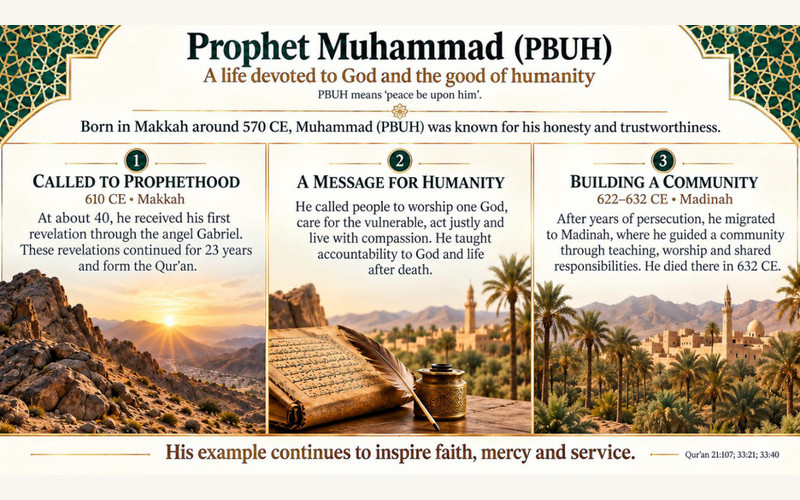
| IN BRIEF Prophet Muhammad ﷺ was born in Makkah around 570 CE into the Quraysh tribe and was known for honesty long before he received his first revelation at about the age of forty. We Muslims believe the Qur’an was revealed to him over the next twenty-three years. He preached in Makkah, migrated to Madinah in 622, returned to Makkah in 630 and died in 632. Today about 2.0 billion Muslims, roughly one in four people on earth, regard him as God’s final messenger. |
|---|
Detailed Story
How we know about his life
The Qur’an addresses Muhammad ﷺ directly but is not a biography. Details of his life come from hadith (reports of his words and actions) and sira (biographical literature). The earliest surviving full biography is by Ibn Ishaq (d. c. 767 CE), preserved mainly in Ibn Hisham’s edition (d. 833 CE). Ibn Sa‘d (d. 845) and al-Tabari (d. 923) add further material.
These works were compiled with great care by scholars who collected and checked the reports of the Prophet’s Companions and their students. Even early non-Muslim records confirm his appearance: the Greek Doctrina Jacobi (c. 634–640) mentions a prophet who had appeared among the Saracens, and the Armenian history attributed to Sebeos (c. 660s) names “Mahmet”.
Early life in Makkah
Muhammad ﷺ was born around 570 CE (scholars give a range of 569–571) in Makkah, a town in western Arabia centred on the Ka‘bah and governed by clan leaders of the Quraysh tribe. According to the tradition his father Abdullah died before his birth and his mother Amina when he was about six. He was raised by his grandfather Abd al-Muttalib and then by his uncle Abu Talib of the Banu Hashim clan.
As a young man he worked in trade and was nicknamed al-Amin, “the trustworthy”. Around 595 he married Khadijah bint Khuwaylid, a successful businesswoman. Their four daughters (Zaynab, Ruqayyah, Umm Kulthum and Fatimah) survived to adulthood; their sons died in infancy. Around 605, when the Ka‘bah was being rebuilt, the Makkan clans accepted him as arbiter in a dispute over who should replace the Black Stone, a story told in Ibn Ishaq’s biography.
Revelation and the Makkan years (610–622)
We Muslims believe that in 610 CE, while in retreat in the cave of Hira on a hill near Makkah, Muhammad ﷺ received his first revelation through the angel Gabriel (Jibril). The first words are identified with Qur’an 96:1–5, which begin with the command “Read” or “Recite” (Sahih al-Bukhari 3). Revelation continued in parts until shortly before his death.
He first shared the message privately, then publicly, calling people to worship one God, to act justly and to care for the poor. A small community formed, and so did opposition from many Quraysh leaders. The Makkan period is explored in the articles on the call in Makkah, persecution and the Hijrah.
Madinah and the final years (622–632)
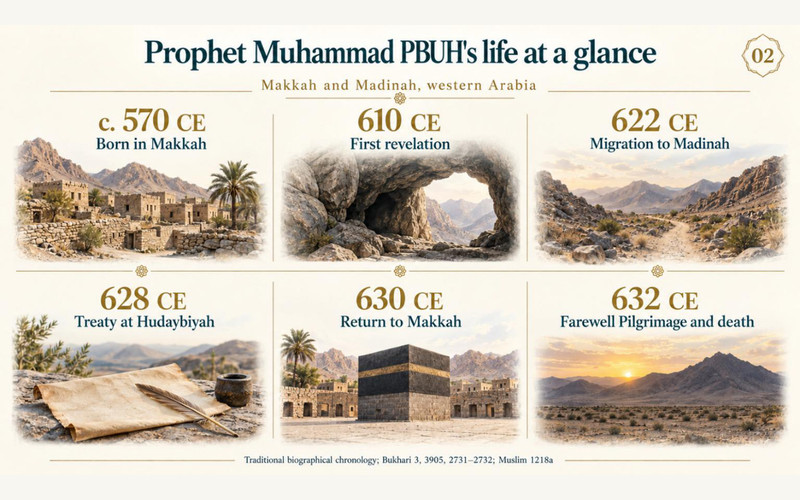
In 622 he migrated to Yathrib, soon known as Madinah, where he led a mixed community of Muslims, Jews and others under the charter described in a separate article. Conflict with Makkah produced the battles of Badr (624), Uhud (625) and the Trench (627), followed by the Treaty of Hudaybiyyah (628). In January 630 he entered Makkah with a large force and proclaimed a general amnesty. In March 632 he led his only full pilgrimage, delivering the Farewell Sermon at Arafah, and he died in Madinah on 8 June 632 (12 Rabi‘ al-Awwal, 11 AH). By then most of the Arabian Peninsula had accepted his leadership.
| Date (CE) | Event | Note |
|---|---|---|
| c. 570 | Birth in Makkah | Scholarly range 569–571 |
| c. 595 | Marriage to Khadijah | Traditional dating |
| 610 | First revelation at Hira | Qur’an 96:1–5; Bukhari 3 |
| c. 615 | First emigration to Abyssinia | See article on Abyssinia |
| 619 | Deaths of Khadijah and Abu Talib | “Year of Sorrow” in tradition |
| 622 | Hijrah to Madinah | Year 1 of the Islamic calendar |
| 624 / 625 / 627 | Badr / Uhud / the Trench | Bukhari and Muslim; Ibn Ishaq |
| 628 | Treaty of Hudaybiyyah | Bukhari 2731–2732 |
| 630 | Entry into Makkah | General amnesty |
| 632 | Farewell Pilgrimage and death | Muslim 1218 |
Why his life is still studied
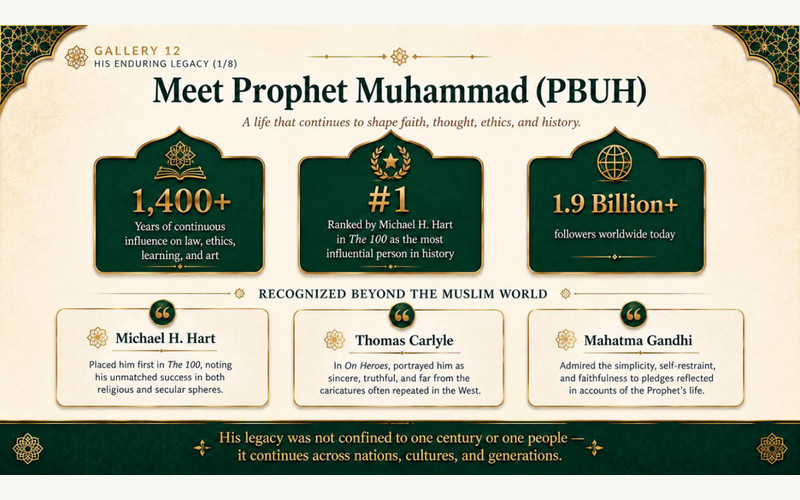
We see him as the final prophet and the model for personal conduct. Others study him as a religious leader, statesman and reformer in late antique Arabia, and the tributes paid to him by non-Muslim thinkers from India and the West are gathered in the final theme of this site.
| FACTS & FIGURES Birth: c. 570 CE (range 569–571). First revelation: 610 CE, at about age 40. The Qur’an was revealed over roughly 23 years, 610–632 CE. The Hijrah of 622 CE marks year 1 of the Islamic (Hijri) calendar; the Islamic year 1448 AH began in mid-2026. Pew Research Center (2025, data for 2020): about 2.0 billion Muslims, 25.6% of the world’s population, second to Christians (28.8%). About 1.2 billion live in Asia-Pacific and 414 million in the Middle East and North Africa. Indonesia (239 million), Pakistan (227 million) and India (213 million) have the largest Muslim populations. Census of India 2011: 172.2 million Muslims, 14.2% of India’s population. |
|---|
| IMPORTANT DISTINCTION: Muhammad ≠ an object of worship Muslims worship God alone. The terms “Muhammadan” and “Muhammadanism” are inaccurate and disliked by Muslims. The Qur’an instructs Muhammad ﷺ to say that he is a human being to whom revelation is given (18:110). Pew Research Center’s 2020 estimate is about 2.0 billion followers. |
|---|
Related Topics
• Article 2: Prophethood in Islam: Revelation, the Chain of Messengers and Why a Human Prophet
• Article 5: The Mission of the Prophet: One God, Justice, Mercy and Moral Character
• Article 9: The Hijrah: Why the Prophet Migrated to Madinah
Sources & Further Reading
• Qur’an 96:1–5, 21:107, 18:110. https://quran.com/96
• Sahih al-Bukhari 3 (beginning of revelation). https://sunnah.com/bukhari:3
• Ibn Hisham / Ibn Ishaq, The Life of Muhammad, trans. A. Guillaume (Oxford University Press, 1955).
• W. Montgomery Watt, Muhammad at Mecca (Oxford University Press, 1953) and Muhammad at Medina (Oxford University Press, 1956).
• Robert G. Hoyland, Seeing Islam as Others Saw It (Darwin Press, 1997).
• Jonathan A. C. Brown, Muhammad: A Very Short Introduction (Oxford University Press, 2011).
• Pew Research Center, How the Global Religious Landscape Changed From 2010 to 2020 (2025). https://www.pewresearch.org/religion/2025/06/09/how-the-global-religious-landscape-changed-from-2010-to-2020/
• Office of the Registrar General, Census of India 2011, religion tables. https://censusindia.gov.in
• Safiur Rahman al-Mubarakpuri, The Sealed Nectar (Ar-Raheeq Al-Makhtum) (Darussalam, 1996).
• Muhammad Hamidullah, Muhammad Rasulullah: A Concise Survey of the Life and Work of the Founder of Islam (Hyderabad Academy, 1974).
• Ibn Kathir, The Life of the Prophet Muhammad (al-Sira al-Nabawiyya), trans. Trevor Le Gassick (Garnet Publishing, 1998–2000).