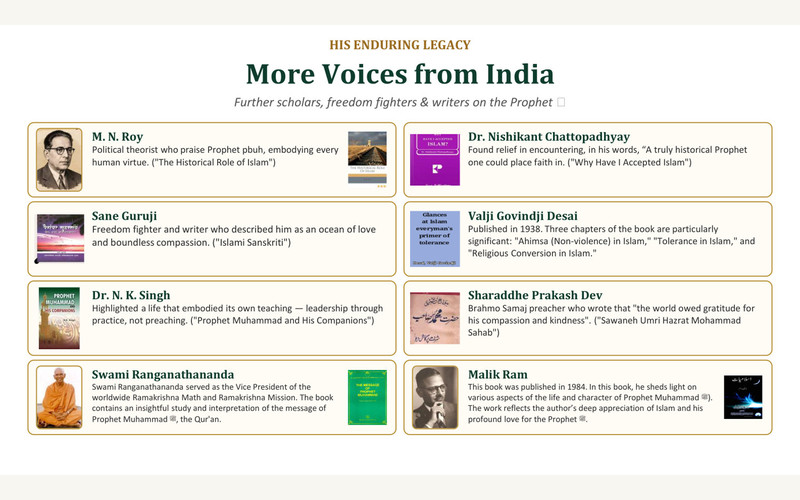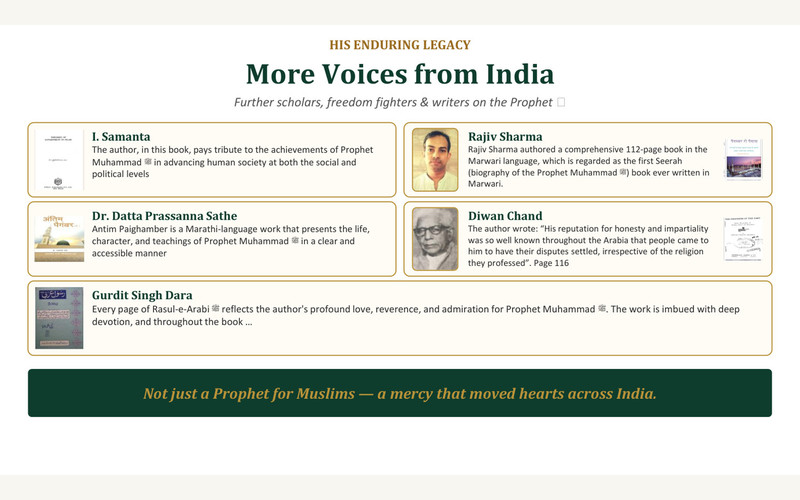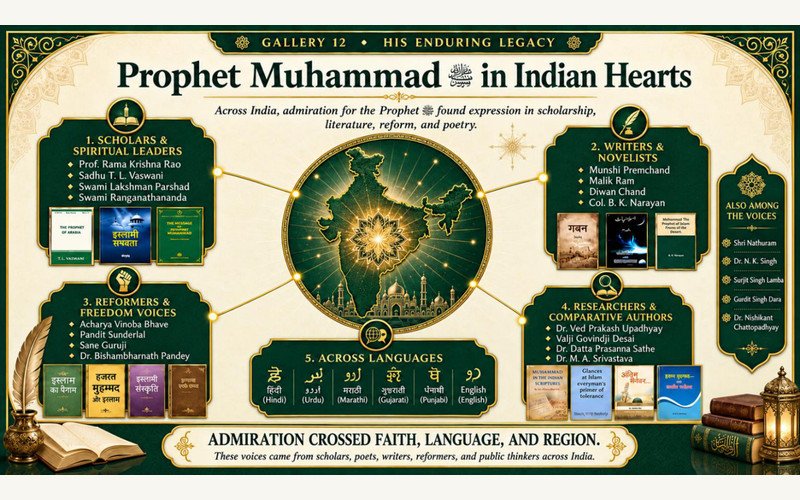
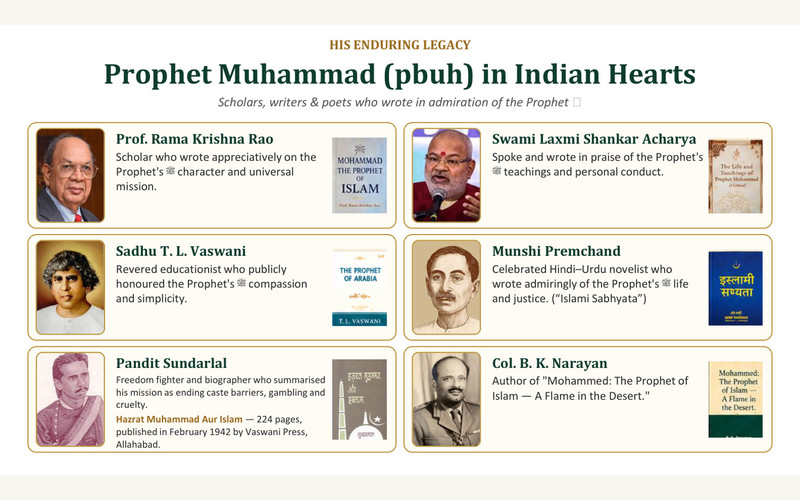
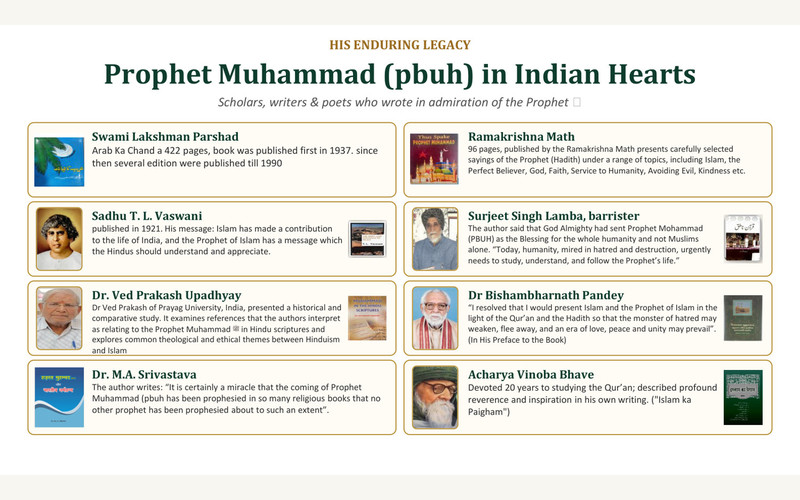
| IN BRIEF Many Indian thinkers from outside the Muslim community have written about Prophet Muhammad ﷺ with admiration, among them Mahatma Gandhi, Acharya Vinoba Bhave, Sarojini Naidu, Pandit Sunderlal, Munshi Premchand, Sadhu Vaswani, Swami Laxmi Shankeracharya, Prof. Rama Krishna Rao, Malik Ram, Col. B.K. Narayan and an unending list of writers and scholars. They praised his simplicity, sincerity, justice and message of equality. This record of respect across faiths is a documented part of India’s intellectual history. |
|---|
Detailed Story
Gandhi
In Young India (1924), Gandhi wrote that, having read the Prophet’s ﷺ life, he was more convinced than ever that Islam did not win its place in the world by the sword. He pointed instead to the Prophet’s ﷺ rigid simplicity, self-effacement, regard for his pledges, devotion to friends and followers, fearlessness and trust in God. The article is available in his Collected Works. The exhibition cites the same qualities.
Vivekananda and Naidu
Swami Vivekananda, in a letter written in 1898 to a Muslim correspondent, Mohammed Sarfaraz Hussain, praised what he called the practical equality shown in Islam and expressed respect for the Prophet ﷺ. Sarojini Naidu, born in Hyderabad in 1879, lectured in Madras in 1918 on “The Ideals of Islam”, calling Islam the first religion to preach and practise democracy. Both are examples of leading Hindu reformers who looked at Islam through the lens of equality and social unity.
Reformers and scholars
Pandit Sunderlal (1885–1981), a freedom fighter, wrote Hazrat Muhammad aur Islam in Hindi in the early 1930s, a biography sympathetic to the Prophet ﷺ. Vinoba Bhave, a disciple of Gandhi, studied the Qur’an closely and produced a Hindi digest of it. Prof. K. S. Ramakrishna Rao, a philosopher, wrote Muhammad: The Prophet ﷺ of Islam. Many other Indian writers, in Hindi, Gujarati, Urdu and other languages, have written in the same spirit.
Why they wrote
Several motives are visible. In the colonial period, nationalist leaders wanted to build Hindu–Muslim unity. Others, as reformers, were interested in comparative religion or in the Qur’anic emphasis on equality and charity. Some were writing in response to polemical attacks on Islam in the press and wished to correct them. Each case is individual.
India’s own tradition of sira
Alongside these tributes stands the long Indian Muslim tradition of writing the Prophet’s ﷺ biography, notably Shibli Nomani and Sulaiman Nadwi’s Sirat-un-Nabi and the work of Muhammad Hamidullah in Hyderabad.
Hyderabad connection
Naidu’s Hyderabad roots, and the poetry of Hyderabad’s prime minister Maharaja Kishen Pershad, discussed in the next article, are two local threads in this wider history.
| FACTS & FIGURES Gandhi on the Prophet ﷺ: Young India, 1924. Vivekananda’s letter to Mohammed Sarfaraz Hussain: 10 June 1898. Sarojini Naidu was born in Hyderabad in 1879; her lectures on Islam were published in 1918. Census of India 2011: Muslims were 14.2% of India’s population, 172.2 million people. |
|---|
| IMPORTANT DISTINCTION: Respect across faith lines These writers remained within their own traditions and recognised the Prophet’s ﷺ character as a gift to humanity. Their tributes are quoted here in their own words and context. |
|---|
Related Topics
• Article 23: Devotion in Verse: Non-Muslim Poets and the Na‘t Tradition in India
• Article 24: Western Scholars and Writers on the Prophet: What They Said and How to Read It
• Article 1: Prophet Muhammad: A Life at a Glance
Sources & Further Reading
• M. K. Gandhi, writing in Young India (1924), reprinted in The Collected Works of Mahatma Gandhi (Publications Division, Government of India). https://www.gandhiheritageportal.org
• Swami Vivekananda, letter to Mohammed Sarfaraz Hussain, 10 June 1898, in The Complete Works of Swami Vivekananda (Advaita Ashrama).
• Sarojini Naidu, Speeches and Writings (G. A. Natesan, Madras, 1918), “The Ideals of Islam”.
• Pandit Sunderlal, Hazrat Muhammad aur Islam (Hindi, early 1930s).
• K. S. Ramakrishna Rao, Muhammad: The Prophet of Islam (Kitab Bhavan).
• Office of the Registrar General, Census of India 2011. https://censusindia.gov.in
• Shibli Nomani and Sulaiman Nadwi, Sirat-un-Nabi (Dar al-Musannifin, Azamgarh; English translation, Kitab Bhavan, New Delhi).
• Muhammad Hamidullah, Muhammad Rasulullah: A Concise Survey of the Life and Work of the Founder of Islam (Hyderabad Academy, 1974).