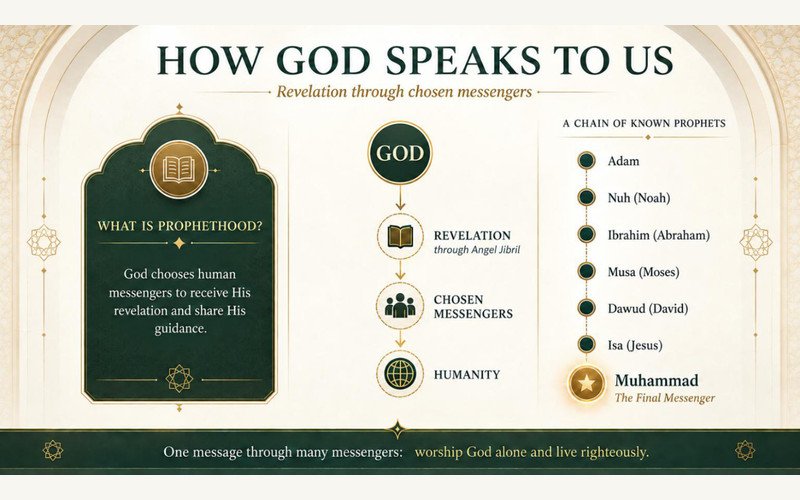
| IN BRIEF In Islam a prophet is a human being chosen by God to receive revelation and convey it. We Muslims believe God sent messengers to every community with one core message, to worship God alone and live righteously, and that Muhammad ﷺ is the last of them. The Qur’an names 25 prophets, among them Adam, Noah, Abraham, Moses, David and Jesus. Prophets are human by design: examples to follow, never objects of worship. |
|---|
Detailed Story
Prophet and messenger
The Qur’an uses two Arabic words, nabi (prophet) and rasul (messenger). Every messenger is a prophet, and a messenger is one who brings a scripture or a law to a community. In everyday Muslim usage both describe people chosen by God to guide humanity.
One message through many messengers
The Qur’an says that a messenger was sent to every community, each calling people to worship God (16:36; 21:25), and instructs Muslims to believe in all of them without distinction (2:136; 2:285). Rejecting any prophet is therefore outside Muslim belief. The Qur’an names 25: Adam, Idris, Nuh (Noah), Hud, Salih, Ibrahim (Abraham), Lut (Lot), Isma‘il, Ishaq, Ya‘qub, Yusuf, Ayyub, Shu‘ayb, Musa (Moses), Harun, Dhul-Kifl, Dawud (David), Sulayman, Ilyas, al-Yasa‘, Yunus, Zakariyya, Yahya, ‘Isa (Jesus) and Muhammad ﷺ.
Many of these figures also appear in Jewish and Christian scripture, which is why Islam is often described as one of the Abrahamic traditions. Musa is the figure mentioned most often in the Qur’an, more than 130 times. Muhammad ﷺ is named only four times (3:144, 33:40, 47:2, 48:29), with a further reference to a coming messenger called Ahmad (61:6). The Qur’an also states that it has not told the stories of every messenger (4:164; 40:78), and Muslims have never agreed on identifying others.
How revelation arrives
According to the Qur’an, God speaks to humans by inspiration, from behind a veil, or by sending a messenger-angel (42:51). The angel of revelation is Jibril (Gabriel) (2:97; 26:192–194). In a famous report a Companion asked the Prophet ﷺ how revelation came to him. He answered that it sometimes came like the ringing of a bell, which was the hardest form for him, and sometimes an angel took the form of a man and spoke to him (Sahih al-Bukhari 2).
Why a human prophet?
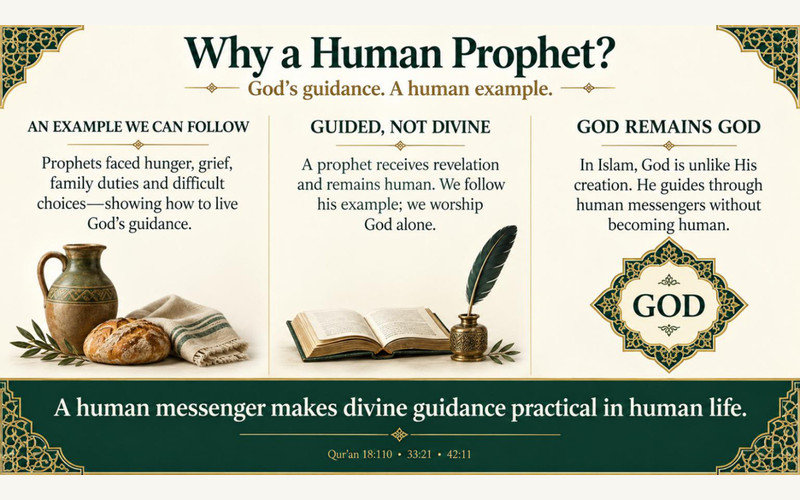
Makkan opponents asked why God would send a mortal, and why not an angel (17:94–95; 25:7). The Qur’an replies that if angels walked the earth, God would have sent an angel as messenger (17:95), and it tells Muhammad ﷺ to say that he is only a man to whom revelation is given (18:110). The reasoning is practical: a human prophet can show how faith is lived through hunger, illness, marriage, trade, grief, leadership and forgiveness. The Qur’an calls his life a “good example” (33:21). Tradition records that he wept at the death of his infant son Ibrahim and said that the eyes shed tears and the heart grieves (Sahih al-Bukhari 1303).
The Qur’an even records a mild divine rebuke when he turned away from a blind man who came to him while he was speaking to Makkan leaders (80:1–10). Our scholars read this as evidence that the text is not his own composition, a point developed in the article on authorship.
God remains God
Islamic theology holds that “there is nothing like Him” (42:11) and that God neither begets nor is begotten (112:3). For that reason prophets are never divine. The Qur’an honours Jesus and his mother Mary, who is named more often in the Qur’an than in the New Testament, and it teaches that Jesus was a mighty messenger of God, born miraculously to Mary, who called his people to worship God alone (4:171; 5:72–75).
The “seal” of the prophets
The Qur’an describes Muhammad ﷺ as “the seal of the prophets” (33:40). Sunni and Shi‘a scholars alike understand this to mean that no prophet follows him. It is a cornerstone of belief for Muslims worldwide: the message he brought is understood to complete, not replace, the guidance given to earlier prophets.
| FACTS & FIGURES The Qur’an names 25 prophets; Muhammad ﷺ is named four times and Moses more than 130 times. Mary (Maryam) is the only woman named in the Qur’an, and has a chapter named after her (surah 19). A well-known tradition in Musnad Ahmad mentions 124,000 prophets sent to humanity, showing that divine guidance reached every people. Finality of Muhammad’s prophethood rests on Qur’an 33:40. |
|---|
| IMPORTANT DISTINCTION: Prophet ≠ divine, and Islam ≠ a rejection of earlier prophets Muslims love and honour Moses, Jesus and Abraham as prophets, and Muhammad ﷺ is understood to have renewed and completed their message of pure monotheism. No prophet, including Muhammad ﷺ, is worshipped; worship is for God alone. |
|---|
Related Topics
• Article 1: Prophet Muhammad: A Life at a Glance
• Article 3: The Qur’an and Its Messenger: Receiving, Conveying and Preserving Revelation
• Article 4: Is the Qur’an the Word of God? Signs of Its Divine Origin
Sources & Further Reading
• Qur’an 2:136, 2:285, 4:164, 16:36, 17:94–95, 18:110, 33:21, 33:40, 40:78, 42:11, 80:1–10. https://quran.com
• Sahih al-Bukhari 2 (modes of revelation). https://sunnah.com/bukhari:2
• Sahih al-Bukhari 1303 (Muhammad’s grief at the death of his son). https://sunnah.com/bukhari:1303
• Seyyed Hossein Nasr et al. (eds.), The Study Quran (HarperOne, 2015).
• Brannon M. Wheeler, Prophets in the Quran: An Introduction to the Quran and Muslim Exegesis (Continuum, 2002).
• Jane Dammen McAuliffe (ed.), Encyclopaedia of the Qur’an (Brill, 2001–2006).
• Muhammad Asad, The Message of the Qur’an (Dar al-Andalus, 1980).
• M. A. S. Abdel Haleem, Understanding the Qur’an: Themes and Style (I. B. Tauris, 1999).
• Muhammad Hamidullah, Introduction to Islam (1957).