
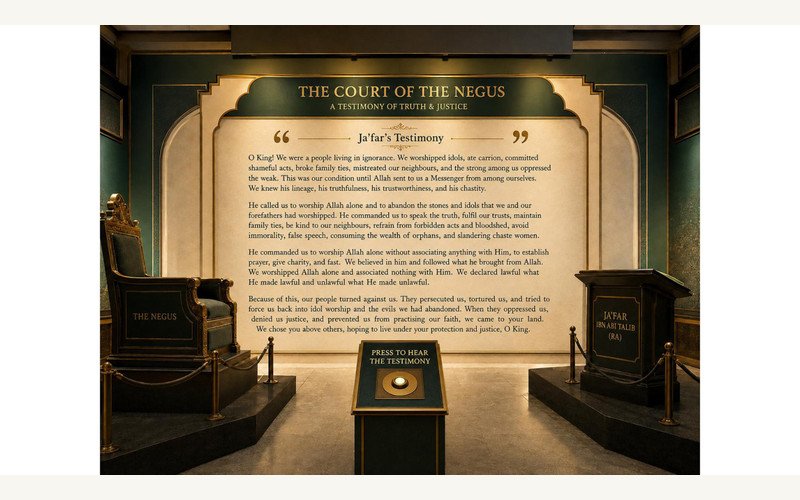
| IN BRIEF Around 615 CE a group of Muslims migrated from Makkah to Abyssinia, a Christian kingdom across the Red Sea, where the king, called the Negus, offered protection. When Quraysh envoys demanded their return, Ja‘far ibn Abi Talib described the Muslims’ past and beliefs and recited from the Qur’an’s chapter on Mary. The king refused to hand them over. The episode is Islam’s first example of refuge in a Christian land. |
|---|
Detailed Story
The first emigration
Facing persecution, the Prophet ﷺ advised some followers to go to Abyssinia, saying that its king would not wrong anyone (Ibn Ishaq). Traditional accounts give a first group of about eleven men and four women, including Uthman ibn Affan and his wife Ruqayyah, the Prophet’s daughter. A second, larger group followed; Ibn Ishaq counts 83 men and several women, led by Ja‘far, the Prophet’s cousin.
Who was the Negus?
Abyssinia was the Kingdom of Aksum, in what is now Ethiopia and Eritrea. It had adopted Christianity in the 4th century under King Ezana. “Negus” (Najashi in Arabic) is a royal title, and the Islamic tradition names this ruler Ashama ibn Abjar. Red Sea trade tied Aksum to Arabia, so Makkans knew the kingdom.
The Quraysh embassy
The Quraysh sent two envoys, Amr ibn al-As and Abdullah ibn Abi Rabi‘a, with gifts for the king and his bishops, hoping to have the refugees returned. The Negus summoned the Muslims and asked about the religion for which they had left their people. The fullest account comes from Umm Salama, one of the emigrants, and is preserved in Ibn Ishaq and Musnad Ahmad.
Hazratb Ja‘far’s (r.a) speech
As reported, Hazrat Ja‘far RA described a community living in ignorance, worshipping idols, eating carrion, breaking family ties and neglecting neighbours, with the strong oppressing the weak. Then God sent a messenger from among them, known to them for truthfulness, trustworthiness and honesty. He called them to worship God alone, to speak truth, keep trusts, maintain family ties, be good neighbours, and refrain from bloodshed, immorality and the wealth of orphans. His people persecuted those who followed, and so they came to Abyssinia, hoping for justice under the king.
The Negus asked for a recitation. Ja‘far recited the opening of surah Maryam (19), which tells of Mary and Jesus. The king is said to have wept, and remarked that what Jesus brought and what the Muslims recited come from one lamp. He refused to surrender them.
The account in the sources
The account is preserved by Umm Salama, who was present, and by Ibn Ishaq and Ahmad. The Muslims lived safely in Abyssinia under the Negus’s protection, and the episode stands as Islam’s first lesson in gratitude to a just host. According to tradition records that the Negus accepted Islam and that, on hearing of his death in about 630, the Prophet ﷺ prayed a funeral prayer for him in absentia (Sahih al-Bukhari 1245). Ja‘far and many emigrants rejoined the Prophet ﷺ in Madinah in 628–629.
Why it matters today
The episode shows how Muslims first experienced life as a religious minority, protected by a Christian ruler. Local tradition in Tigray, northern Ethiopia, associates the mosque at Negash with the early emigrants.
| FACTS & FIGURES c. 615 CE: first emigration; 83 men in the second group according to Ibn Ishaq. Aksum adopted Christianity in the 4th century CE under King Ezana. The Negus died c. 630 CE according to our tradition; the Prophet ﷺ prayed in absentia for him (Sahih al-Bukhari 1245). Ja‘far returned to Madinah around 628–629 CE. |
|---|
| IMPORTANT DISTINCTION: Abyssinia ≠ modern Ethiopia, and refuge ≠ conquest The Aksumite kingdom covered parts of modern Ethiopia, Eritrea and the Red Sea coast. The Muslims were refugees and grateful guests of a just king, not conquerors. |
|---|
Related Topics
• Article 7: From Ridicule to Boycott: Opposition and Persecution in Makkah
• Article 9: The Hijrah: Why the Prophet Migrated to Madinah
• Article 16: The Ethics of Conflict: Restraint, Peace and Protection of Non-Combatants
Sources & Further Reading
• Qur’an 19:16–36. https://quran.com/19
• Sahih al-Bukhari 1245. https://sunnah.com/bukhari:1245
• Ibn Hisham / Ibn Ishaq, The Life of Muhammad, trans. A. Guillaume (Oxford, 1955), pp. 146–153.
• Aḥmad ibn Ḥanbal, Musnad (hadith of Umm Salama on the Abyssinian migration).
• W. Montgomery Watt, Muhammad at Mecca (Oxford, 1953).
• Stuart Munro-Hay, Aksum: An African Civilisation of Late Antiquity (Edinburgh University Press, 1991).
• Robert G. Hoyland, Arabia and the Arabs (Routledge, 2001).
• Safiur Rahman al-Mubarakpuri, The Sealed Nectar (Ar-Raheeq Al-Makhtum) (Darussalam, 1996).
• Ibn Kathir, The Life of the Prophet Muhammad (al-Sira al-Nabawiyya), trans. Trevor Le Gassick (Garnet Publishing, 1998–2000).