| IN BRIEF Although he became the leading authority in Arabia, the Prophet ﷺ lived in small mud-brick rooms, slept on a mat, often went without a full meal and gave away what came to him. When he died, his armour was pledged to a Jewish merchant in return for barley. His simplicity is a model, for the all particularly those who are in power. |
|---|
Detailed Story
His home
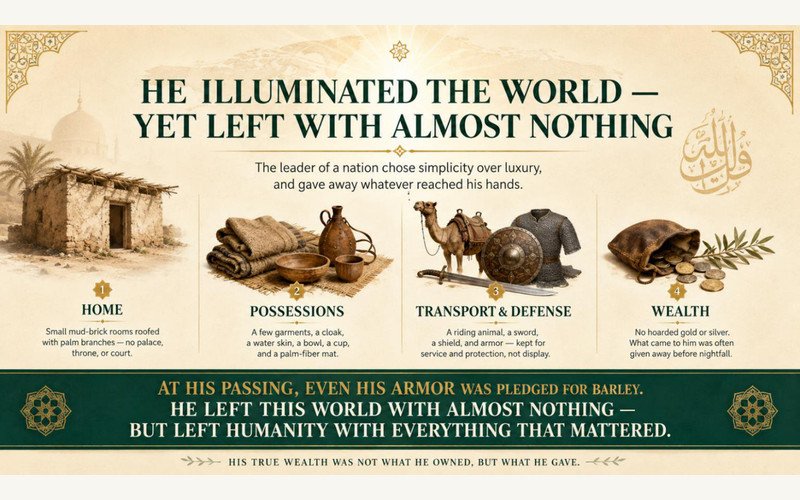
His rooms beside the Prophet’sﷺ Mosque (Masjid e Nabwi) in Madinah were small, built of mud brick and palm trunks with roofs of palm branches, and low enough that a man could touch the ceiling (Ibn Sa‘d, al-Tabaqat). There was no palace, throne or guard.
His possessions and food
Reports describe a few garments, a cloak, a water skin and a bowl. He slept on a mat that left marks on his side (Sunan al-Tirmidhi 2377). Umar (RA) once wept at seeing this and said that the Persian and Byzantine rulers lived in luxury while the Prophet ﷺ of God was in such conditions, and the Prophet ﷺ answered that for him the world was like a traveller resting under a tree (Sahih al-Bukhari 4913; Tirmidhi 2377). Aisha (RA) said that the family of Muhammad ﷺ did not eat their fill of wheat bread for three days in a row until he died (Sahih Muslim 2970).
Wealth and generosity
He said that if he had gold like Mount Uhud he would not want it to stay with him for more than three nights, apart from what he kept to pay debts (Sahih al-Bukhari 2389). Gifts and revenues were spent on the poor, delegations and public needs. Charity (sadaqa) was forbidden to his household, and he said that prophets leave no inheritance and what they leave is charity (Sahih al-Bukhari 3093).
His death
Aisha (RA) reported that when he died his shield was pledged to a Jewish man in exchange for thirty measures of barley (Sahih al-Bukhari 2916). A measure (sa‘) is roughly 2.5–3 kg, so the quantity is about 75–90 kg. The detail has been cited for centuries as showing both his poverty and his willingness to deal with neighbours of other faiths.
A leader of a growing state
By 632 he was the main authority across much of Arabia. Revenues such as zakat and the war share (khums) went to defined public uses and never to personal luxury. Academic historians such as Watt likewise recognise the plain living of the Prophet ﷺ.
The wives’ perspective
The Qur’an records that his wives asked for more worldly comforts and that revelation offered them a choice between the adornments of the world and God and His Messenger (33:28–29). They chose the latter. The episode shows that his household freely chose simplicity for the sake of God and His Messenger.
| FACTS & FIGURES Shield pledged for 30 measures (sa‘) of barley, about 75–90 kg (Sahih al-Bukhari 2916). He died aged about 63, in June 632. The family did not eat their fill of wheat bread three days in a row until his death (Sahih Muslim 2970). |
|---|
| IMPORTANT DISTINCTION: Simplicity ≠ a rule of poverty The Qur’an asks who has forbidden the adornments God brought forth (7:32), and the Prophet ﷺ said that God likes to see the effect of His blessings on a servant (Sunan al-Tirmidhi 2819). His own life is a model of detachment and generosity, and lawful enjoyment with gratitude is also part of our faith. |
|---|
Related Topics
• Article 12: The Prophet at Home: Family Life and Everyday Character
• Article 20: The Farewell Sermon: A Charter of Human Dignity
• Article 5: The Mission of the Prophet: One God, Justice, Mercy and Moral Character
Sources & Further Reading
• Qur’an 7:32, 33:28–29. https://quran.com
• Sahih al-Bukhari 2389, 2916, 3093, 4913. https://sunnah.com/bukhari:2916
• Sahih Muslim 2970. https://sunnah.com/muslim:2970
• Sunan al-Tirmidhi 2377, 2819. https://sunnah.com/tirmidhi:2377
• Ibn Sa‘d, Kitab al-Tabaqat al-Kabir, trans. S. Moinul Haq (Kitab Bhavan, 1972).
• Martin Lings, Muhammad (Allen & Unwin, 1983).
• al-Tirmidhi, al-Shama’il al-Muhammadiyya (9th century), on the Prophet’s character and daily life.
• Qadi ‘Iyad, al-Shifa bi-Ta‘rif Huquq al-Mustafa, trans. Aisha Bewley as Muhammad, Messenger of Allah: Ash-Shifa (Madinah Press, 1991).
Theme 7: Enduring Legacy: India and the World
How Indian and Western writers, scholars and poets have responded to the Prophet ﷺ.