
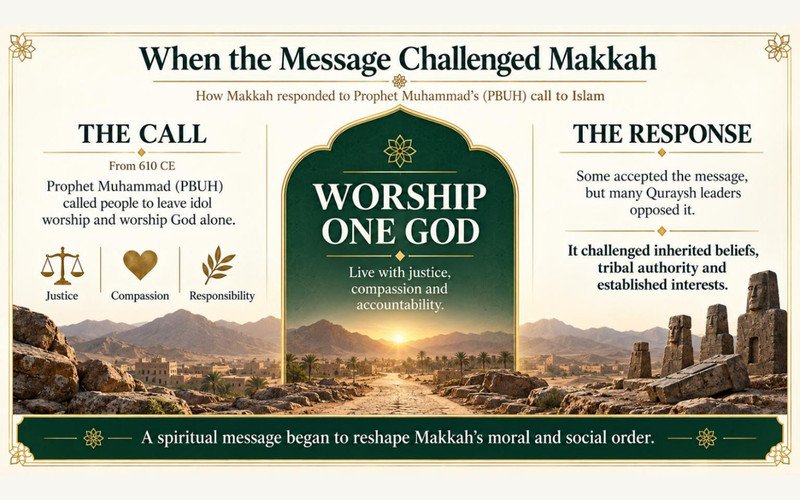
| IN BRIEF For about three years Muhammad ﷺ shared his message privately, then publicly, notably from Mount Safa. He called Makkans to worship one God alone and to live with justice and compassion. Some accepted, including people of low status and some of high rank, but many Quraysh leaders opposed him. The message challenged ancestral belief, the authority of clan leaders and the status of the Ka‘bah as a centre of pilgrimage and trade. |
|---|
Detailed Story
Makkah before the message
Makkah was a sanctuary town centred on the Ka‘bah, which the Quraysh tended. Tradition says the sanctuary held many idols; Ibn al-Kalbi’s Book of Idols gives the traditional count of 360 around the Ka‘bah. Pilgrims brought prestige and trade to the Quraysh. Arabia was not uniformly polytheist: Jews, Christians and monotheist seekers called hanifs also lived there. Waraqa ibn Nawfal, Khadijah’s cousin, is described as a Christian scholar.
The private and public call
After the first revelation the Prophet ﷺ invited people quietly. The first to believe included Khadijah, his cousin Ali, his freedman Zayd ibn Haritha and his friend Abu Bakr. Revelation then commanded him to warn his closest kin (26:214) and to proclaim openly (15:94). Ibn Abbas reports that he climbed Mount Safa and called the Makkans, asking whether they would believe him if he said an army was behind the mountain. They said they had never known him to lie, and then he warned them of a coming judgement; Abu Lahab, an uncle, rejected him angrily (Sahih al-Bukhari 4770).
What he asked of them
The message had three strands. First, worship of one God and rejection of idols. Second, belief in resurrection and judgement, which many Makkans found hard to accept (17:49–51). Third, social ethics: honour orphans, feed the poor, be honest in weights and trade (89:17–20; 107; 83:1–3). Early followers were a mix of the young, the poor, slaves such as Bilal, and some leading figures such as Uthman ibn Affan.
Why many resisted
The sources and historians suggest several overlapping reasons. Theological: rejecting ancestral religion was seen as disloyal. Political: Quraysh leaders feared losing authority to the Banu Hashim clan. Economic: Watt and others argued that pilgrimage-related income gave leaders a stake in the existing shrine. Social: the message that slaves and masters were equal before God cut across hierarchy. Not every Makkan opposed him: his uncle Abu Talib, who never became a Muslim by most accounts, protected him under clan custom.
What the opposition shows
The Qur’an itself preserves the objections it faced, such as the demand for miracles and the complaint that he was merely human (17:90–93). The gallery’s theme, that a spiritual message reshaped Makkah’s moral and social order, is borne out by Muslim and academic accounts alike.
| FACTS & FIGURES Private preaching lasted about three years according to Ibn Ishaq; the public call followed, traditionally dated to c. 613 CE. The Prophet’s first followers included Khadijah, Ali, Zayd ibn Haritha and Abu Bakr. Tradition counts 360 idols around the Ka‘bah (Ibn al-Kalbi). |
|---|
| IMPORTANT DISTINCTION: Pre-Islamic Arabia ≠ uniformly pagan Jews, Christians and monotheist hanifs lived in and around the Hijaz. The message challenged polytheism in Makkah specifically, not the existence of other monotheist communities. |
|---|
Related Topics
• Article 5: The Mission of the Prophet: One God, Justice, Mercy and Moral Character
• Article 7: From Ridicule to Boycott: Opposition and Persecution in Makkah
• Article 9: The Hijrah: Why the Prophet Migrated to Madinah
Sources & Further Reading
• Qur’an 15:94, 17:49–51, 26:214, 89:17–20, 107, 83:1–3. https://quran.com
• Sahih al-Bukhari 4770 (the call at Safa). https://sunnah.com/bukhari:4770
• Ibn al-Kalbi, The Book of Idols, trans. Nabih Amin Faris (Princeton University Press, 1952).
• Ibn Hisham / Ibn Ishaq, The Life of Muhammad, trans. A. Guillaume (Oxford, 1955).
• Robert G. Hoyland, Arabia and the Arabs (Routledge, 2001).
• W. Montgomery Watt, Muhammad at Mecca (Oxford, 1953).
• Safiur Rahman al-Mubarakpuri, The Sealed Nectar (Ar-Raheeq Al-Makhtum) (Darussalam, 1996).
• Ibn Kathir, The Life of the Prophet Muhammad (al-Sira al-Nabawiyya), trans. Trevor Le Gassick (Garnet Publishing, 1998–2000).