
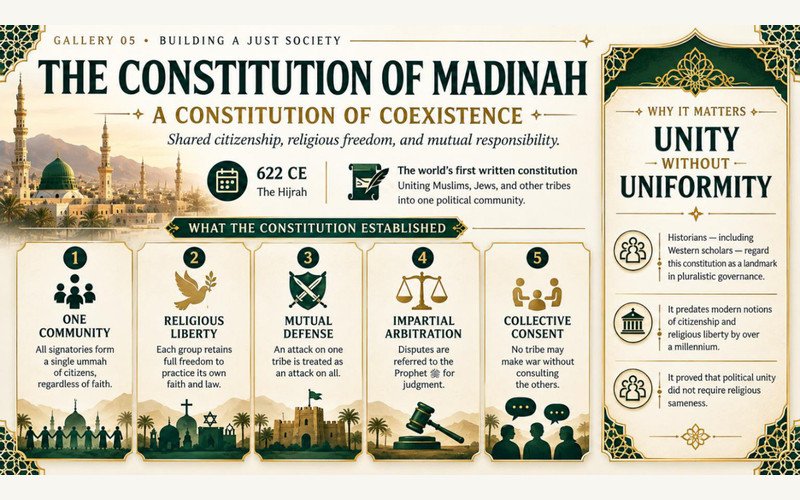
| IN BRIEF Soon after arriving in Madinah the Prophet ﷺ agreed a written covenant, known as the Charter of Madinah, among the Muslim emigrants, the Madinan Muslims and other groups including Jewish clans. Historians called it the first written constitution in the world. It created a shared community with mutual defence, religious freedom for each group and the Prophet ﷺ as arbiter, and it stands as an early model of coexistence under a common law. |
|---|
Detailed Story
The document
The text, called Sahifat al-Madina or Kitab al-Umma, survives in quotations in Ibn Ishaq’s biography (via Ibn Hisham) and in Abu ‘Ubayd’s Kitab al-Amwal, with other citations in later works. It lays out obligations in some forty-odd clauses, depending on how modern editors number them.
What it provided
• The Muslims of Quraysh and Yathrib, and those who joined them, form one community (umma) distinct from others.
• Mutual defence: those who are party to the document defend Yathrib against attack, and no group makes peace or war separately without the others.
• Religious freedom: the Jewish clans named in the document are part of the community alongside the believers; “to the Jews their religion and to the Muslims theirs”.
• Blood-money and ransom are handled by customary arrangements, reducing the cycle of tribal feuds.
• Disputes are referred to God and Muhammad ﷺ; Yathrib is declared a sanctuary for the parties of the document.
• No protection is offered to Quraysh of Makkah, who were then hostile.
Scholarly appreciation
Muhammad Hamidullah devoted a study to the Charter and described it as the foundation of the Madinan state. Academic historians including W. Montgomery Watt and Fred Donner likewise regard it as an authentic early charter, and Donner points out that the umma it created included righteous Jews and Christians alongside the believers.
A pioneering written covenant
Muhammad Hamidullah called the Charter the first written constitution in the world. Earlier written legal codes existed, such as the Code of Ur-Nammu (c. 2100 BCE) and Hammurabi’s laws (c. 1750 BCE), but the Charter is remarkable as an early written covenant that creates a single political community of different faiths with defined rights and duties. It predates modern constitutions such as that of the United States (1787) and Poland (1791) by well over a thousand years.
What followed
The Prophet ﷺ upheld the Charter’s terms within the Madinan community. The later conflicts with the Banu Qaynuqa, Banu Nadir and Banu Qurayza arose, according to our sources, from breaches of the agreements and from treachery in wartime.
Relevance for India
India’s Constitution (1950) guarantees freedom of religion in Articles 25–28. The two belong to different eras, but both reflect the idea that a political community can include people of different faiths under shared obligations.
| FACTS & FIGURES 622 CE (approximate date): early Madinan period. Preserved by Ibn Ishaq (d. c. 767) and Abu ‘Ubayd (d. 838). Hamidullah (1941) described the document as the first written constitution in the world. Code of Ur-Nammu: c. 2100 BCE. United States Constitution: 1787. Poland’s Constitution of 3 May 1791 is among the earliest modern written constitutions in Europe. |
|---|
| IMPORTANT DISTINCTION: A covenant of mutual protection The Charter was a covenant among tribes and religious groups under the Prophet ﷺ as arbiter. Its lasting value is as an early model of coexistence and mutual protection. |
|---|
Related Topics
• Article 9: The Hijrah: Why the Prophet Migrated to Madinah
• Article 11: A Society Transformed: What Changed in Twenty-Three Years?
• Article 15: Hostility After the Hijrah: Badr, Uhud, the Trench and Hudaybiyyah
Sources & Further Reading
• Ibn Hisham / Ibn Ishaq, The Life of Muhammad, trans. A. Guillaume (Oxford, 1955), pp. 231–233.
• Fred M. Donner, Muhammad and the Believers (Harvard University Press, 2010).
• Muhammad Hamidullah, Majmu‘at al-Watha’iq al-Siyasiyya (Cairo, 1941).
• Muhammad Hamidullah, The First Written Constitution in the World (Sh. Muhammad Ashraf, Lahore, 1941).