
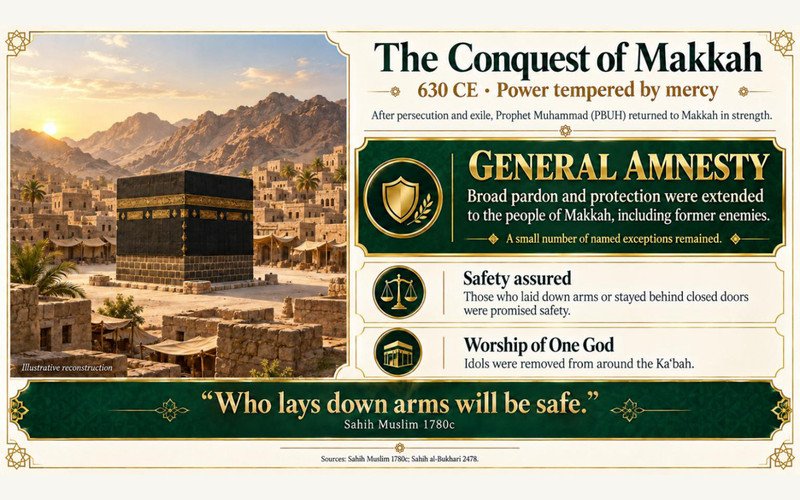
| IN BRIEF In January 630 CE the Prophet ﷺ entered Makkah with about 10,000 men after the Quraysh and their allies broke the Hudaybiyyah truce. He declared protection for those who stayed at home, laid down arms or took refuge at the Ka‘bah or Abu Sufyan’s house, removed the idols around the Ka‘bah and pardoned most former enemies. A small number of named individuals were excluded, and some of these were executed. |
|---|
Detailed Story
Why the march
Two years into the Hudaybiyyah truce, a clan allied with the Quraysh attacked Khuza‘a, an ally of the Prophet ﷺ. The Prophet ﷺ regarded the truce as broken and marched on Makkah in Ramadan, 8 AH (January 630) with about 10,000 men.
Entering the city
Abu Sufyan, who had led Quraysh opposition, came out and accepted Islam. The Prophet ﷺ is reported to have announced that whoever entered Abu Sufyan’s house, whoever laid down arms, and whoever closed his door would be safe (Sahih Muslim 1780). The army entered from several sides. Most met no resistance; one column under Khalid ibn al-Walid met some, and Ibn Ishaq reports about two Muslims and twelve or so of the opposing side killed.
At the Ka‘bah
The Prophet ﷺ circled the Ka‘bah and had the idols removed from it and around it, reciting that truth had come and falsehood vanished (17:81). Tradition says he then addressed the Quraysh, asking what they expected of him. They answered that he was a noble brother and the son of a noble brother. The words “Go, for you are free” are widely quoted from Ibn Ishaq and later sources as his answer, echoing the words of the Prophet ﷺ Yusuf to his brothers (12:92).
The general amnesty and its exceptions
The amnesty was wide. A very small number of individuals named by Ibn Ishaq were excluded because of earlier killings or acts of treachery, and some of them were executed, for example Abdullah ibn Khatal and Miqyas ibn Subaba. Most of those who sought mercy were forgiven, including Ikrima ibn Abi Jahl, Safwan ibn Umayya, Hind bint ‘Utba and Wahshi, the killer of Hamza (RA). Abdullah ibn Sa‘d ibn Abi Sarh was pardoned after Uthman’s intercession.
What followed
The Qur’an says that there is no compulsion in religion (2:256), and the Prophet ﷺ did not impose conversion on Makkans, though political submission and public allegiance followed and many soon embraced Islam. He did not make Makkah his capital but returned to Madinah, leaving a young governor, ‘Attab ibn Usayd. Soon after, the Battle of Hunayn was fought against the Hawazin and Thaqif tribes.
Historical context
In late antiquity, conquered cities were often sacked. The Prophet’s ﷺ clemency toward Makkah stands out, and academic historians such as Watt likewise describe the conquest as notably restrained, while our tradition sees in it a supreme act of mercy and forgiveness.
| FACTS & FIGURES Date: 20 Ramadan 8 AH, about January 630 CE. Army: about 10,000. Reported fighting deaths: about two Muslims and about a dozen opponents (Ibn Ishaq). Idols around the Ka‘bah: 360 according to tradition. Governor appointed: ‘Attab ibn Usayd, then about 20 years old, according to later sources. |
|---|
| IMPORTANT DISTINCTION: General amnesty ≠ no exceptions The pardon was extensive, but the sources list a few people exempted and some were executed. The accurate statement is that the vast majority were forgiven and bloodshed was minimal. |
|---|
Related Topics
• Article 15: Hostility After the Hijrah: Badr, Uhud, the Trench and Hudaybiyyah
• Article 16: The Ethics of Conflict: Restraint, Peace and Protection of Non-Combatants
• Article 17: Prisoners of War: Dignity, Release and Ransom
Sources & Further Reading
• Qur’an 2:256, 17:81. https://quran.com
• Sahih Muslim 1780 (conquest of Makkah). https://sunnah.com/muslim:1780
• Sahih al-Bukhari, Book of Military Expeditions (Maghazi), chapters on the conquest of Makkah. https://sunnah.com/bukhari/64
• Ibn Hisham / Ibn Ishaq, The Life of Muhammad, trans. A. Guillaume (Oxford, 1955), pp. 543–553.
• W. Montgomery Watt, Muhammad at Medina (Oxford, 1956).
• Martin Lings, Muhammad (Allen & Unwin, 1983).
• Safiur Rahman al-Mubarakpuri, The Sealed Nectar (Ar-Raheeq Al-Makhtum) (Darussalam, 1996).
• Ibn Kathir, The Life of the Prophet Muhammad (al-Sira al-Nabawiyya), trans. Trevor Le Gassick (Garnet Publishing, 1998–2000).