
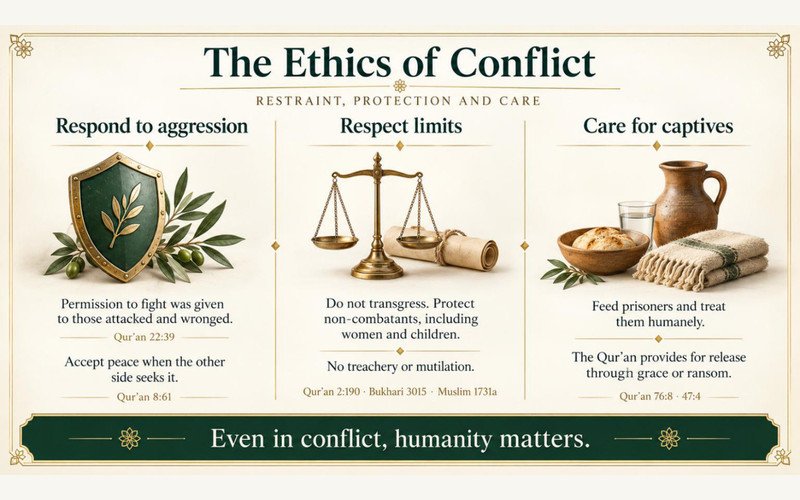
| IN BRIEF The Qur’an and the Prophet’s ﷺ instructions allow fighting only in response to aggression, command acceptance of peace when the enemy seeks it, and forbid transgression. Soldiers were told not to kill women, children and the elderly, not to mutilate bodies, not to destroy without need, and to treat prisoners humanely. These rules predate the Geneva Conventions by over a thousand years. |
|---|
Detailed Story
Permission, not obligation to aggress
The first permission to fight was given to those who had been wronged (22:39). The Qur’an commands Muslims to fight those who fight them “but do not transgress” (2:190), and to incline to peace when the enemy does (8:61). It encourages kindness and justice towards non-Muslims who have not fought them (60:8) and requires that a person seeking asylum be given safe conduct (9:6). It declares that killing one innocent person is like killing all humanity (5:32).
Instructions to commanders
Buraydah (RA) reports the Prophet’s ﷺ standing instructions when sending an army: fight in God’s name, do not steal from the spoils, do not betray, do not mutilate and do not kill children (Sahih Muslim 1731). When he saw a woman killed in a raid he forbade killing women and children (Sahih al-Bukhari 3015). Other reports forbid mutilation and plunder (Sahih al-Bukhari 2474) and punishing with fire (Sahih al-Bukhari 3016). Abu Bakr’s (RA) instructions to the army sent to Syria, recorded in Malik’s Muwatta, added bans on killing the old, cutting fruit trees or destroying inhabited places, and killing animals except for food. They also told soldiers to leave monks in their cells.
Care and justice
The same teaching requires honouring treaties and not breaking agreements. The Qur’an requires justice even toward an enemy (5:8). The exhibition’s theme “even in conflict, humanity matters” reflects these principles.
Developed in law
Muslim jurists developed these rules into a branch of law called siyar. The early jurist al-Shaybani (d. 805) wrote a major work on it, and later scholars such as Majid Khadduri, Sohail Hashmi and Asma Afsaruddin have described how carefully our jurists set out the conditions and limits of war. Many contemporary scholars emphasise that armed struggle is justified for defence and for the protection of the oppressed.
The standard
The Prophet’s ﷺ rules remain the standard by which every Muslim army and individual is judged. Attacks on civilians committed in the name of Islam are condemned by our scholars and institutions as violations of it.
Comparison with modern law
The Hague Conventions (1899, 1907) and the Geneva Conventions (1949) are the foundations of modern international humanitarian law. Their principles of distinction between combatants and civilians and humane treatment of prisoners resemble principles in classical Islamic law, a similarity noted by the International Committee of the Red Cross and by scholars such as Muhammad Hamidullah. The principles the Prophet ﷺ taught in the seventh century therefore anticipated, by more than a millennium, norms the world adopted in the twentieth.
| FACTS & FIGURES Qur’an 22:39 (permission to fight the wronged), 2:190 (no transgression), 8:61 (accept peace), 5:32 (sanctity of life). Hague Conventions: 1899 and 1907. Geneva Conventions: 1949. Al-Shaybani’s Kitab al-Siyar al-Kabir dates to the late 8th century CE (he died 805). |
|---|
| IMPORTANT DISTINCTION: Jihad ≠ holy war ≠ terrorism Jihad means striving; the Qur’an uses the root in the sense of moral struggle too (25:52). Armed jihad has strict conditions in classical law, and attacks on civilians are prohibited. Individual Muslims’ or groups’ crimes are not Islamic doctrine. |
|---|
Related Topics
• Article 15: Hostility After the Hijrah: Badr, Uhud, the Trench and Hudaybiyyah
• Article 17: Prisoners of War: Dignity, Release and Ransom
• Article 18: The Conquest of Makkah and the General Amnesty
Sources & Further Reading
• Qur’an 2:190, 5:8, 5:32, 8:61, 9:6, 22:39, 25:52, 60:8. https://quran.com
• Sahih Muslim 1731. https://sunnah.com/muslim:1731
• Sahih al-Bukhari 2474, 3015, 3016. https://sunnah.com/bukhari:3015
• Malik ibn Anas, al-Muwatta’, Book of Jihad (instructions of Abu Bakr).
• Majid Khadduri, War and Peace in the Law of Islam (Johns Hopkins Press, 1955).
• Sohail H. Hashmi (ed.), Just Wars, Holy Wars, and Jihads (Oxford University Press, 2012).
• Asma Afsaruddin, Striving in the Path of God: Jihad and Martyrdom in Islamic Thought (Oxford University Press, 2013).
• Muhammad Hamidullah, The Muslim Conduct of State (Ashraf, 1945).
• Mohammad Hashim Kamali, Shari‘ah Law: An Introduction (Oneworld, 2008).