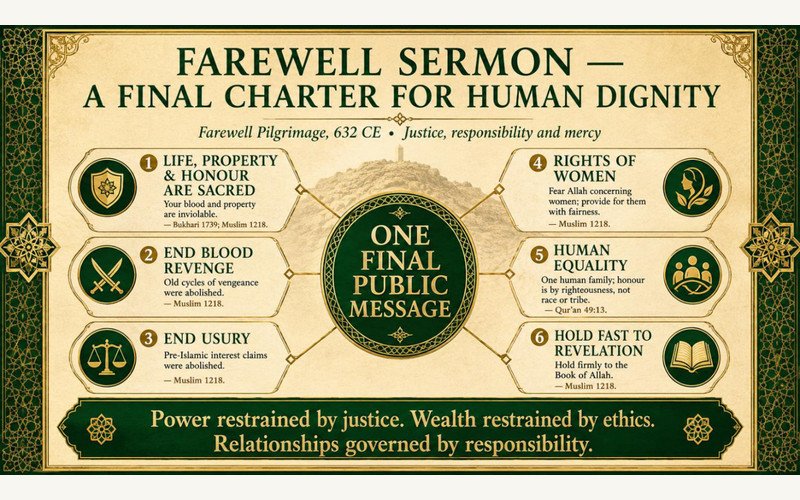
| IN BRIEF At Mount Arafah on 9 Dhu al-Hijjah, 10 AH (early March 632 CE), during his only full pilgrimage, the Prophet ﷺ addressed a very large gathering. The sermon, preserved across several hadith narrations, declared the sanctity of life, property and honour, cancelled pre-Islamic blood feuds and interest, urged fair treatment of women, affirmed that no race or tribe is superior and told the audience to convey the message onward. It is often called a charter of human dignity. |
|---|
Detailed Story
Setting
The Prophet ﷺ performed his farewell pilgrimage in the tenth year after the Hijrah. Traditional accounts say that more than 100,000 people were present. He spoke from his camel at Arafah, and the sermon was repeated for the crowd by Rabi‘a ibn Umayya. He died about three months later, on 8 June 632.
One sermon, several narrations
The sermon was delivered on several occasions during the pilgrimage, and the Companions preserved it in many narrations: Jabir’s long account of the pilgrimage in Sahih Muslim 1218, Abu Bakra’s report of the sermon at Mina (Sahih al-Bukhari 67, 1741; Sahih Muslim 1679), Ibn ‘Abbas (Sahih al-Bukhari 1739) and others. The lines on equality come from Musnad Ahmad 23489, and the teaching on wishing for one’s brother what one wishes for oneself from Sahih al-Bukhari 13; together they form the well-known text of the sermon.
Main themes
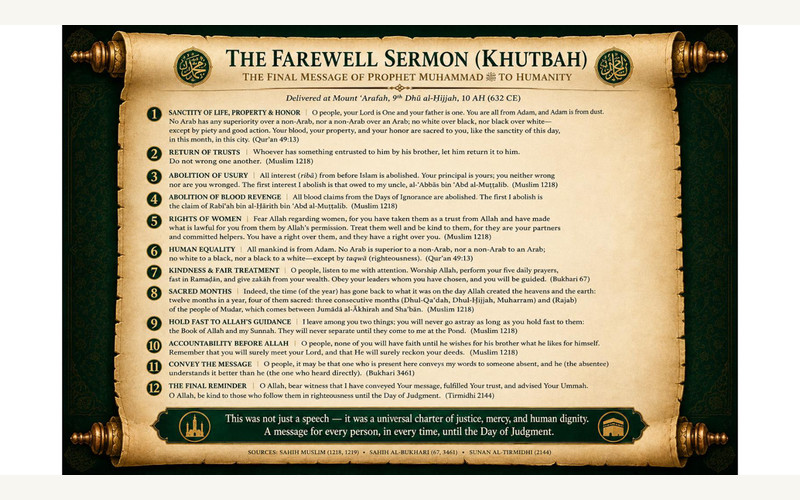
• Sanctity of life, property and honour: “Your blood, your property and your honour are sacred to you,” like the sanctity of the day, month and city (Sahih al-Bukhari 1739; Sahih Muslim 1218).
• End of blood revenge: all blood claims of the Days of Ignorance are abolished, beginning with that of the Prophet’sﷺ own relative Rabi‘a ibn al-Harith (Sahih Muslim 1218).
• End of pre-Islamic interest: interest owed from before Islam is abolished, beginning with that owed to his uncle al-‘Abbas (Sahih Muslim 1218).
• Women: fear God regarding women, who have rights over men and men over them (Sahih Muslim 1218). A related report calls women “helpers” (‘awan) of men (Sunan al-Tirmidhi 1163).
• Equality: all people descend from Adam; no Arab is superior to a non-Arab, nor a non-Arab to an Arab, nor white to black, except by God-consciousness (Musnad Ahmad 23489; compare Qur’an 49:13).
• Scripture and conveying the message: the Book of God as guidance (Sahih Muslim 1218), and “let the one who is present convey to the one who is absent” (Sahih al-Bukhari 67).
Notes on wording
Sahih Muslim 1218 records the Prophet ﷺ leaving the “Book of God” as the safeguard against going astray. Other narrations add “and my Sunnah” (Malik’s Muwatta; al-Hakim’s Mustadrak) and “and my family” (Sahih Muslim 2408; Sunan al-Tirmidhi 3786), and together they teach holding fast to the Qur’an, following the Prophet’sﷺ example and loving his household.
Human dignity and modern rights
The sermon’s language is often compared with the Universal Declaration of Human Rights (1948), whose first article states that all human beings are born free and equal in dignity and rights. The themes are close: dignity, equality, and the protection of life and property. Scholars such as Mohammad Hashim Kamali show how these principles are rooted in Islam’s own sources. The Farewell Sermon stands as a charter of human dignity delivered fourteen centuries ago.
Revelation at Arafah
Tradition says that on that day the verse “Today I have perfected your religion for you” (5:3) was revealed (Sahih al-Bukhari 45).
The exhibition’s interactive concept
The panel describing a door-based installation, where visitors encounter questions such as whether race makes anyone superior, is a design for the gallery, and its questions correspond to the sermon’s themes above.
| FACTS & FIGURES Date: 9 Dhu al-Hijjah, 10 AH, early March 632 CE; death on 8 June 632. Attendance: traditionally more than 100,000. UDHR, Article 1 (1948): “All human beings are born free and equal in dignity and rights.” Hadith sources: Sahih Muslim 1218; Sahih al-Bukhari 67, 1739, 1741; Musnad Ahmad 23489. |
|---|
| IMPORTANT DISTINCTION: One sermon, preserved in many narrations The sermon was delivered on several occasions during the pilgrimage, and the Companions preserved it in many narrations. Each reference above names its collection, so readers can consult the wording in its source. |
|---|
Related Topics
• Article 11: A Society Transformed: What Changed in Twenty-Three Years?
• Article 21: Simplicity and Generosity: How the Prophet Lived and What He Left
• Article 5: The Mission of the Prophet: One God, Justice, Mercy and Moral Character
Sources & Further Reading
• Sahih Muslim 1218 (Jabir’s hadith on the Prophet’s pilgrimage). https://sunnah.com/muslim:1218a
• Sahih al-Bukhari 13, 45, 67, 1739, 1741. https://sunnah.com/bukhari:1739
• Musnad Ahmad ibn Hanbal, hadith 23489 (equality).
• Sunan al-Tirmidhi 1163 and 3786. https://sunnah.com/tirmidhi:3786
• Sahih Muslim 1679 and 2408. https://sunnah.com/muslim:1679
• Ibn Hisham / Ibn Ishaq, The Life of Muhammad, trans. A. Guillaume (Oxford, 1955), pp. 649–651.
• United Nations, Universal Declaration of Human Rights (1948). https://www.un.org/en/about-us/universal-declaration-of-human-rights
• Safiur Rahman al-Mubarakpuri, The Sealed Nectar (Ar-Raheeq Al-Makhtum) (Darussalam, 1996).
• Ibn Hajar al-‘Asqalani, Fath al-Bari bi-Sharh Sahih al-Bukhari (15th century).
• Mohammad Hashim Kamali, Freedom, Equality and Justice in Islam (Islamic Texts Society, 2002).