
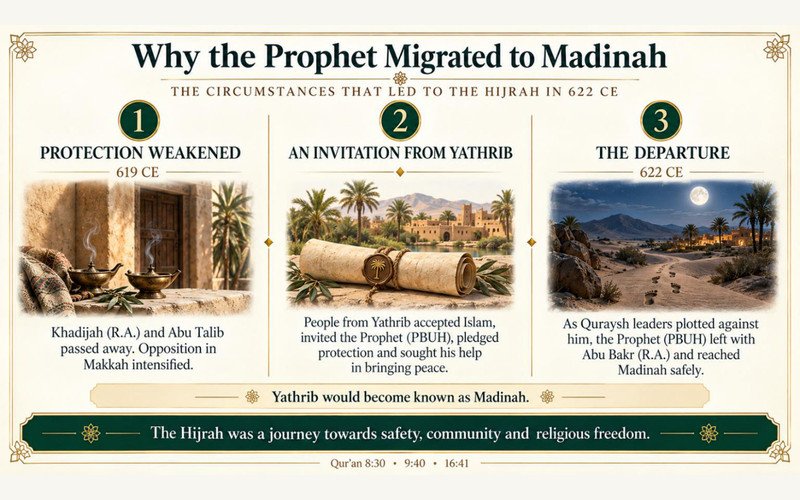
| IN BRIEF In 622 CE the Prophet ﷺ migrated from Makkah to Yathrib, soon called Madinah. After the deaths of Khadijah and Abu Talib in 619 his position had weakened, while delegations from Yathrib pledged to protect him and asked him to arbitrate their feuds. When Quraysh leaders plotted against him, he left with Abu Bakr and reached Madinah safely. The Hijrah became year 1 of the Islamic calendar. |
|---|
Detailed Story
Why leave Makkah?
Three pressures converged. First, the deaths of Khadijah and Abu Talib in 619 removed his support at home and his clan protection. Second, after Ta’if rejected him he sought a new base. Third, Yathrib, an oasis about 350 km north, was divided between the Aws and Khazraj Arab tribes, exhausted by wars such as the Battle of Bu‘ath (c. 617), and shared the town with Jewish clans. Some Yathribites had met the Prophet ﷺ during pilgrimage seasons and were open to a leader who could act as impartial arbitrator.
The pledges of al-‘Aqabah
In 621, six men from Khazraj accepted Islam; in 621–622 twelve and then about seventy-three men and two women pledged at al-‘Aqabah, near Makkah, to protect the Prophet ﷺ as they would their own families. Mus‘ab ibn Umayr was sent to teach them. Muslim families began migrating in small groups.
The plot and the departure
Quraysh leaders met in the Dar al-Nadwa and resolved to prevent his departure. The Qur’an refers to this plotting (8:30). The Prophet ﷺ left Makkah by night with Abu Bakr, while Ali remained in his bed to hold entrusted deposits. They hid for three days in the cave of Thawr, south of the town. Qur’an 9:40 recalls that he told his companion not to grieve, because God was with them. Aisha’s (RA) long narration in Sahih al-Bukhari 3905 gives the details, including the guide Abdullah ibn Uraqit and a pursuit by Suraqa ibn Malik.
Arrival in Madinah
After about a week on the road he stopped at Quba, where he is traditionally said to have founded the first mosque, and entered Madinah in September 622. The people reportedly welcomed him, and tradition holds that every household hoped he would stay with them. He lodged with Abu Ayyub al-Ansari and then built a mosque and living quarters. Yathrib came to be known as Madinat al-Nabi, “the City of the Prophet ﷺ”, or simply Madinah.
Why the Hijrah matters
The Qur’an praises those who left their homes after being wronged (16:41). Politically, it transformed a persecuted group into a community with its own governance. The caliph Umar later set the start of the Islamic calendar at the Hijrah, not the Prophet’s birth or the first revelation, which Muslims interpret as taking the founding of the community as the beginning of history. The Hijri year, based on lunar months, began in 622 CE; the year 1448 AH began in mid-2026.
A turning point in history
Academic historians, including Watt and Fred Donner, likewise treat the Hijrah as the turning point when Prophet Muhammad’s pbuh role grew from preacher to leader of a community.
| FACTS & FIGURES 619 CE: death of Khadijah and Abu Talib. 621–622 CE: pledges at al-‘Aqabah. Hijrah: September 622 CE. The Hijri calendar counts from 1 Muharram, 1 AH, corresponding to 16 July 622 CE. Distance from Makkah to Madinah: roughly 350–450 km depending on the route. Caliph Umar introduced the Hijri calendar around 638 CE (17 AH). |
|---|
| IMPORTANT DISTINCTION: Hijrah ≠ flight only The Hijrah was not only an migration but a negotiated move: Madinah’s representatives pledged protection, and the migration created a new political community and calendar. |
|---|
Related Topics
• Article 7: From Ridicule to Boycott: Opposition and Persecution in Makkah
• Article 10: The Charter of Madinah: Pluralism, Citizenship and Coexistence
• Article 15: Hostility After the Hijrah: Badr, Uhud, the Trench and Hudaybiyyah
Sources & Further Reading
• Qur’an 8:30, 9:40, 16:41. https://quran.com
• Sahih al-Bukhari 3905 (the Hijrah). https://sunnah.com/bukhari:3905
• Ibn Hisham / Ibn Ishaq, The Life of Muhammad, trans. A. Guillaume (Oxford, 1955).
• W. Montgomery Watt, Muhammad at Medina (Oxford University Press, 1956).
• Fred M. Donner, Muhammad and the Believers: At the Origins of Islam (Harvard University Press, 2010).
• Martin Lings, Muhammad: His Life Based on the Earliest Sources (Allen & Unwin, 1983).
• Safiur Rahman al-Mubarakpuri, The Sealed Nectar (Ar-Raheeq Al-Makhtum) (Darussalam, 1996).
• Ibn Qayyim al-Jawziyya, Zad al-Ma‘ad fi Hady Khayr al-‘Ibad (14th century).
• Shibli Nomani and Sulaiman Nadwi, Sirat-un-Nabi (Dar al-Musannifin, Azamgarh; English translation, Kitab Bhavan, New Delhi).
Theme 3: Building a Society in Madinah
The Charter of Madinah and the social changes associated with the Prophet’s leadership.