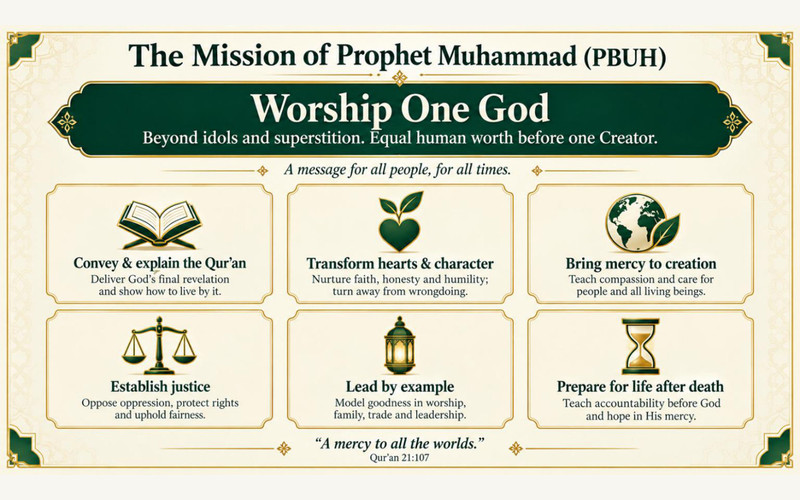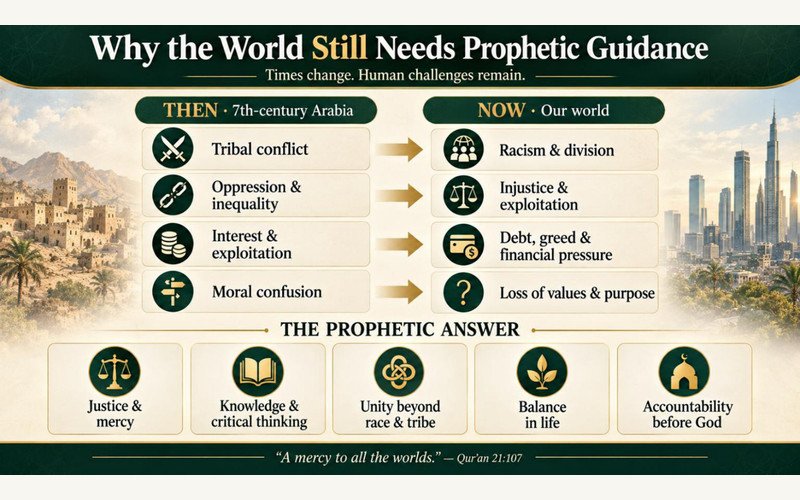
| IN BRIEF We understand Muhammad’s pbuh mission as calling people to worship one God, delivering and explaining the Qur’an, shaping character, establishing justice, showing mercy and teaching accountability after death. The Qur’an calls him “a mercy to all the worlds” (21:107). The gallery sets seventh-century Arabia beside today’s world, and the Prophet’s teachings on justice, equality and compassion speak to both. |
|---|
Detailed Story
The starting point: belief in one God
At the heart of the mission is tawhid, the oneness of God. The Qur’an presents the Prophet’s first task as calling people away from idols and from reliance on tribe, ancestry or wealth, to worship God alone (e.g. 112:1–4). From that principle follow equal worth of all humans before one Creator, as stated in 49:13: people were made into nations and tribes so that they might know one another, and the most honoured is the most God-conscious.
Transforming character
A widely cited hadith has the Prophet ﷺ saying that he was sent to perfect noble character (al-Bukhari, al-Adab al-Mufrad 273). The Qur’an describes him as being “of a great moral character” (68:4). Our tradition stresses honesty, humility, patience, keeping promises and forgiveness. Even before prophethood, he took part around 590 CE in the Hilf al-Fudul, an agreement among Makkan clans to defend wronged persons, and later said he would honour such a pact even in Islam (Ibn Hisham; Musnad Ahmad).
Justice and mercy
The Qur’an commands justice even toward enemies (5:8) and even against one’s own family (4:135). It condemns oppression, the exploitation of orphans, and cheating in trade (83:1–3). The exhibition’s theme of mercy rests on 21:107 and on hadith such as the report that “he who does not show mercy will not be shown mercy” (Sahih al-Bukhari 5997), and reports on kindness to animals (Sahih al-Bukhari 3321).
Accountability and hope
Belief in life after death gives the message its moral weight: actions matter because everyone will answer for them. Yet the tradition also stresses hope in God’s mercy (39:53). Muslim teaching on the hereafter is thus both a warning and a consolation.
Reading the “then and now” comparison
The gallery pairs seventh-century problems such as tribal conflict, oppression and interest with modern ones such as racism and debt. We find in the Prophet’s teachings timeless answers to each, and academic writers such as Watt likewise recognised that his message met a real moral and social need in Makkah as it moved from tribal solidarity to commercial wealth.
| Problem named in the exhibition | Teaching in the sources | Reference |
|---|---|---|
| Tribal pride and racism | Honour is by God-consciousness, not tribe or race | Qur’an 49:13; Musnad Ahmad 23489 |
| Oppression and injustice | Justice even against oneself or one’s kin | Qur’an 4:135; 5:8 |
| Exploitative interest and debt | Interest (riba) prohibited; honest contracts | Qur’an 2:275–279; 2:282 |
| Greed and moral confusion | Charity (zakat) as an obligation; accountability | Qur’an 9:60; 99:7–8 |
| FACTS & FIGURES The mission is described in the Qur’an as lasting 23 years of revelation (610–632 CE). The Hilf al-Fudul, a Makkan pact for the protection of the wronged, is dated by Ibn Ishaq to about 590 CE, roughly twenty years before the first revelation. Qur’an 49:13 is the key verse on human equality and diversity. |
|---|
| IMPORTANT DISTINCTION: Mission ≠ political conquest The Prophet ﷺ led a community in Madinah, but his mission was to convey a message of guidance, and the Qur’an affirms that there is “no compulsion in religion” (2:256). |
|---|
Related Topics
• Article 1: Prophet Muhammad: A Life at a Glance
• Article 6: The Call in Makkah: Why the Message Challenged the Quraysh
• Article 11: A Society Transformed: What Changed in Twenty-Three Years?
Sources & Further Reading
• Qur’an 2:256, 4:135, 5:8, 21:107, 49:13, 68:4, 83:1–3. https://quran.com
• Sahih al-Bukhari 5997 and 3321. https://sunnah.com/bukhari:5997
• al-Bukhari, al-Adab al-Mufrad 273. https://sunnah.com/adab:273
• Ibn Hisham / Ibn Ishaq, The Life of Muhammad, trans. A. Guillaume (Oxford University Press, 1955).
• W. Montgomery Watt, Muhammad at Mecca (Oxford University Press, 1953).
• Karen Armstrong, Muhammad: A Prophet for Our Time (HarperCollins, 2006).
• Qadi ‘Iyad, al-Shifa bi-Ta‘rif Huquq al-Mustafa, trans. Aisha Bewley as Muhammad, Messenger of Allah: Ash-Shifa (Madinah Press, 1991).
• Mohammad Hashim Kamali, Freedom, Equality and Justice in Islam (Islamic Texts Society, 2002).