
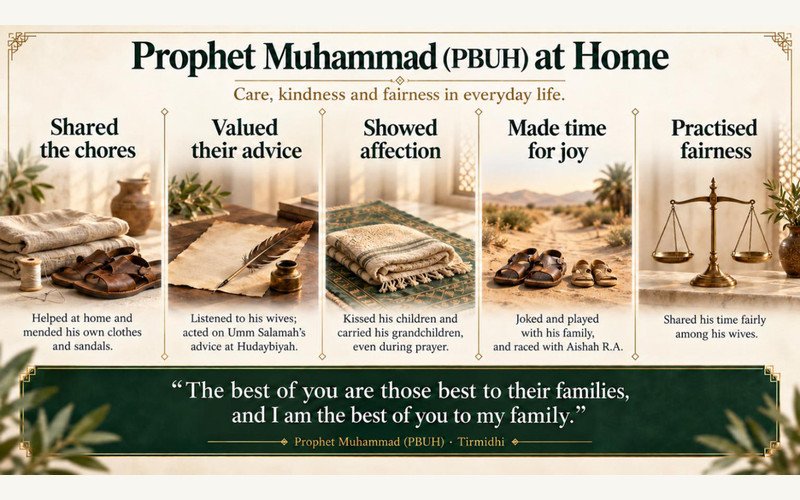
| IN BRIEF Hadith collections portray Prophet Muhammad ﷺ as an attentive family man. He is reported to have mended his own clothes, helped with housework, kissed and carried his children and grandchildren, consulted his wives and raced with Hazrat Aisha (RA). He said that the best of people are those best to their families. These reports come from his household and Companions and are consistently preserved in the main hadith collections. |
|---|
Detailed Story
Sources for his home life
Most of what is known about his home life comes from Aisha (RA) and other wives, and from Companions who visited. These accounts are found in the Sahih collections of Bukhari and Muslim and in Sunan and Musnad works. These accounts are preserved with chains of narration. Western biographers such as Karen Armstrong, and the Muslim biographer Martin Lings, also draw on them.
Sharing household work
Asked what he did at home, Aisha (RA) replied that he was in the service of his family, and when the time for prayer came he went out to pray (Sahih al-Bukhari 676). She also reported that he mended his own sandals and stitched his clothes (Musnad Ahmad 24903; graded sound). The message of these reports is that household tasks are not beneath a leader.
Affection for children and grandchildren
A bedouin chief, al-Aqra‘ ibn Habis, once saw the Prophet ﷺ kiss his grandson Hasan and remarked that he had ten children and had never kissed one. The Prophet ﷺ replied that one who shows no mercy will receive none (Sahih al-Bukhari 5997). He is reported to have carried his granddaughter Umamah on his shoulder during prayer, setting her down when he bowed (Sahih al-Bukhari 516; Sahih Muslim 543). In a society where girls had sometimes been buried alive, he honoured his daughters; he is reported to have stood to greet Fatimah and kissed her (Sunan Abi Dawud 5217).
He lost most of his children in his own lifetime, and tradition records his grief: when his infant son Ibrahim died he wept, saying that the eye weeps and the heart grieves (Sahih al-Bukhari 1303).
Consultation and humour
At Hudaybiyyah, when the Companions hesitated to follow his instruction to sacrifice and shave, he consulted his wife Umm Salama (RA), who advised him to do it first himself. He did, and the others followed (Sahih al-Bukhari 2731–2732). Aisha (RA) reports that he raced her: she won once, and later when she had gained weight he won, saying it was “one for one” (Sunan Abi Dawud 2578). He joked, but reportedly said only what was true (Sunan al-Tirmidhi 1990).
Fairness and the household
He is reported to have divided his nights equally among his wives and to have prayed to God about what was beyond his control, that is, feelings of the heart (Sunan Abi Dawud 2134). The Qur’an makes justice a condition of plural marriage (4:3) and warns that perfect equality is hard (4:129).
A saying about family
The exhibition quotes the hadith “The best of you are those best to their families, and I am the best of you to my family” (Sunan al-Tirmidhi 3895). Our scholars read it as a standard for all believers.
A note on interpretation
These accounts present the ideal that Muslims have long followed in the home, and the Prophet’s example is not only the standard for every Muslim household but to the people of all faith.
| FACTS & FIGURES Aisha (RA) is credited with 2,210 hadith; she was his closest source for domestic life. The Prophet’s sons Qasim, Abdullah and Ibrahim died in infancy; four daughters survived to adulthood, of whom Fatimah alone outlived him by a few months. The saying on the best being best to their families is in Tirmidhi 3895 and Ibn Majah 1977. |
|---|
| IMPORTANT DISTINCTION: The Prophet’sﷺ example ≠ local custom The picture in this article is the Prophet’sﷺ own conduct. Where a custom falls short of it, the custom is cultural and not part of the Prophet’sﷺ teaching. |
|---|
Related Topics
• Article 13: The Prophet’s Marriages: Purposes and Wisdom
• Article 14: A’ishah bint Abi Bakr: The Age Question, Historical Context and Scholarly Legacy
• Article 5: The Mission of the Prophet: One God, Justice, Mercy and Moral Character
Sources & Further Reading
• Sahih al-Bukhari 516, 676, 1303, 2731–2732, 5997. https://sunnah.com/bukhari:676
• Sahih Muslim 543. https://sunnah.com/muslim:543
• Sunan Abi Dawud 2134, 2578, 5217. https://sunnah.com/abudawud:2578
• Sunan al-Tirmidhi 1990, 3895. https://sunnah.com/tirmidhi:3895
• Musnad Ahmad ibn Hanbal, hadith 24903.
• Karen Armstrong, Muhammad: A Prophet for Our Time (HarperCollins, 2006).
• al-Tirmidhi, al-Shama’il al-Muhammadiyya (9th century), on the Prophet’s character and daily life.
• Qadi ‘Iyad, al-Shifa bi-Ta‘rif Huquq al-Mustafa, trans. Aisha Bewley as Muhammad, Messenger of Allah: Ash-Shifa (Madinah Press, 1991).