
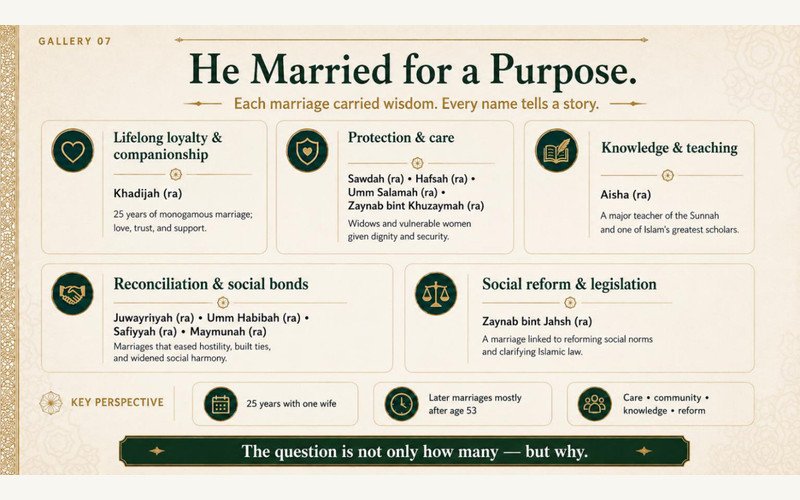
| IN BRIEF After Khadijah’s (RA) death the Prophet ﷺ had several marriages in Madinah and before it, reaching eleven wives in his lifetime (nine at his death). Each marriage carried a purpose: protecting widows, building bonds between tribes, reconciling former enemies, teaching the community and reforming social custom. Through his wives, the details of his private life were preserved for all generations. |
|---|
Detailed Story
The marriage to Hazrat Khadijah (RA)
For about 25 years, from around 595 until her death in 619, Muhammad ﷺ had one wife, Khadijah, a businesswoman who, by tradition, was older than he. She supported him in the first revelations, and he remembered her fondly for the rest of his life.
After Hazrat Khadijah (RA)
He married Sawda (RA) bint Zam‘a, a widow, soon after Khadijah’s (RA) death, and betrothed Aisha (RA), daughter of Abu Bakr (see the separate article). In Madinah he married Hafsa (RA), daughter of Umar (RA) and widowed after Badr; Zaynab (RA) bint Khuzayma, who died within months; Umm Salama (RA), widowed after Uhud; Zaynab (RA) bint Jahsh; Juwayriyya (RA) of the Banu Mustaliq; Umm Habiba (RA), daughter of Abu Sufyan; Safiyya (RA), a Jewish noblewoman taken at Khaybar and freed by him; and Maymuna (RA). Our sources also mention Mariya al-Qibtiyya (RA), an Egyptian gift, mother of Ibrahim, whose status as wife or concubine is discussed by scholars. Nine wives were alive at his death.
The explanations offered
Our tradition explains these marriages by purposes: companionship (Khadijah RA), protection of widows (Sawda, Hafsa, Umm Salama, Zaynab bint Khuzayma RA), education of the community (Aisha RA), reconciliation and alliances (Juwayriyya, Umm Habiba, Safiyya, Maymuna RA), and social reform. The marriage to Zaynab RA bint Jahsh, a cousin who had been married to his adopted son Zayd RA, is linked to Qur’an 33:37 and the ending of the legal effects of adoption.
Reports indicate concrete effects. After Juwayriyya’s RA marriage, Aisha RA said, the Muslims freed the captives of her tribe, since they were now the Prophet’sﷺ in-laws, and she knew of no woman more blessed for her people (Sunan Abi Dawud 3931). Umm Habiba’s (RA) marriage is recorded as having taken place through the Negus in Abyssinia (Ibn Sa‘d).
Wisdom behind the marriages
Academic writers such as Watt note that marriage was a recognised means of forging bonds between tribes, and the Prophet’sﷺ marriages to Juwayriyya, Umm Habiba and Safiyya, who came from tribes and families that had been hostile, helped to end enmity and open hearts. Scholars add that the Qur’an gave the Prophet ﷺ particular provisions (33:50) while limiting other men to four wives with strict fairness (4:3), and that the Qur’an later forbade him further marriages (33:52).
The wives’ role
The Qur’an calls them “mothers of the believers” (33:6) and sets for them a higher standard of conduct (33:30–34). They taught: Aisha (RA) is credited with 2,210 hadith and Umm Salama (RA) with 378. They are an important reason a large part of the Prophet’sﷺ private life is documented.
Reading the exhibition’s timeline
The panel says later marriages came mostly after age 53. That matches the Madinan period, which began when he was about 53, though his marriages to Sawda and the betrothal with Aisha came earlier, at about age 50.
| FACTS & FIGURES 25 years of monogamous marriage to Khadijah (c. 595–619 CE). Eleven wives over his lifetime in the traditional count; nine alive at his death. Mariya (RA) is counted separately by many scholars. Qur’an 4:3 limits other men to four wives on condition of fairness; 33:50–52 sets special provisions for the Prophet ﷺ. Aisha (RA) is credited with 2,210 narrations; Umm Salama (RA) with 378. |
|---|
| IMPORTANT DISTINCTION: The Prophet’s special rulings ≠ a general rule The Qur’an itself distinguishes his situation (33:50) from that of other Muslims, who are bound by the limit of four wives and by conditions of justice. Polygyny in Islam is permitted, not required, and is rare in much of the Muslim world today. |
|---|
Related Topics
• Article 12: The Prophet at Home: Family Life and Everyday Character
• Article 14: A’ishah bint Abi Bakr: The Age Question, Historical Context and Scholarly Legacy
• Article 5: The Mission of the Prophet: One God, Justice, Mercy and Moral Character
Sources & Further Reading
• Qur’an 4:3, 4:129, 33:6, 33:30–34, 33:37, 33:50–53. https://quran.com
• Sunan Abi Dawud 3931 (Juwayriyya). https://sunnah.com/abudawud:3931
• Ibn Sa‘d, Kitab al-Tabaqat al-Kabir, vol. 8, trans. Aisha Bewley, The Women of Madina (Ta-Ha, 1995).
• W. Montgomery Watt, Muhammad at Medina (Oxford, 1956).
• Denise A. Spellberg, Politics, Gender, and the Islamic Past: The Legacy of ‘A’isha bint Abi Bakr (Columbia University Press, 1994).
• Martin Lings, Muhammad (Allen & Unwin, 1983).
• Ibn Kathir, The Life of the Prophet Muhammad (al-Sira al-Nabawiyya), trans. Trevor Le Gassick (Garnet Publishing, 1998–2000).
• Safiur Rahman al-Mubarakpuri, The Sealed Nectar (Ar-Raheeq Al-Makhtum) (Darussalam, 1996).
• Shibli Nomani and Sulaiman Nadwi, Sirat-un-Nabi (Dar al-Musannifin, Azamgarh; English translation, Kitab Bhavan, New Delhi).