
| IN BRIEF the Qur’an was revealed to Muhammad ﷺ by the angel Gabriel over about 23 years. He recited it to his community, who memorised it and wrote it on materials such as palm leaves, bones and leather. After his death the text was gathered into a single volume and, under the third caliph Uthman (r. 644–656), standardised copies were sent to major cities. Radiocarbon dating of early manuscripts supports a very early written text. |
|---|
Detailed Story
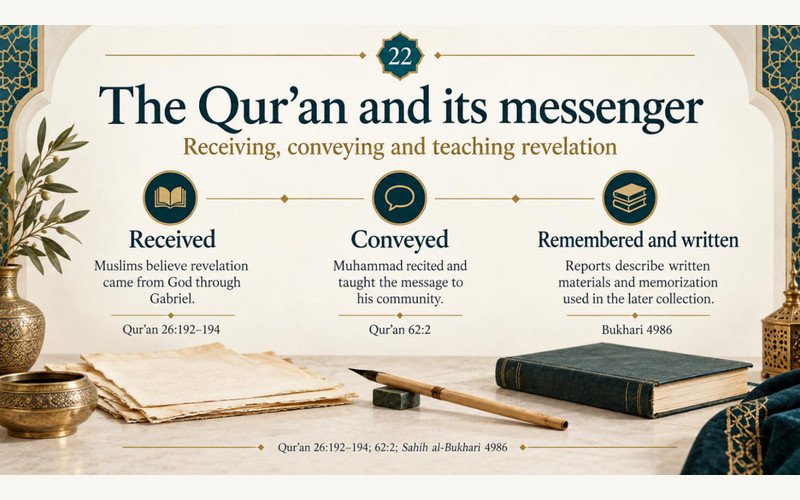
Received
The Qur’an presents itself as revelation brought to Muhammad’s heart by the “Trustworthy Spirit” in clear Arabic (26:192–195). Tradition identifies Gabriel as that angel. Revelation came in portions, sometimes a few verses and sometimes a whole chapter, in response to events and questions in his community. The first words are linked to 96:1–5; the last is traditionally linked to the days around the Farewell Pilgrimage.
Conveyed
The Qur’an describes Muhammad ﷺ as one who recites God’s verses to the people, purifies them and teaches them “the Book and wisdom” (62:2). In practice this meant public recitation, teaching and daily prayer, in which Muslims recite portions of the Qur’an aloud. Several Companions were known as scribes of revelation, among them Zayd ibn Thabit.
Memorised and written
Arabia in the 7th century had a strong oral culture, and memorisation of the Qur’an began in the Prophet’s lifetime. Writing was used as well. Reports describe verses being recorded on palm-leaf stalks, flat stones, shoulder bones and pieces of leather (Sahih al-Bukhari 4986).
After many reciters were martyred in the Battle of Yamama (632–633), the first caliph, Abu Bakr, asked Zayd ibn Thabit to collect the scattered written material and the memorised text into a single copy. Later, when differences in recitation appeared among troops from different regions, the caliph Uthman had Zayd and other scribes prepare standard copies and sent them to the main cities; other variant copies were withdrawn (Sahih al-Bukhari 4986–4987). This careful process, carried out before the Companions who had learned the Qur’an directly from the Prophet ﷺ, is why Muslims everywhere recite the same text.
What the manuscripts show
Physical evidence supports an early date for the written text. The University of Birmingham’s Mingana collection holds two parchment leaves with parts of surahs 18–20. Radiocarbon analysis at Oxford dated the parchment to between 568 and 645 CE with 95.4% probability.
Readings and printing today
Alongside the written text, Muslims preserve recitation traditions known as qira’at. Ten are recognised as canonical and they differ mainly in pronunciation and a small number of word forms. Most printed copies today, including most in India, follow the reading of Hafs from ‘Asim, while North and West Africa commonly use Warsh. The Cairo edition of 1924 helped standardise printed text.
Muslim belief and historical method
the Qur’an is the speech of God and that its preservation is a divine promise (15:9). The manuscript evidence, from the Birmingham parchment to the standard copies sent out by Uthman, fits that promise: the text recited today is the text recited in the Prophet’s time.
| FACTS & FIGURES The Qur’an has 114 chapters (surahs) and 6,236 verses in the standard Hafs count. It was revealed over about 23 years, 610–632 CE. Birmingham Qur’an leaves: parchment radiocarbon-dated to 568–645 CE at 95.4% probability (University of Birmingham, 2015). Ten canonical qira’at (recitation traditions) exist; Hafs ‘an ‘Asim is the most widely printed today. Uthman’s standard copies are traditionally dated to about 650 CE, roughly two decades after the Prophet’s death. |
|---|
| IMPORTANT DISTINCTION: Memorised ≠ unwritten; revealed ≠ Prophet’s own words The Qur’an was both memorised and written from the start. It should also be distinguished from hadith: the Qur’an is regarded as God’s words, hadith as reports of the Prophet’s own sayings and actions. |
|---|
Related Topics
• Article 2: Prophethood in Islam: Revelation, the Chain of Messengers and Why a Human Prophet
• Article 4: Is the Qur’an the Word of God? Signs of Its Divine Origin
• Article 1: Prophet Muhammad: A Life at a Glance
Sources & Further Reading
• Qur’an 15:9, 26:192–195, 62:2, 96:1–5. https://quran.com
• Sahih al-Bukhari 4986–4987 (collection of the Qur’an). https://sunnah.com/bukhari:4986
• University of Birmingham, Birmingham Qur’an manuscript dated among the oldest in the world (22 July 2015). https://www.birmingham.ac.uk/news/2015/birmingham-quran-manuscript-dated-among-the-oldest-in-the-world
• M. M. al-A‘zami, The History of the Qur’anic Text from Revelation to Compilation (UK Islamic Academy, 2003).
• M. A. S. Abdel Haleem, Understanding the Qur’an: Themes and Style (I. B. Tauris, 1999).
• Ibn Hajar al-‘Asqalani, Fath al-Bari bi-Sharh Sahih al-Bukhari (15th century).