| IN BRIEF European and American writers from the 18th century to today have written about the Prophet ﷺ with respect, among them Edward Gibbon, Thomas Carlyle, Alphonse de Lamartine, Washington Irving and Annie Besant, while W. Montgomery Watt’s biography remains a standard academic reference. This article gathers tributes whose original works can be cited. |
|---|
Detailed Story
A changing picture in Europe
European writing about Muhammad ﷺ changed over the centuries. The Enlightenment brought fairer treatments, such as Henri de Boulainvilliers’ La Vie de Mahomed (1730) and George Sale’s English translation of the Qur’an (1734), and the tributes below belong to that current.
Voices of respect
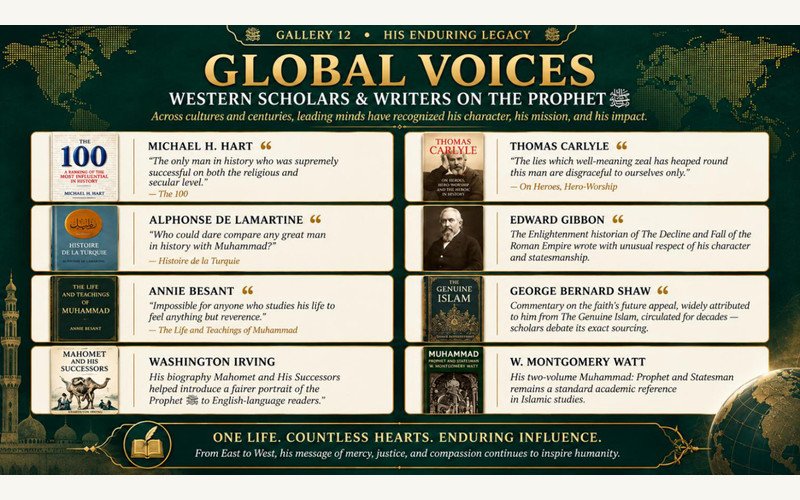
• Edward Gibbon (1737–1794): In The Decline and Fall of the Roman Empire (chapter 50), he treats Muhammad’s ﷺ character and statesmanship with respect.
• Thomas Carlyle (1795–1881): In the 1840 lecture “The Hero as Prophet”, published in On Heroes, Hero-Worship, and the Heroic in History (1841), he rejected the view that Muhammad ﷺ was a conscious impostor and called it a falsehood that reflects badly on those who spread it.
• Alphonse de Lamartine (1790–1869): In Histoire de la Turquie (1854), he asked whether anyone could humanly be compared to Muhammad ﷺ when judged by three measures: the greatness of the aim, the smallness of the means and the size of the result.
• Washington Irving (1783–1859): Mahomet and His Successors (1850) was an influential English-language biography, sympathetic in tone.
• Annie Besant (1847–1933): In The Life and Teachings of Muhammad ﷺ (1932), she expressed reverence for his character.
• W. Montgomery Watt (1909–2006): Watt’s Muhammad at Mecca (1953) and Muhammad at Medina (1956) remain standard academic references, and he concluded that Muhammad ﷺ was sincere. His one-volume condensation is Muhammad: Prophet and Statesman (1961). The gallery panel’s phrase “two-volume Muhammad: Prophet and Statesman” should be read accordingly.
Our own scholars writing in English
Our scholars have also introduced the Prophet’s ﷺ life to English readers. Muhammad Hamidullah, who taught in Hyderabad before moving to Europe, wrote Muhammad Rasulullah and Introduction to Islam. Martin Lings (Abu Bakr Siraj al-Din) wrote what many regard as the most readable biography based on the earliest sources. Safiur Rahman al-Mubarakpuri’s The Sealed Nectar won a major international prize for sira writing. Readers can compare these works with the non-Muslim authors above.
How to read these tributes
These writers came from different backgrounds, and each recognised greatness in the Prophet’s ﷺ character, courage and achievement. A tribute from a non-Muslim does not stand in for faith, but it shows that his character has been honoured beyond his own community. Readers who wish to quote them should consult the original editions listed below.
| FACTS & FIGURES Carlyle’s lecture “The Hero as Prophet”: 1840; published 1841. Irving: Mahomet and His Successors, 1850. Lamartine: Histoire de la Turquie, 1854. Besant: The Life and Teachings of Muhammad ﷺ, 1932. Watt: Muhammad at Mecca (1953), Muhammad at Medina (1956), Prophet and Statesman (1961). |
|---|
| IMPORTANT DISTINCTION: Tributes and faith Admiration from non-Muslim writers is a tribute to the Prophet’s ﷺ character; our own faith in him rests on revelation. Quotations should be taken from the original editions listed below. |
|---|
Related Topics
• Article 22: Prophet Muhammad in Indian Hearts: Scholars, Reformers and Writers
• Article 1: Prophet Muhammad: A Life at a Glance
• Article 23: Devotion in Verse: Non-Muslim Poets and the Na‘t Tradition in India
Sources & Further Reading
• Thomas Carlyle, On Heroes, Hero-Worship, and the Heroic in History (James Fraser, 1841), lecture 2.
• Edward Gibbon, The History of the Decline and Fall of the Roman Empire, vol. 5 (1788), ch. 50.
• Alphonse de Lamartine, Histoire de la Turquie (Paris, 1854).
• Washington Irving, Mahomet and His Successors (1850).
• Annie Besant, The Life and Teachings of Muhammad (Theosophical Publishing House, Madras, 1932).
• W. Montgomery Watt, Muhammad: Prophet and Statesman (Oxford University Press, 1961).
• Karen Armstrong, Muhammad: A Prophet for Our Time (HarperCollins, 2006).
• Martin Lings, Muhammad: His Life Based on the Earliest Sources (Allen & Unwin, 1983).
• Muhammad Hamidullah, Muhammad Rasulullah: A Concise Survey of the Life and Work of the Founder of Islam (Hyderabad Academy, 1974).
• Safiur Rahman al-Mubarakpuri, The Sealed Nectar (Ar-Raheeq Al-Makhtum) (Darussalam, 1996).
• Ibn Kathir, The Life of the Prophet Muhammad (al-Sira al-Nabawiyya), trans. Trevor Le Gassick (Garnet Publishing, 1998–2000).
• K. S. Ramakrishna Rao, Muhammad: The Prophet of Islam (Kitab Bhavan)
• Swami Laxmi Shankeracharya : The Life and Teachings of Prophet Muhammadﷺ