4. Why Does Man Need Divine Guidance?
1.The Limitations of Human Reason
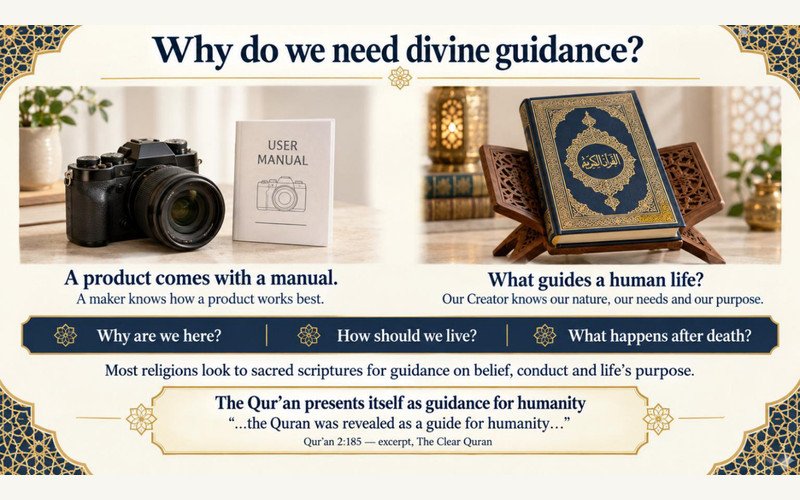
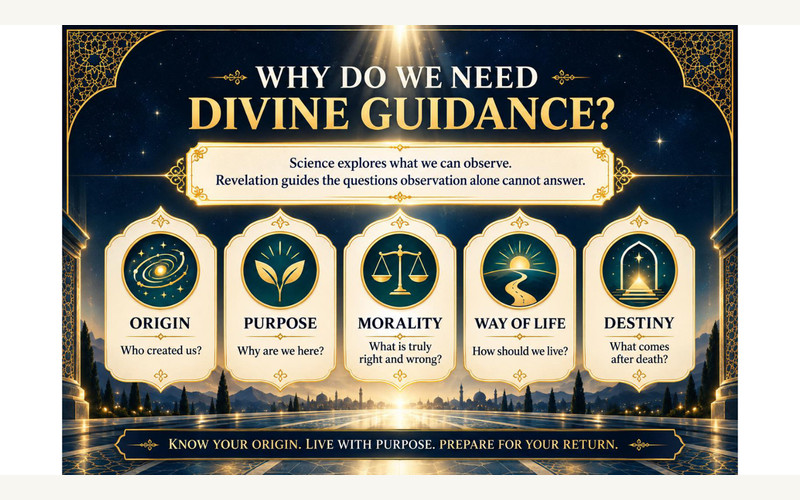
Human reason cannot independently answer questions such as:
Why does the universe exist?
Why were human beings created?
What occurs after death?
What constitutes objective justice?
Which actions please the Creator?
2. Revelation Explains the Purpose of Human Existence
Without revelation, philosophers have proposed numerous meanings of life:
Pleasure
Happiness
Virtue
Power
Evolutionary survival
Economic success
Personal fulfilment
Quran provides a fundamentally different answer.
Allah declares:
"I did not create jinn and mankind except that they worship Me." (Qur'an 51:56)
Islam understands worship (ʿibādah) comprehensively.
It includes:
Prayer
Charity
Honesty
Justice
Seeking knowledge

Family responsibilities
Caring for society
Lawful work
Every righteous act performed sincerely for Allah becomes “worship”.
Hence revelation defines both humanity's purpose and the path toward fulfilling it.
3. Divine Guidance Establishes Objective Morality
Modern societies frequently debate whether morality is objective or socially constructed.
Quran firmly rejects moral relativism, i.e. human opinions and social customs are not the ultimate authority for determining what is morally right or wrong. Moral truth is grounded in divine guidance
The Qur’an establishes morality on the foundation of obedience to Allah, whose perfect justice and infinite knowledge provide the ultimate standard for distinguishing right from wrong.
2. What does the Qur’an teach?
Among the ethical principles repeatedly emphasized are:
Justice
Mercy
Compassion
Honesty
Chastity
Generosity
Patience
Truthfulness
Respect for parents
Protection of life
Protection of property

Allah says:
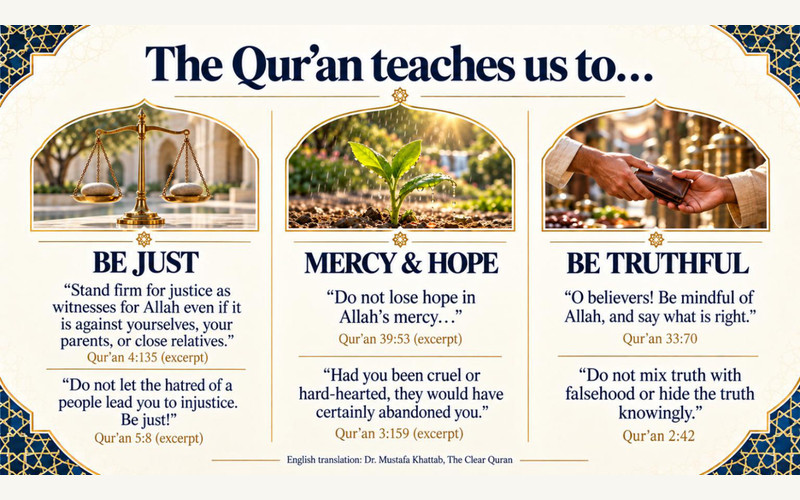
"Indeed, Allah commands justice, excellence, and generosity to relatives, and forbids immorality, wrongdoing, and oppression." (Qur'an 16:90)
O believers! Stand firm for justice as witnesses for Allah even if it is against yourselves, your parents, or close relatives. Be they rich or poor, Allah is best to ensure their interests. So do not let your desires cause you to deviate ˹from justice˺. If you distort the testimony or refuse to give it, then ˹know that˺ Allah is certainly All-Aware of what you do. (Qur’an 4:135)
4. Divine Guidance Provides Knowledge of the Unseen
One of revelation's unique contributions is knowledge inaccessible through empirical investigation.
Science investigates observable reality.
Revelation informs humanity concerning:
Angels
Revelation
Resurrection
Paradise
Hell
Divine judgment
The soul
Accountability
Allah says: "This is the Book in which there is no doubt—a guidance for those who believe in the unseen." (Qur'an 2:2–3)
Such knowledge shapes ethical conduct by reminding human beings that every action carries eternal consequences.
5. Divine Guidance Gives Meaning to Suffering
Human existence inevitably includes:
Disease
Poverty
Bereavement
Oppression
Failure
Death
Materialistic worldviews often struggle to explain suffering beyond biological or social causes.
Islam interprets suffering within a theological framework.
Allah says:
"He who created death and life to test you as to which of you is best in deeds." (Qur'an 67:2)
Likewise:
"Indeed, with hardship comes ease." (Qur'an 94:5–6)
Trials become opportunities for patience gratitude, repentance, and spiritual elevation.