8. Why Is the Qur’an Unique?
The Qur’an is unique not merely because Muslims regard it as sacred, but because of a combination of features concerning its message, preservation, language, structure, historical transmission, and influence.
1. It claims to be the direct Word of God
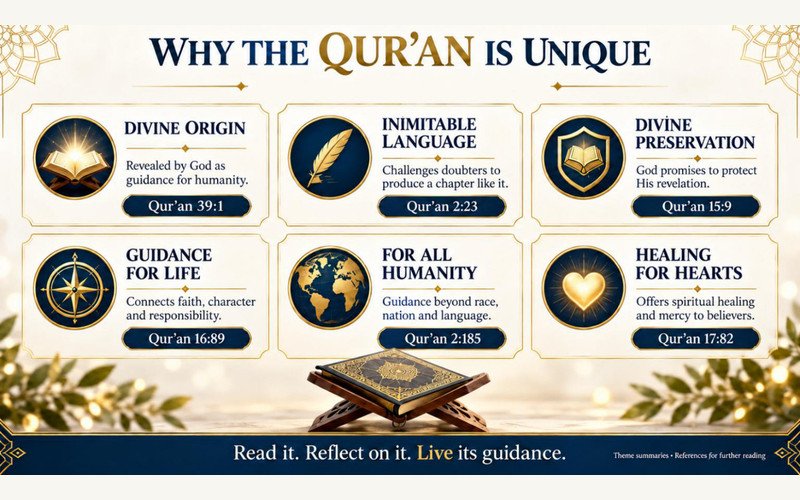
The Qur’an consistently presents itself as revelation from Allah rather than the personal composition of Muhammad ﷺ: “A revelation from the Lord of the worlds.” (Qur’an 26:192)
It also distinguishes revelation from the Prophet’s own speech: “Nor does he speak from his own desire. It is nothing but revelation revealed.” (Qur’an 53:3–4)
2. Its text has been preserved through both memorization and writing
From the earliest Muslim community, Qur’anic transmission operated through oral memorization alongside written records. The Qur’an itself states: “Indeed, We have sent down the Reminder, and surely We will preserve it.” (Qur’an 15:9)
This produced a distinctive transmission system in which the text was learned by large numbers of people while also being written down.
Qur’an - Preserved as Promised
“Indeed, it is We who sent down the Qur’an and indeed, We will be its Guardian. The Qur’an 15:9
• The preservation and incorruptibility of the Qur’an were boldly promised therein. One should wonder how a book primarily committed to memory and documented on bones, palm leaves, and leather scraps over the span of twenty-three years could survive.
• People would learn some Qur’an from the Prophet صلى الله عليه وسلمor his Companions, then travel back to their homelands and teach it to their families, friends, and students, who would then relay it to others. These separate oral transmissions continued independently for centuries, across the earth.
• Despite that, all 1.8 billion Muslims today somehow still recite the Qur’an exactly as it was taught to the Prophet’s صلى الله عليه وسلمCompanions and written in the original Uthmanic codex.
• And yet, a millennium and a half later, we do not find contradictions in meaning between all these oral traditions worldwide.
• It is also remarkable that the Qur’an in written form today perfectly matches the original manuscripts of the Qur’an compiled by the Prophet’s Companions.
3. It is still recited in its original Arabic
The Qur’an has been translated into hundreds of languages, but translations are regarded as translations of its meanings, not replacements for the Arabic Qur’anic text.
Thus a Muslim in India, Egypt, Indonesia, Nigeria, Britain, or the United States can recite the same Arabic Qur’anic text.
4. Its central message is remarkably unified
Although revealed over approximately 23 years, in different circumstances and in both Mecca and Medina, the Qur’an repeatedly develops a coherent worldview:
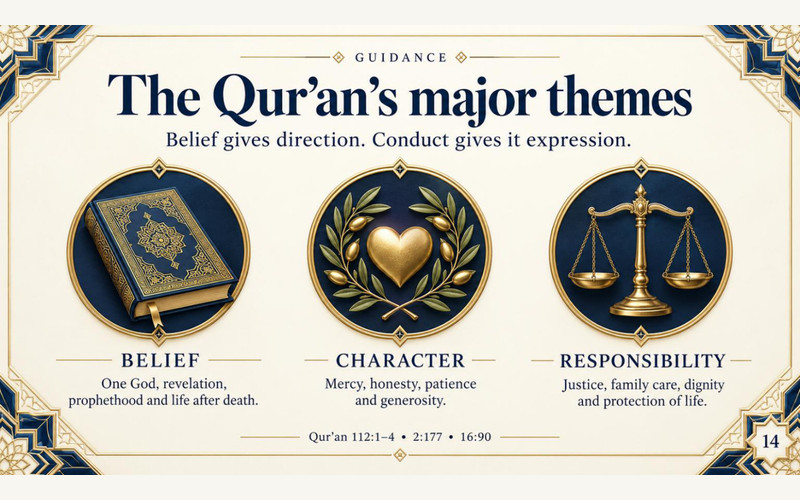
Oneness of God — worship of the One God
Prophet hood
Revelation
Human responsibility
Moral accountability
Justice
Mercy
Worship
Life after death
For example:
“Say: He is Allah, the One; Allah, the Self-Sufficient. He neither begets nor is born, and there is none comparable to Him.” (Qur’an 112:1–4)
5. It combines belief with a complete moral framework
The Qur’an does not restrict itself to theology. It addresses:
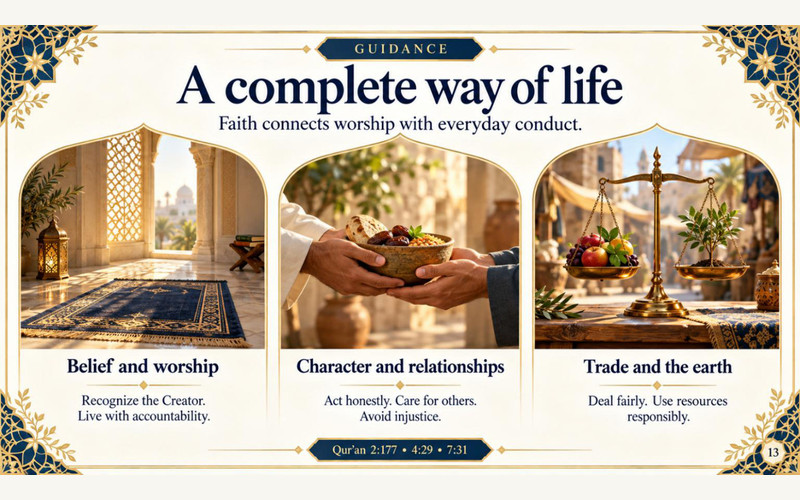
Belief → Worship → Personal morality → Family → Society → Economics → Justice → Law → Human rights → Environmental responsibility → Accountability before God.
For example: “Indeed, Allah commands justice and excellence.” (Qur’an 16:90)
6. It repeatedly calls people to think and reflect
The Qur’an does not simply ask its audience to accept claims without reflection. It repeatedly appeals to reason, observation and contemplation: “Will you not use your reason?”
and: “Will they not contemplate the Qur’an?” (Qur’an 4:82)
It also directs attention to the universe:
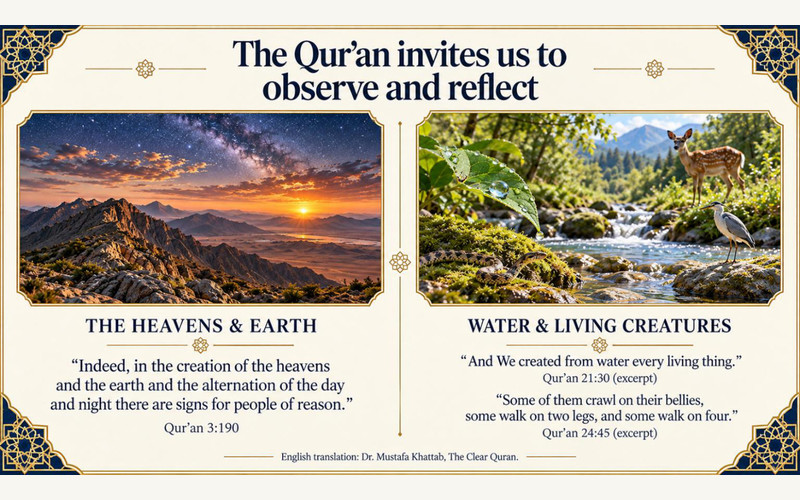
“Indeed, in the creation of the heavens and the earth … are signs for people of understanding.” (Qur’an 3:190)
7. It challenged its first audience to produce something comparable
The Qur’an issued a literary challenge:
“Then produce a surah like it.” (Qur’an 2:23)
This challenge is particularly significant because the Qur’an emerged in seventh-century Arabia, a society in which eloquence and poetry had enormous cultural importance.
Muslim scholars traditionally understand this as the iʿjāz al-Qurʾān—the inimitability of the Qur’an.
8. Its literary form is distinctive
The Qur’an is neither conventional prose nor conventional Arabic poetry. Its style incorporates:
powerful rhythm,
rhetorical devices,
parallelism,
repetition,
concise expressions,
shifts in grammatical person,
metaphor and imagery,
thematic connections across passages.
Its literary character is one of the principal reasons classical Arabic scholars regarded it as exceptional.
9. It presents itself as guidance for all humanity
The Qur’an does not describe its audience as one ethnic group:
“It is only a reminder for all the worlds.” (Qur’an 12:104)
And: “A guidance for mankind.” (Qur’an 2:185)
Consequently, its message is presented as universal rather than restricted to Arabs.
10. It transformed the society in which it was first proclaimed
Within the Qur’an's historical setting, its teachings addressed:
tribal conflict,
treatment of the poor,
slavery,
inheritance,
marriage,
treatment of women,
commercial honesty,
justice,
charity,
accountability.
The Qur’an became the foundational scripture around which Islamic religious, intellectual, legal and social traditions developed.
11. It combines spiritual depth with practical instruction
A distinctive characteristic is the movement between different dimensions of human life.
A passage may discuss:
God → creation → human psychology → moral responsibility → social conduct → the Hereafter.
For example, Qur’an 2:177 defines righteousness not merely as ritual orientation but through faith, charity, fulfilling commitments, patience and moral action.
12. It has remained a living recited scripture
The Qur’an is not only studied as a historical document. It is memorized, recited in daily prayer, taught to children, studied in schools and universities, and used as a source of religious guidance throughout the Muslim world.