
In Brief
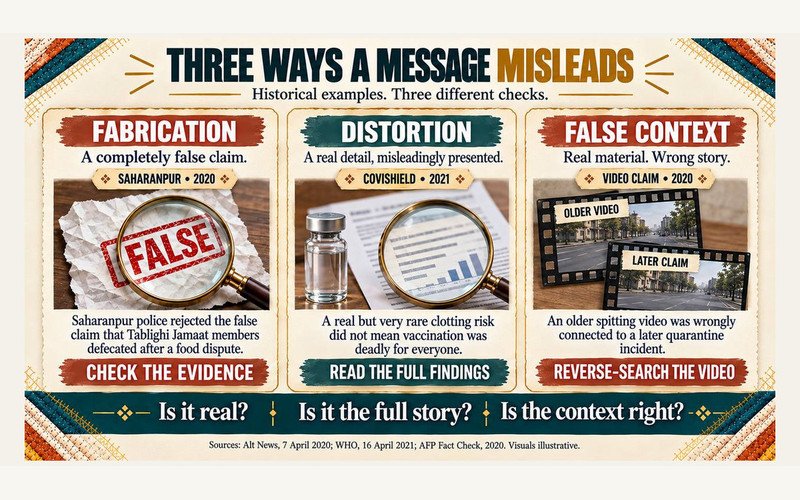
Misleading information takes different forms. A story may invent an event, distort a genuine finding or attach a false explanation to real footage. Each requires a slightly different check. Find the original claim, examine its date and context, compare reliable evidence and distinguish independent confirmation from repetition. Indian examples in the gallery show why this matters: false claims about quarantine behaviour, a genuine vaccine-safety issue stripped of qualifications and old Kerala footage recirculated with a communal caption. Verification can correct the specific falsehood without excusing unrelated wrongdoing or pretending that all uncertainty has disappeared.
Detailed Story
Fabrication invents the event or a decisive detail
In April 2020, reports alleged that Tablighi Jamaat members at a Saharanpur quarantine facility had defecated in the open after being denied non-vegetarian food. Alt News traced the claim and reproduced a 5 April police statement rejecting it after an investigation. [1] The relevant correction concerned that specific allegation. It did not establish a conclusion about every quarantine facility or every participant in a religious gathering.
A serious accusation needs more than a vivid narrative. Identify who observed the event, what was investigated and what the evidence actually showed. An official denial is evidence of the authority's finding, whose scope should be stated; it is not a licence to stop scrutinising authorities in unrelated cases.
Distortion removes the qualifications
In April 2021, WHO reviewed a very rare syndrome involving blood clots with low platelets following AstraZeneca vaccines, including Covishield. Its assessment discussed risks alongside the benefits of preventing severe COVID-19 and called for consideration of age, local disease conditions and available alternatives. [2]
A message saying the vaccine was dangerous for everyone would flatten that analysis. A message claiming there was no safety signal would also misrepresent it. This is a historical media-literacy example, not current vaccination advice. The lesson is to retain the population, period, denominator and uncertainty that give a medical finding its meaning.
False context turns real footage into a different story
In July 2023, footage from Nadapuram, Kerala, was circulated as if it showed a recent religious attack. Alt News traced it to reporting from August 2016 concerning political violence after the killing of an Indian Union Muslim League worker. Houses associated with different political parties had been attacked. Correcting the communal caption does not minimise the actual violence; it identifies the event more accurately. [3]
A separate Mumbai-area clip circulating during the pandemic showed a man spitting at police and was falsely linked to the Tablighi gathering. AFP located reporting from February 2020, before the March gathering. [4] The revised gallery retains that earlier-circulation finding without adding an unsupported date.
Five checks that work together
First, pause when a message demands immediate anger or forwarding. Second, find the author, original publication and full claim. Third, check the image or video: search an image or selected video frame and compare earlier uploads, locations and captions. Fourth, consult a fact-check that shows its evidence. Fifth, corroborate through sources that genuinely add independent information.
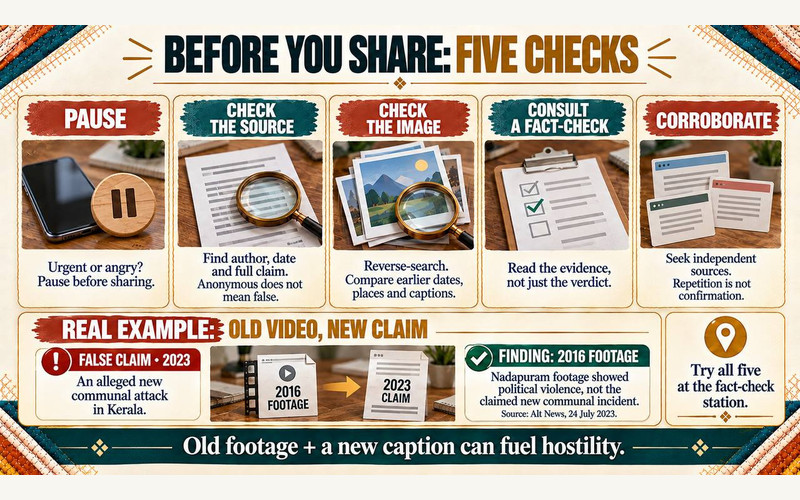
These checks are not a guarantee that everything can be resolved immediately. Search engines may miss an original upload; a reverse-image search may return no match; witnesses may disagree. “Not enough information” is a valid conclusion. It is more accurate than treating an unsuccessful search as proof that an image is authentic.
Correct the claim without repeating the attack
A useful correction states what is known, briefly identifies the false interpretation and supplies the source. Avoid circulating unnecessary abusive wording or private details. If the original reached a family group, the correction belongs there too. Research on lateral-reading instruction supports teaching people to investigate a source beyond its own page, while recognising that training does not make anyone infallible. [5]
The standard should remain consistent when a correction challenges a story favourable to our own group. Verification protects the credibility of legitimate criticism by separating it from invented or mislabelled evidence.
Facts & Figures
Saharanpur correction: police statement dated 5 April 2020, documented by Alt News on 7 April. [1]
Vaccine-safety assessment discussed here: WHO, 16 April 2021. [2]
Kerala example: 2016 footage recirculated in 2023. [3]
Sources & Further Reading
1. Jignesh Patel, Alt News. “Media misreport: Tablighi Jamaat members defecate in open after being refused non-veg food,” 7 April 2020; includes police statement. https://www.altnews.in/media-misreport-tablighi-jamat-defecating-in-open-after-being-refused-non-veg-food/
2. WHO GACVS. Review of rare adverse blood coagulation events with AstraZeneca COVID-19 vaccines, 16 April 2021. https://www.who.int/news/item/16-04-2021-global-advisory-committee-on-vaccine-safety-%28gacvs%29-review-of-latest-evidence-of-rare-adverse-blood-coagulation-events-with-AstraZeneca-covid-19-vaccine-%28vaxzevria-and-covishield%29
3. Oishani Bhattacharya, Alt News. “7-yr-old video of political clash in Kerala falsely shared as Muslims throwing stones at Hindu houses,” 24 July 2023. https://www.altnews.in/7-yr-old-video-of-political-clash-in-kerala-falsely-shared-as-muslims-throwing-stones-at-hindu-houses/
4. AFP Fact Check. “This video has circulated in reports since at least February 2020, weeks before the incident at a coronavirus quarantine facility in India,” 2020. https://factcheck.afp.com/video-has-circulated-reports-least-february-2020-weeks-incident-coronavirus-quarantine-facility
5. Jessica E. Brodsky et al. “Improving college students’ fact-checking strategies through lateral reading instruction in a general education civics course.” Cognitive Research, 2021. https://doi.org/10.1186/s41235-021-00291-4
Related Topics
Why rumours travel and how a forward can cause harm