
In Brief
A rumour can damage a livelihood or reputation before anyone verifies it. Repetition makes a message familiar, while sharing by a trusted person may make it appear credible. Neither establishes truth. Research on Twitter between 2006 and 2017 found that verified false stories travelled differently from true ones, but those results are not universal measurements of every platform or present-day messaging group. The gallery's branching network is a hypothetical illustration. Real networks contain overlap, non-sharing users and platform restrictions. Each recipient can nevertheless interrupt their own contribution by checking the claim before forwarding it.
Detailed Story
The human cost starts before a verdict
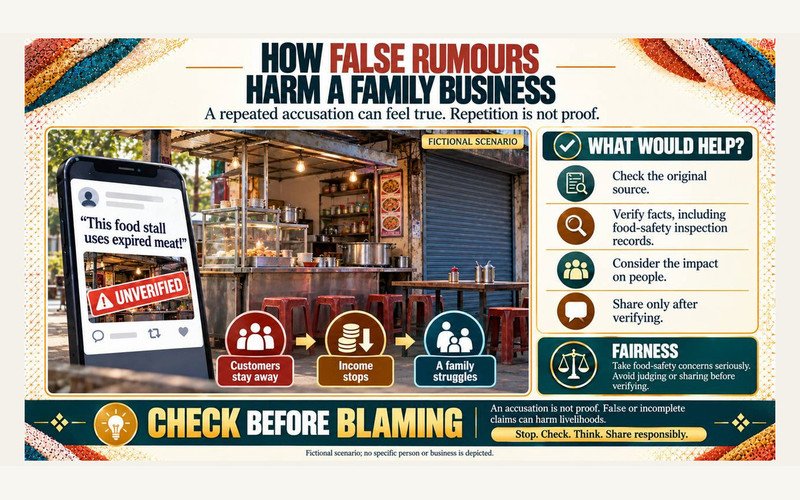
The gallery imagines a food stall accused of using expired meat. It is a fictional scenario, not a documented allegation against the person pictured. It illustrates a real evidential problem: customers may avoid a business while a claim remains unverified. Employees and family members can be affected even if they had no involvement in the alleged conduct.
Food-safety concerns should still be reported and investigated. Verification means establishing the product, date, place and relevant inspection or complaint records. It does not mean protecting a business from legitimate scrutiny. A photograph of a shop and a confident caption are insufficient to establish what happened inside it.
What the Twitter study found
Soroush Vosoughi, Deb Roy and Sinan Aral studied approximately 126,000 rumour cascades shared by about three million Twitter users between 2006 and 2017. Their 2018 paper found that falsehood spread farther, faster, more deeply and more broadly than truth in the examined data. False stories were 70% more likely to be retweeted; true stories took about six times as long to reach 1,500 people. These comparisons concern the study's data and methods, not a fixed property of every false message. [1]
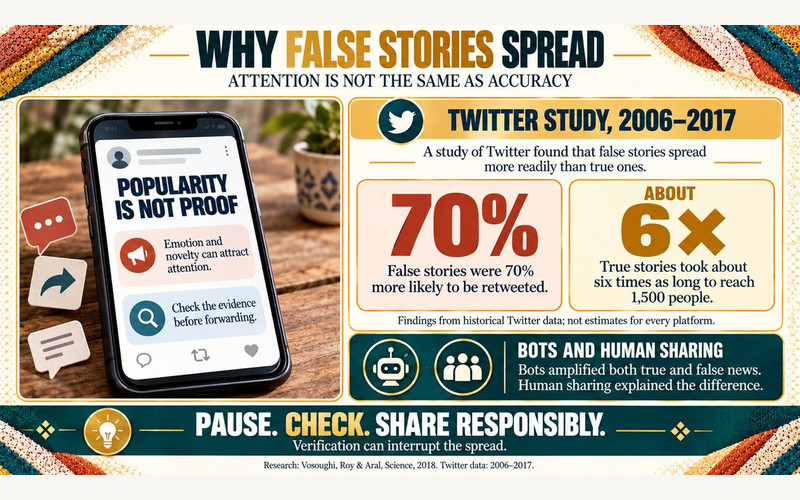
The researchers found that bots accelerated both true and false news, while the difference in diffusion was associated with human sharing. This does not prove that automated accounts are harmless. It cautions against assuming that misinformation is entirely a machine problem that ordinary users have no role in addressing.
Familiarity can resemble evidence
When a claim is repeated, the reader may recognise it more easily. Experimental research on the illusory-truth effect has found that repetition can increase perceived truth, even for implausible statements under some conditions. [2] Familiarity and evidence must therefore be distinguished. Seeing the same wording in several groups may indicate repeated copying rather than multiple witnesses.
One way to expose that difference is to trace each version backwards. Do the reports cite different first-hand sources, or do they all point to one original post? Does a fact-check reproduce the original material and explain the discrepancy? A large number of messages may still amount to one unsupported claim.
A branching diagram is not a forecast
In the gallery's hypothetical network, each person forwards to three new people, creating successive rounds of 1, 3, 9 and 27. The example assumes no overlap and universal forwarding. It explains how branching can expand reach; it does not predict the number of people who will see a particular WhatsApp message.
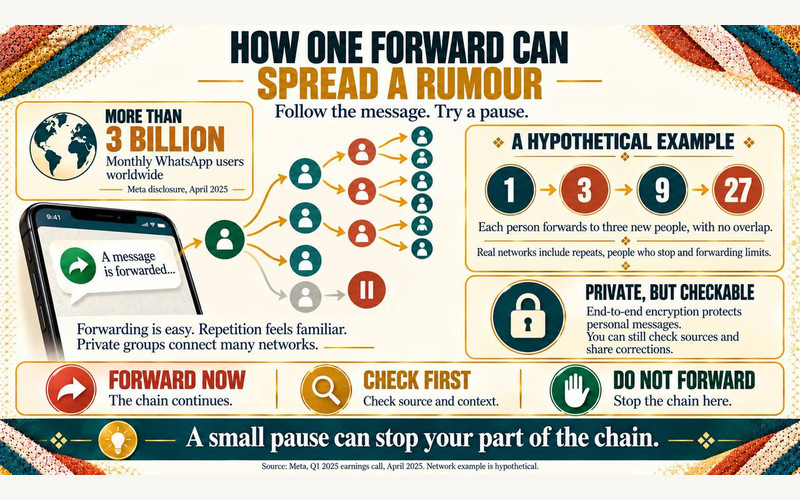
Real groups overlap. Some recipients ignore messages, others correct them, and platform rules can limit forwarding. End-to-end encryption protects message contents in transit; it does not certify accuracy. A message from a relative still needs an identifiable source when it makes a serious accusation. WhatsApp's own announcement of tighter limits on frequently forwarded messages in April 2020 acknowledged the problem of overwhelming and misleading viral content. [3]
Interrupt your part of the chain
Before forwarding, identify the precise claim and look for its origin. If it alleges misconduct, distinguish a complaint from an established finding. If the subject cannot be verified, withholding the forward avoids adding your credibility to uncertainty. If you already shared it, send a clear correction to the same audience and include the evidence. A correction may not reach everyone, but it can prevent additional repetition and demonstrate a fair standard for future messages.
Facts & Figures
The Twitter study analysed material circulated from 2006 to 2017 and was published in 2018. [1]
Its 70% retweet comparison and roughly sixfold timing difference are study-specific findings. [1]
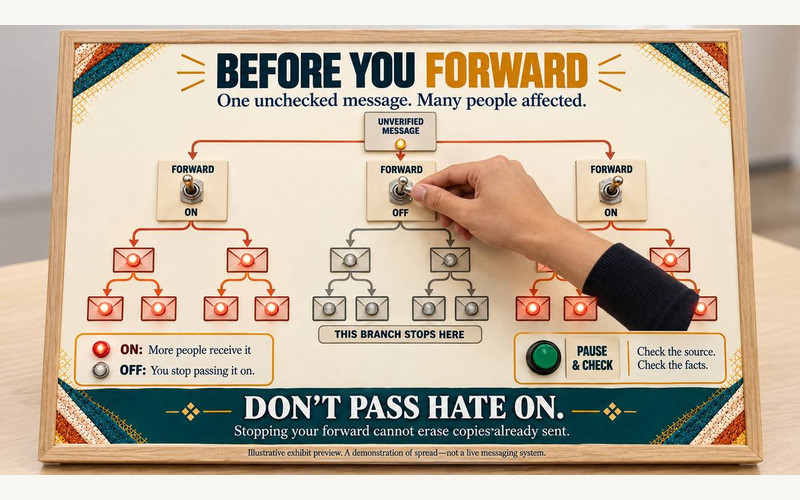
The 1 → 3 → 9 → 27 sequence is mathematical illustration, not measured audience reach.
Sources & Further Reading
1. Soroush Vosoughi, Deb Roy and Sinan Aral. “The spread of true and false news online.” Science, 2018. https://pubmed.ncbi.nlm.nih.gov/29590045/ ; research explanation: https://ide.mit.edu/insights/the-truth-about-false-news/
2. Lisa K. Fazio, David G. Rand and Gordon Pennycook. “Repetition increases perceived truth equally for plausible and implausible statements.” Psychonomic Bulletin & Review, 2019. https://doi.org/10.3758/s13423-019-01651-4
3. WhatsApp. “Keeping WhatsApp personal and private,” 7 April 2020. https://blog.whatsapp.com/keeping-whatsapp-personal-and-private
Related Topics
How headlines frame what we notice
Checking fabricated claims distorted facts and false context