
In Brief
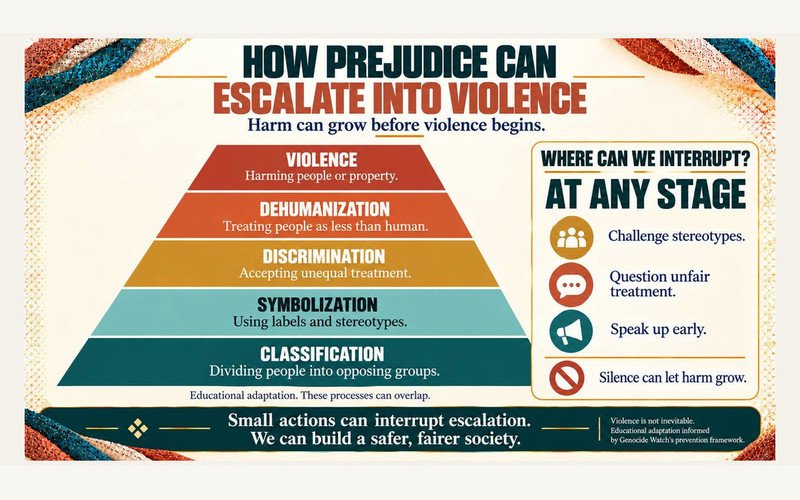
Escalation models help people notice exclusion before it develops into more serious harm. They are teaching tools, not laws of human behaviour. The gallery's pyramid combines classification, symbolisation, discrimination, dehumanisation and violence. Gregory Stanton's fuller framework describes ten overlapping processes associated with genocide and opportunities for prevention. Neither should be read as a timetable or as proof that a society has reached a legally established stage of genocide. Prevention involves protecting rights, challenging dehumanisation, supporting threatened people and holding institutions accountable. It remains possible at multiple points, rather than only before the first warning sign.
Detailed Story
What the pyramid makes visible
Violence is highly visible; the rules and habits that make some people less protected can develop less visibly. A group may first be portrayed as fundamentally separate, then treated as less deserving of housing, work or legal protection. Language and discriminatory practice can reinforce one another. The pyramid directs attention to those earlier forms of harm.
Its limits are just as important. Classification itself is not necessarily harmful: a census, language class or voluntary religious association uses categories. Symbolic identity may express belonging rather than exclusion. The danger lies in how categories are connected to unequal rights, collective suspicion or organised attack. Nor does every discriminatory act progress to physical violence. The harm should be challenged on its own merits, without an exaggerated prediction.
Stanton describes overlapping processes
Gregory Stanton's ten-stage framework includes classification, symbolisation, discrimination, dehumanisation, organisation, polarisation, preparation, persecution, extermination and denial. Genocide Watch describes these as processes that can operate simultaneously and can be interrupted. [1] The gallery presents a shortened selection; it is not the complete model.
Organisation matters because mass violence requires capacity: people, resources, instructions and institutions capable of enabling or refusing participation. Polarisation can target those who resist the division between camps. Denial may hide evidence or excuse perpetrators, including while violence is taking place. Calling these “stages” should not imply that one ends neatly before another begins.
A warning framework is different from a legal finding
The Genocide Convention defines genocide through specified acts committed with intent to destroy, in whole or in part, a national, ethnical, racial or religious group as such. The definition includes more than killing, but it requires a particular intent. [2] A graphic showing discrimination is not, by itself, sufficient to establish every legal element.
Other grave abuses may constitute crimes against humanity, war crimes or domestic offences without satisfying the genocide definition. Accurate naming is essential for accountability. It is also unnecessary to wait for the most severe legal classification before opposing discrimination, protecting people or investigating threats.
Prevention needs institutions as well as courage
The UN Framework of Analysis for Atrocity Crimes examines multiple risk factors, including instability, prior serious violations, weak protective institutions, motives and capacity. [3] This discourages diagnosis from a single slogan. It also points towards practical responsibilities: reliable reporting, protection for threatened communities, independent investigation and safeguards against the abuse of state power.
For a school, workplace or neighbourhood association, the scale is different but the principle of early intervention remains useful. A rule excluding a group should be reviewed before it becomes routine. A threat should reach someone able to respond. The person targeted should not be required to confront an aggressor alone. Institutions can record decisions and provide routes for complaints so that support does not depend entirely on personal bravery.
Respond proportionately
An insulting comment, a discriminatory policy and an imminent violent threat require different responses. Discussion or correction may fit one situation; formal investigation or urgent protection may fit another. Overstating every dispute can undermine credibility, while understating repeated exclusion can normalise harm. The purpose of a warning model is to improve judgement: recognise patterns, seek corroboration and choose an intervention suited to the evidence.
Facts & Figures
The Genocide Convention was adopted on 9 December 1948. [2]
Stanton's expanded framework names ten processes; the exhibition pyramid is a simplified adaptation. [1]
The UN's 2014 framework contains 14 risk factors for atrocity crimes, including common and crime-specific factors. [3]
Important Distinction
The exhibition pyramid is not Allport's original five-point scale. Allport's familiar sequence concerns hostile speech, avoidance, discrimination, physical attack and extermination. Classification and symbolisation belong to a different conceptual vocabulary. The displayed pyramid is best understood as an illustrative synthesis of several frameworks.
Sources & Further Reading
1. Gregory H. Stanton, Genocide Watch. “The Ten Stages of Genocide,” current institutional presentation. https://www.genocidewatch.com/tenstages
2. United Nations. Convention on the Prevention and Punishment of the Crime of Genocide, 1948, Article II. https://www.ohchr.org/en/instruments-mechanisms/instruments/convention-prevention-and-punishment-crime-genocide
3. United Nations. Framework of Analysis for Atrocity Crimes, 2014. https://www.un.org/en/genocideprevention/documents/about-us/Doc.3_Framework%20of%20Analysis%20for%20Atrocity%20Crimes_EN.pdf
4. Gordon W. Allport. The Nature of Prejudice. Addison-Wesley, 1954, chapter 1. Scholarly reference for the original scale; no quotation reproduced.
Related Topics
How fear becomes collective blame