
In Brief
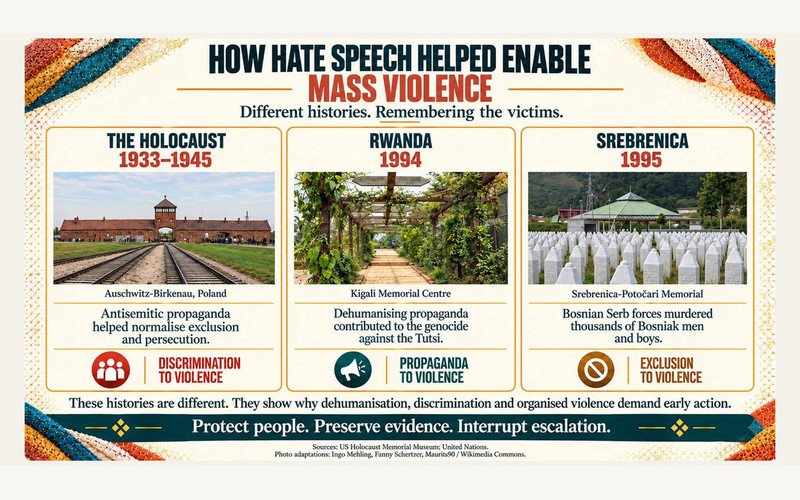
The Holocaust, the 1994 genocide against the Tutsi in Rwanda, the Srebrenica genocide and India's 1984 anti-Sikh violence have distinct histories. Comparing them responsibly means examining mechanisms such as dehumanisation, organised targeting, failures of protection and the destruction of evidence. It does not mean treating their scale, legal classifications or political settings as identical. Nor can responsibility be inherited by everyone who shares a perpetrator's religion or nationality. Historical learning honours victims through accurate records and asks how public institutions and ordinary people can resist exclusion and protect those at risk.
Detailed Story
The Holocaust and the machinery of exclusion
The United States Holocaust Memorial Museum defines the Holocaust as the systematic, state-sponsored persecution and murder of six million European Jews by Nazi Germany and its allies and collaborators. It places the period between 1933 and 1945. Antisemitic ideology, discriminatory laws, dispossession, deportation and organised killing developed within a changing wartime context. Other groups also suffered persecution and murder under Nazism. [1]
The lesson is not that propaganda alone caused the Holocaust. Bureaucratic decisions, policing, military conquest and material cooperation helped turn ideology into action. Studying the institutions that implemented persecution also reveals that the atrocity was made through decisions, rather than an unavoidable consequence of religious or ethnic difference.
Rwanda and the mobilisation of neighbours
During the 1994 genocide against the Tutsi in Rwanda, Tutsi people were systematically targeted; Hutu who opposed the killing and others were also murdered. UN accounts commonly describe more than 800,000 deaths within roughly three months, while some estimates are higher. The scale should be presented as an estimate, not an exact census. [2]
Incitement and dehumanising propaganda operated alongside organised mobilisation and coercion. Reducing the history to “ancient tribal hatred” obscures political choices and the institutions that enabled killing. It also erases those who resisted or protected others. The existence of rescuers does not diminish the atrocity; it helps identify alternative actions that were possible, sometimes at enormous personal risk.
Bosnia and the specificity of Srebrenica
The Bosnian war lasted from 1992 to 1995. In July 1995, Bosnian Serb forces killed thousands of Bosnian Muslim men and boys following the fall of Srebrenica. International criminal tribunals established that the Srebrenica killings constituted genocide. Their records also document forcible transfer and other crimes. [3]
It is important to distinguish the broader war from the specific judicial findings. The legal responsibilities of particular leaders and participants do not make every Serb collectively guilty. The same principle protects every community: responsibility follows evidence about conduct, participation and command, not identity alone.
India's anti-Sikh violence in 1984
Following the assassination of Prime Minister Indira Gandhi on 31 October 1984, Sikhs were targeted in Delhi and elsewhere. The Justice Nanavati Commission examined attacks, institutional responses and allegations concerning organisers. Its report records evidence of organised targeting and serious failures of protection. [4]
Describing the events only as a spontaneous exchange between communities can obscure the directed nature of attacks on Sikh people, homes and businesses. Equally, specific allegations and judicial outcomes must be distinguished. An inquiry report, a criminal conviction and a survivor's testimony are different forms of evidence, each with its own purpose and limits.
Compare mechanisms without flattening history
Across these cases, ask who defined the target, who spread accusations, who organised harm and which institutions protected or abandoned people. These questions make comparison useful. A competition over which community has suffered most makes it less useful and can reproduce the exclusions the gallery seeks to challenge.
Memorials preserve names and experiences that perpetrators often tried to erase. Courts and archives help establish a record that can be tested. Visitors can bring this discipline to contemporary claims: verify the source, avoid collective guilt and recognise that a person's safety should not depend on belonging to the majority. Historical analogy should prompt careful inquiry, not replace it.
Facts & Figures
Holocaust: 1933–1945; six million European Jews murdered. [1]
Rwanda: genocide against the Tutsi in 1994; UN accounts describe more than 800,000 killed in less than three months. [2]
Srebrenica: July 1995; genocide established in international tribunal judgements. [3]
India: anti-Sikh attacks followed the assassination on 31 October 1984; the Nanavati Commission reported in 2005. [4]
Sources & Further Reading
1. United States Holocaust Memorial Museum. “Introduction to the Holocaust,” Holocaust Encyclopedia, undated. https://encyclopedia.ushmm.org/content/en/article/introduction-to-the-holocaust
2. United Nations Secretary-General. Message for the 25th commemoration of the genocide against the Tutsi in Rwanda, 2019. https://rwanda.un.org/en/3373-kwibuka-25-international-day-reflection-1994-genocide-against-tutsi-rwanda-secretary-generals
3. UN International Residual Mechanism for Criminal Tribunals. “Srebrenica 30,” 2025; tribunal record and commemorative resource. https://www.irmct.org/srebrenica/en/
4. Justice Nanavati Commission of Inquiry. Report on the 1984 Anti-Sikh Riots, volume I, 2005. Government of India. https://www.mha.gov.in/sites/default/files/Nanavati-I_eng_0.pdf
Related Topics
Recognising escalation without treating violence as inevitable