
In Brief
A prison population is not a count of people proven guilty, and an individual's crime does not establish the character of a religious community. India's prison data distinguish convicted prisoners from undertrials and other categories. Reading these distinctions prevents a striking number from becoming a misleading accusation. A fair assessment also asks about population size, age, policing, access to lawyers and time spent awaiting trial. Responsibility belongs to the people whose conduct is established through evidence; it cannot be transferred to everyone who shares their name, nationality or religion.
Detailed Story
What a prison count actually measures
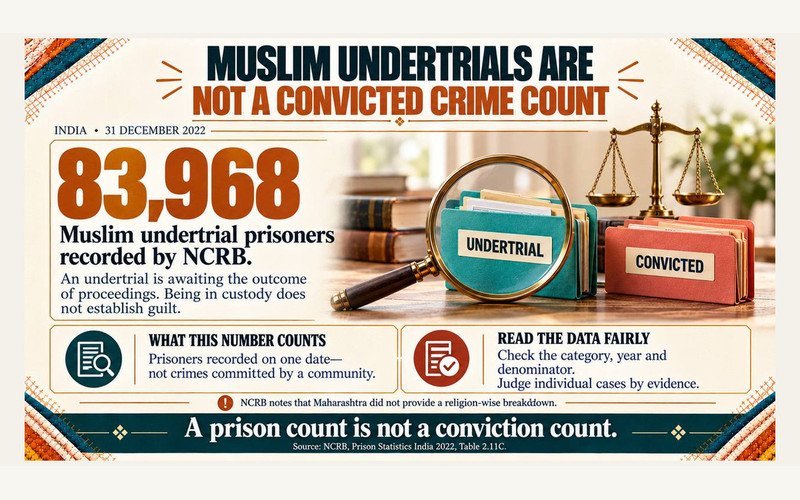
The exhibition uses a historical snapshot: on 31 December 2022, Indian prisons held 573,220 people, including 434,302 undertrials, approximately 75.8% of the total. [1] An undertrial is detained while proceedings remain unresolved; that status is different from a conviction. These figures describe custody on a particular date, not all offences committed during the year and not the proportion of any community that committed crime.
The gallery also gives the reported figure of 83,968 Muslim undertrials at 31 December 2022. The NCRB-derived secondary dataset and contemporary reporting agree on this count. The primary religion table remains an archive-check item in the resources playbook. Maharashtra did not provide the religion breakdown, so the table must not be presented as a complete religion profile of every undertrial in India. [2]
Ask what is being divided by what
A count becomes a rate only when it is related to an appropriate denominator. Suppose, as a purely illustrative example, two districts each record 100 arrests. If their populations differ greatly, the identical totals do not mean identical arrest rates. Even comparable arrest rates are not conviction rates, and neither measure automatically reveals the underlying incidence of offending.
Comparisons between communities require similar care. A group's share of prisoners cannot be interpreted without considering its population size and composition, the type of cases, place and period, and how cases enter the justice system. Poverty, legal representation and duration of detention are relevant questions. No single table can determine their relative contributions. Describing over-representation is a starting point for investigation, not proof of an innate group tendency.
Separate the stages of a case
An allegation is a claim. Registration of a case records a procedural step. Arrest places a person in custody under legal authority. A charge identifies what must be answered in court. A conviction is a judicial determination, subject to the applicable appeal process. Collapsing these stages into the word “criminal” removes distinctions on which fair treatment depends.
The same discipline applies when a person is acquitted or discharged: report the actual decision and its scope. Do not imply that the outcome proves every statement made by every participant. Precise reporting makes accountability stronger because it ties conclusions to findings rather than affiliation.
Why the gallery places different offenders together
The panel names Ramesh “Sunny” Balwani, Bachan Kaur Athwal and Abdul Karim Telgi to expose the logic of collective blame. Balwani was convicted in the United States in 2022 of conspiracy and wire fraud; Athwal was convicted in Britain in 2007 of murder; Telgi was convicted of conspiracy and cheating in a counterfeit stamp-paper case in May 2009. [3–5] These are specific individual convictions, not examples of religiously motivated wrongdoing.
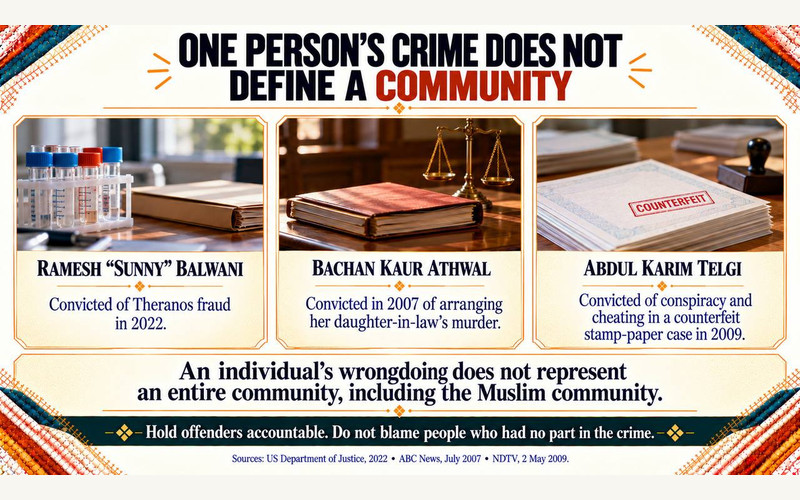
These cases are not equivalent in harm or circumstance. Their educational purpose is narrower: nothing about an individual's proven conduct authorises suspicion of millions of unrelated people. Nor is a list of offenders a representative sample from which to compare religions. Religious identity is not a substitute for evidence about motive, organisation or responsibility.
Read justice data as questions about institutions
Useful questions include whether accused people can obtain legal assistance, whether detention lasts longer than necessary and whether cases are resolved fairly. India's National Legal Services Authority publishes information on undertrial review work. [6] Such institutional questions remain important whatever a prisoner's religion. Taking them seriously supports both public safety and the principle that the state must establish an individual's responsibility.
Facts & Figures
31 December 2022: 573,220 prisoners; 434,302 undertrials, about 75.8%. [1]
Reported Muslim undertrials at 31 December 2022: 83,968. This is a custody stock, not a conviction count or a community crime rate. [2]
The religion breakdown excludes data not supplied by Maharashtra; retain that qualification when reusing the count. [2]
Important Distinction
Arrest, undertrial detention and conviction describe different legal positions. A statistic about any one of them must retain that label. An individual conviction establishes no collective religious guilt.
Sources & Further Reading
1. Government of India. Prisons in India, 2024, reporting NCRB's Prison Statistics India 2022. https://cdnbbsr.s3waas.gov.in/s3ec0490f1f4972d133619a60c30f3559e/uploads/2024/11/2024110677.pdf
2. Dataful. NCRB year-wise undertrial prisoners by religion, 2022 entries. https://dataful.in/datasets/467/ ; corroborating reporting, The Economic Times, 1 March 2024: https://economictimes.indiatimes.com/news/india/states-uts-told-not-to-segregate-prisoners-on-caste-class-or-religion/articleshow/108117296.cms
3. NDTV. Telgi convicted in fake stamp paper scam, 21 May 2009. https://www.ndtv.com/india-news/telgi-convicted-in-fake-stamp-paper-scam-393312
4. US Department of Justice. Theranos Chief Operating Officer Ramesh “Sunny” Balwani Found Guilty of Conspiracy, Wire Fraud, 7 July 2022. https://www.justice.gov/usao-ndca/pr/theranos-chief-operating-officer-ramesh-sunny-balwani-found-guilty-conspiracy-wire
5. The Guardian. Report of Bachan Kaur Athwal's murder conviction, 26 July 2007. https://www.theguardian.com/uk/2007/jul/26/ukcrime1
6. National Legal Services Authority. Under Trial Prisoner Report, ongoing publication series. https://nalsa.gov.in/under-trial-prisoner-report/
Related Topics
Checking fabricated claims distorted facts and false context