
In Brief
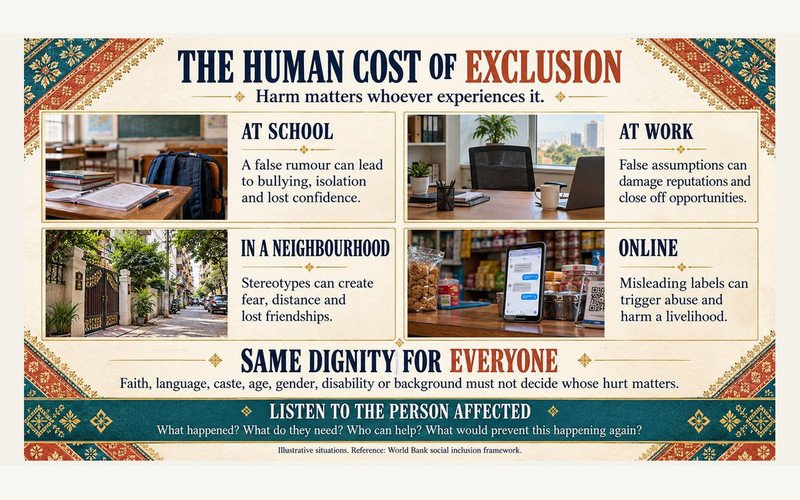
Exclusion can occur without spectacular violence. A child repeatedly mocked, a qualified applicant dismissed because of identity or a family shut out of housing loses more than one opportunity. Such experiences can narrow participation in education, work and neighbourhood life. They also deprive institutions of abilities and relationships they need. The costs are real, but they cannot responsibly be reduced to an invented national price tag. Understanding exclusion means tracing how particular barriers operate, who bears them and what changes would make participation genuinely fairer.
Detailed Story
Exclusion is a process
Social exclusion concerns barriers to participation, not simply whether people have low incomes. The World Bank's Inclusion Matters examines the ability, opportunity and dignity with which people participate in markets, services and public spaces. [1] This framework helps explain why offering a service is not always enough: people may be technically eligible but unable to use it without humiliation, danger or prohibitive difficulty.
Consider an illustrative school situation. A pupil is repeatedly treated as the spokesperson for every controversy involving their religion. The problem is not merely an unpleasant question. The pupil's ordinary role as a learner has been displaced by a demand to defend an identity. A teacher who redirects discussion towards evidence and prevents personal targeting changes the conditions of participation.
What educational evidence can tell us
UNESCO's 2019 global synthesis reported that almost one in three students, 32%, had been bullied by peers at school at least once in the preceding month. [2] The estimate combines evidence from multiple countries and survey systems; it is not an India-specific rate of religious bullying.
The report links bullying with poorer educational and wellbeing outcomes. Its relevance here is the importance of a safe learning environment, not a claim that every instance of teasing produces the same consequence. Schools need procedures that distinguish respectful disagreement from sustained targeting, hear affected pupils and address behaviour consistently.
Unequal access to work and housing
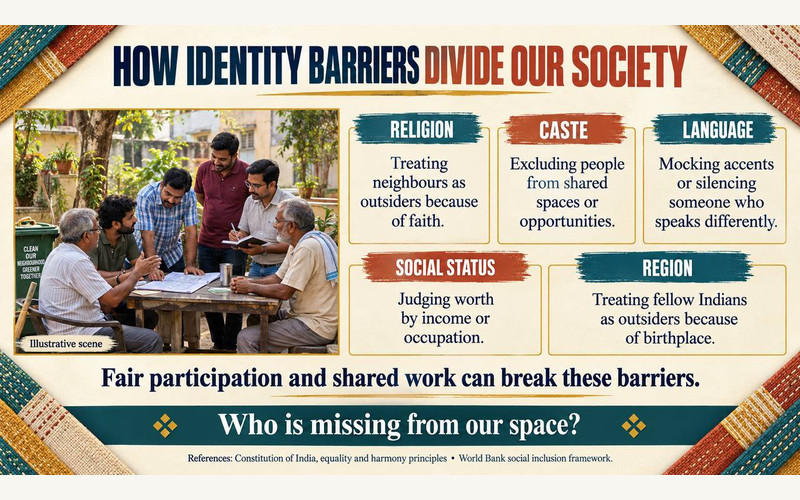
The Sachar Committee's 2006 report documented the social, economic and educational situation of Muslims in India using the data and consultations available then. [3] It remains a significant historical source, but its measurements should not be presented as if collected today. Its value includes the questions it raised about access to education, employment, credit and public services.
For an individual applicant, exclusion may be difficult to prove because decision-making is opaque. Transparent eligibility rules, documented reasons and accessible review procedures make unfair treatment easier to identify. They also protect institutions from relying on informal stereotypes instead of relevant qualifications.
How a community loses opportunities
Imagine a local fair where traders refuse to cooperate across religious lines. This is an illustration, not a measured event. Fewer participating sellers may mean less choice, weaker coordination and fewer chances for repeat business. The immediate loss belongs to the excluded trader, but customers and organisers can lose as well.
The mechanism should not be confused with a quantified finding. To estimate an actual economic cost, researchers would need data, an explicit comparison and a method for separating exclusion from other causes. A persuasive moral argument does not excuse an unsupported statistic.
When rumours interrupt work and study
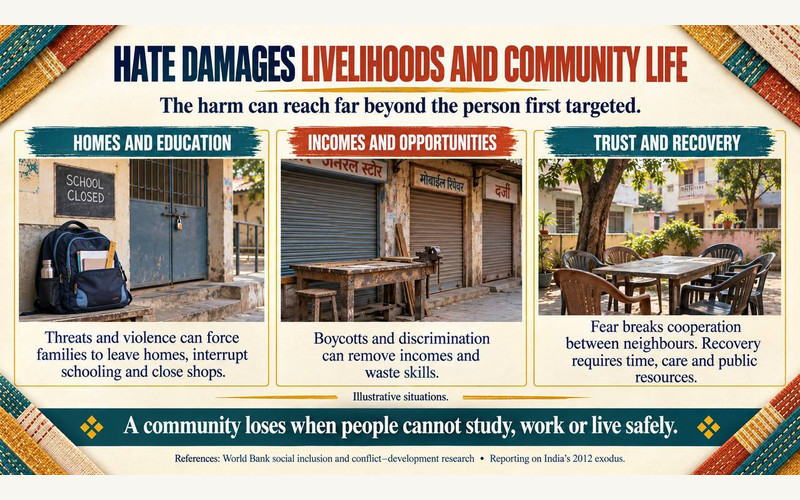
In August 2012, rumours of attacks led people from the North East to leave Bengaluru and other cities. Contemporary reporting described departures by train and the disruption created by fear. [4] The gallery does not use a train-ticket count as a total for everyone displaced. A departure can interrupt employment, education and ordinary neighbourhood relationships even when the person is far from the original conflict. The wider economic lesson is a mechanism, not a measured national rupee loss: insecurity can prevent people from studying, working and cooperating.
Dignity is not conditional on productivity
Economic arguments can show that discrimination wastes opportunities. They cannot be the whole case against it. A person deserves fair treatment even if including them does not raise an institution's measured output. Children, older people, disabled people and unpaid caregivers should not have to prove market value before their dignity counts.
A practical response combines rules and relationships: fair access, reliable complaints processes, respectful communication and opportunities to participate in decisions. The question is not whether every uncomfortable interaction can be eliminated. It is whether identity becomes a recurring barrier that people must overcome before they can do ordinary things others take for granted.
Facts & Figures
UNESCO's 2019 global synthesis reported 32% of students bullied at least once in the preceding month; this is not a religion-specific Indian estimate. [2]
The Sachar Committee report was submitted in 2006; its findings must retain their historical date. [3]

Inclusion Matters was published by the World Bank in 2013. [1]
Important Distinction
A disparity is a pattern requiring explanation; it does not by itself identify every cause. Equally, the difficulty of measuring discrimination does not establish its absence.
Sources & Further Reading
1. World Bank. Inclusion Matters: The Foundation for Shared Prosperity, 2013. https://documents.worldbank.org/curated/en/384801468326712492/pdf/817480WP0Inclu0Box0379844B00PUBLIC0.pdf
2. UNESCO. Behind the Numbers: Ending School Violence and Bullying, 2019. https://www.unesco.org/en/articles/behind-numbers-ending-school-violence-and-bullying
3. Prime Minister's High Level Committee, Government of India. Social, Economic and Educational Status of the Muslim Community of India, 2006, chaired by Rajindar Sachar. https://www.education.gov.in/sites/upload_files/mhrd/files/sachar_comm.pdf
4. The Indian Express. Exodus of NE people continues; government issues 15-day ban on bulk SMSes, August 2012. https://indianexpress.com/article/news-archive/latest-news/exodus-of-ne-people-continues-govt-issues-15day-ban-on-bulk-smses/
Related Topics
Crime statistics and the mistake of collective guilt